Revenge4 min read
The Appraisal on the Fake Diamond
When my mother-in-law demanded I give my heirloom diamond ring to her younger son's wealthy fiancée—calling me a mere placeholder—I agreed on one condition: we walk across the square for an official appraisal.
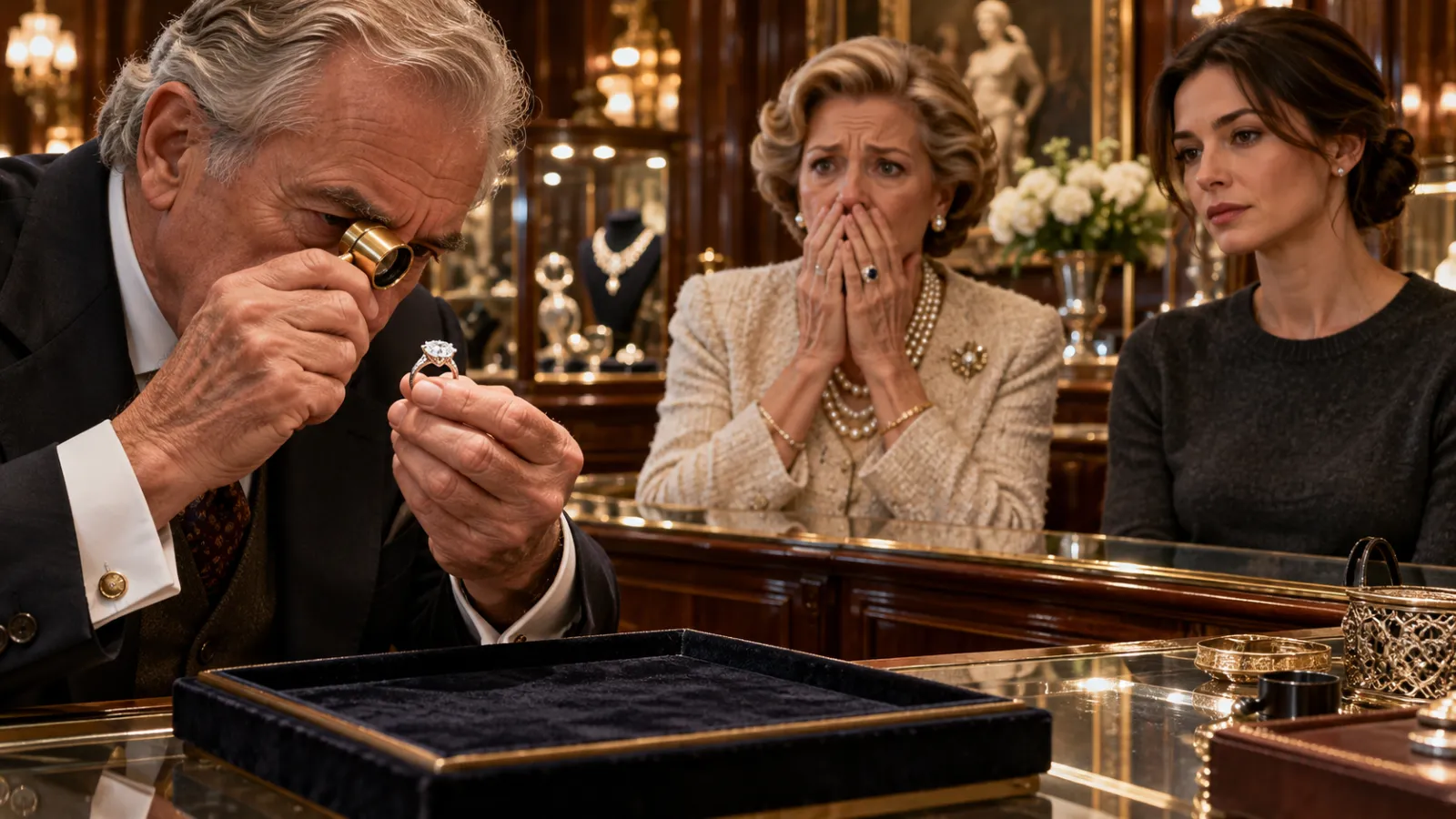
Chapter 4: Under the Master's Loupe
Evelyn stepped briskly to the center of the appraisal counter, attempting to reclaim the imperious authority she had commanded across the brunch table. She smoothed her lavender wool jacket and raised her chin.
"Good afternoon, Monsieur Bernard," Evelyn said in her most refined, patrician tone. "We are here for a brief administrative transaction. The Harrington family is transferring our nineteen twenty-eight heirloom solitaire from Kenneth's wife to Richard's fiancée, Patricia Sterling. We simply need your signature on a standard custody transfer document so Patricia can take possession this afternoon."
Monsieur Bernard rested his hands lightly against the polished mahogany counter. His blue eyes, magnified slightly behind his wire-rimmed spectacles, were steady and discerning.
"Beaumont Jewelers has served the Harrington family since your late father-in-law, Arthur Harrington, opened his account in nineteen fifty-two," Monsieur Bernard said in measured, rhythmic tones. "However, as a licensed member of the American Gem Society, I cannot sign an insured custody transfer without a physical examination. Our seal certifies provenance, carat weight, clarity, and structural integrity. That protocol cannot be waived for any client."
Patricia stepped beside Evelyn, adjusting her designer handbag over her shoulder. "Of course, Monsieur Bernard. We completely understand. We want everything documented properly. The sixty-five-thousand-dollar appraisal will give us complete peace of mind."
Monsieur Bernard's gray eyebrows rose slightly at the mention of the figure, but his professional composure did not waver. He reached beneath the counter and brought out a rectangular appraisal tray lined with black velvet.
"Whenever you are ready, madam," he said, looking at me.
I stepped forward to the counter. For six years, this ring had been a constant physical presence on my hand, a heavy circle of metal that carried the suffocating weight of Evelyn's expectations. I reached down with my right hand, took hold of the band, and slid it off my fourth finger.
The ring slid free with surprising ease. The skin beneath felt pale, cool, and suddenly unburdened. I leaned forward and placed the solitaire squarely in the center of the dark velvet tray.
Beneath the soft boutique chandelier, the stone sparkled with an array of sharp, prismatic flashes. Patricia leaned over the counter, admiring the bright reflections with a possessive smile.
Monsieur Bernard adjusted a goose-neck halogen lamp, directing a focused beam of pure white light onto the velvet tray. He reached into his charcoal vest pocket, retrieved a polished brass jeweler's loupe, and fitted it securely over his right eye. With his left hand, he selected a pair of fine titanium tweezers and lifted the ring by its band.
He brought the setting within an inch of his loupe.
For thirty seconds, the only sound in the salon was the muffled ticking of a grandfather clock in the corner. Bernard rotated the ring slowly under the halogen beam, studying the facets of the crown, the girdle, and the culet.
Gradually, the polite, welcoming warmth in his expression vanished. His brow furrowed into deep, parallel ridges. He adjusted the angle of the light, tilted the ring upside down, and inspected the underside of the prongs.
Without speaking, he lowered the loupe from his eye and placed the ring back onto the tray. He walked to the secondary counter behind him and picked up an electronic thermal conductivity diamond tester. He switched on the unit, waited for the calibration tone, and returned to the velvet tray.
He brought the fine metallic probe down against the table facet of the stone.
Instead of the sharp, climbing chirp that indicates natural diamond conductivity, the tester emitted a dull, flat buzz. A small red warning indicator flashed at the base of the wand: Non-Diamond.
Patricia's smile wavered. She glanced at Richard, whose smirk had begun to dissolve into confusion.
Monsieur Bernard did not utter a word. He placed the thermal wand on the counter, retrieved an optical refractometer and a small glass vial of testing fluid, and took a measurement of the gemstone's refractive index. Finally, he carried the ring to a forty-power binocular microscope mounted on the side wall. He positioned the setting under the dual lenses and turned the focus dials with deliberate care.
Evelyn's hands tightened against the strap of her alligator handbag until her knuckles were stark white. She shifted her weight from one foot to the other, her breath coming in shallow, ragged bursts.
After three long minutes, Monsieur Bernard switched off the microscope lamp. He took the ring from the stage with his tweezers, walked back to the center counter, and laid it gently back on the black velvet tray.
He removed his wire-rimmed spectacles, pulled a silk handkerchief from his pocket, and cleaned the lenses with slow, methodical strokes.
"Monsieur Bernard?" Patricia asked, her voice losing its crisp confidence. "Is there an issue with the setting? Does it require cleaning before you sign the certificate?"
Monsieur Bernard replaced his spectacles, folded his hands over the velvet ledger, and looked directly across the counter.
"This piece cannot be certified as an antique nineteen twenty-eight Harrington heirloom," Bernard said, his voice entirely devoid of emotion.
"What are you talking about?" Richard demanded, stepping forward with his hands thrust into his pockets. "That is my great-grandmother's ring. It is insured for sixty-five thousand dollars!"
Monsieur Bernard looked at Richard with calm, unyielding gravity.
"The stone before you is not a three-point-four-carat natural diamond," Bernard said quietly. "It is a machine-cut cubic zirconia, manufactured from synthetic zirconium dioxide, with an approximate retail value of forty-five dollars. Furthermore, the mount is not solid platinum. It is cast brass, electroplated with a micro-thin layer of rhodium. Under the forty-power objective, the plating has begun to oxidize and corrode into green verdigris beneath the lower gallery."
End of chapter 4