Family4 min read
The Old Truck in Dad’s Barn
When his arrogant older brother auctions off the family farm and leaves him only a rusted 1982 Ford pickup sunk in the barn mud, thirty-one-year-old Jesse refuses to scrap it. Restoring the chassis alongside his late father's oldest friend, he uncovers a secret welded inside the frame rails.
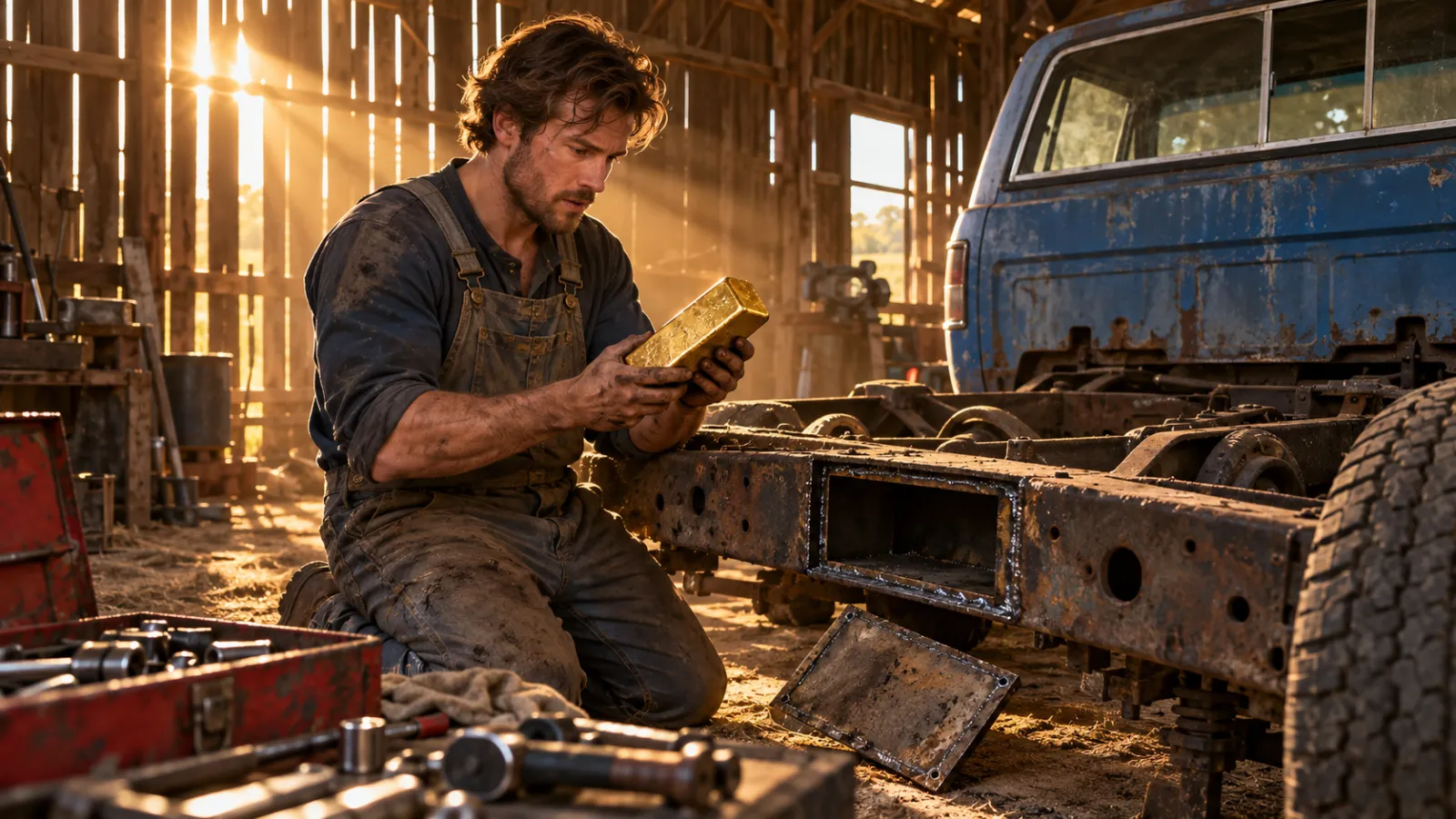
Chapter 4: Forty Ounces in the Frame
The pneumatic die grinder sang with a high-pitched whine as its carbide burr bit into the brass seam. I kept my elbows braced firmly against the truck frame, letting the spinning flute shave away the soft yellow metal without scoring the hard tool steel beneath.
Fine golden filings rained onto the cardboard shield Eli had laid across the concrete floor. The scent of hot brass and mineral coolant drifted up into the cool shop air. When the perimeter was completely relieved, I shut off the compressor valve and cleaned the recessed channel with a shop vacuum until every metal flake was gone.
I took a 3/8-inch T-handle Allen wrench from Eli's rack and fitted the hexagonal bit into the first countersunk cap screw. With a firm, steady push from my shoulder, the fastener broke loose with a crisp metallic snap.
Silas had coated every single thread in copper anti-seize paste before torquing it home. The six grade-8 alloy screws backed out as smoothly as if they had been seated yesterday, their black oxide finish untouched by corrosion. I set them in a clean magnetic parts dish on the workbench.
At opposite diagonal corners of the access plate, Dad had drilled and tapped two smaller quarter-inch holes. I threaded a pair of hardened jack bolts into the holes, turning each bolt half a turn at a time with a small box wrench. The screws pressed against the inner frame shoulder, gently forcing the tight-tolerance lid outward until the airtight seal released with a faint, hollow hiss.
I lifted the heavy steel plate away and set it on a clean shop rag. The inside of the rectangular cavity was lined with half-inch closed-cell neoprene foam, still pliable and smelling faintly of dry rubber and protective mineral oil.
Nestled snugly inside the foam pocket was an olive-drab steel container, roughly the size of a vintage field radio, sealed with dual heavy-duty toggle latches and a thick silicone gasket. I reached in with both hands, hooked my fingers beneath the steel side handles, and lifted it out. The box was startlingly heavy, pulling at my forearms with dense, concentrated mass.
"Set it on the bench, Jess," Eli whispered, clearing aside a row of dial calipers and setting a clean woolen welding blanket over the timber tabletop.
I carried the box to the center of the workbench. Eli switched on the overhead twin-tube halogen lamp, flooding the worn maple planks with warm, amber light. My fingers worked the two steel toggle latches, flipping them open with twin clicks. The silicone seal parted, and the lid swung back smoothly on its piano hinge.
Inside sat two tiers of dark American walnut trays, machined by hand with precision end mills. Dad had milled each tray out of a single block of kiln-dried timber, carving twenty recessed rectangular pockets lined with emerald-green jeweler's felt.
In each pocket rested a one-ounce bar of certified Credit Suisse pure gold, sealed inside its original tamper-evident assay card. The polished gold caught the halogen glare, gleaming with a deep, heavy luster that made the cold shop seem entirely quiet.
Forty bars in total. Forty troy ounces of 999.9 fine investment bullion, resting in hand-carved hardwood pockets like custom tooling in a master machinist's chest.
Eli stared at the trays, his weathered hands resting on the edge of the bench. "Forty ounces," he murmured softly, shaking his head in quiet wonder. "At today's market price, that's well over one hundred thousand dollars in pure metal right there on the table."
I picked up one of the assay cards with careful fingers. The plastic was clear and unmarred, bearing an individual serial number and the official stamp of the foundry assayer. A sudden memory from my early twenties came back to me. Twice every year, in late June and early December, Dad would put on his good wool trousers and tell me he had to drive into downtown Columbus to purchase specialty alloy billets from a commercial distributor. He always returned with a small cardboard box that he carried directly into his private office, locking the door behind him.
He had never been buying scrap steel. For twelve years, Silas had been converting every spare dollar into certified gold bars, preparing for a day he knew would eventually come.
Beneath the second walnut tray lay a heavy manila envelope bound with red cotton twill tape. I untied the knot and pulled out the contents.
The first stack consisted of carbon-copy receipts from Huntington National Bank's precious metals desk on High Street in Columbus. They spanned twelve consecutive years, dated from 2008 to 2020. Every six months, Dad had taken certified funds and purchased two or three one-ounce bars, logging each receipt with matching serial numbers in his small, neat handwriting.
Beneath the bank receipts lay three sheets of white drafting vellum, covered from top to bottom in Dad's unmistakable architectural block lettering, written with an indelible black drafting pen.
The heading was dated five years before his death, the very week he had parked the blue Ford in the barn:
"For Jesse. Read this alone, or with Eli. Do not show this paper to Vance or Corinne."
I looked up at Eli. His eyes were moist at the corners as he pulled two stools over to the bench. "Go ahead and read it, son," Eli said, his voice thick with emotion. "Your dad built that vault for you, and it's time you heard what he had to say."
End of chapter 4