Mystery5 min read
The Five-Dollar Coin in the Tip Jar
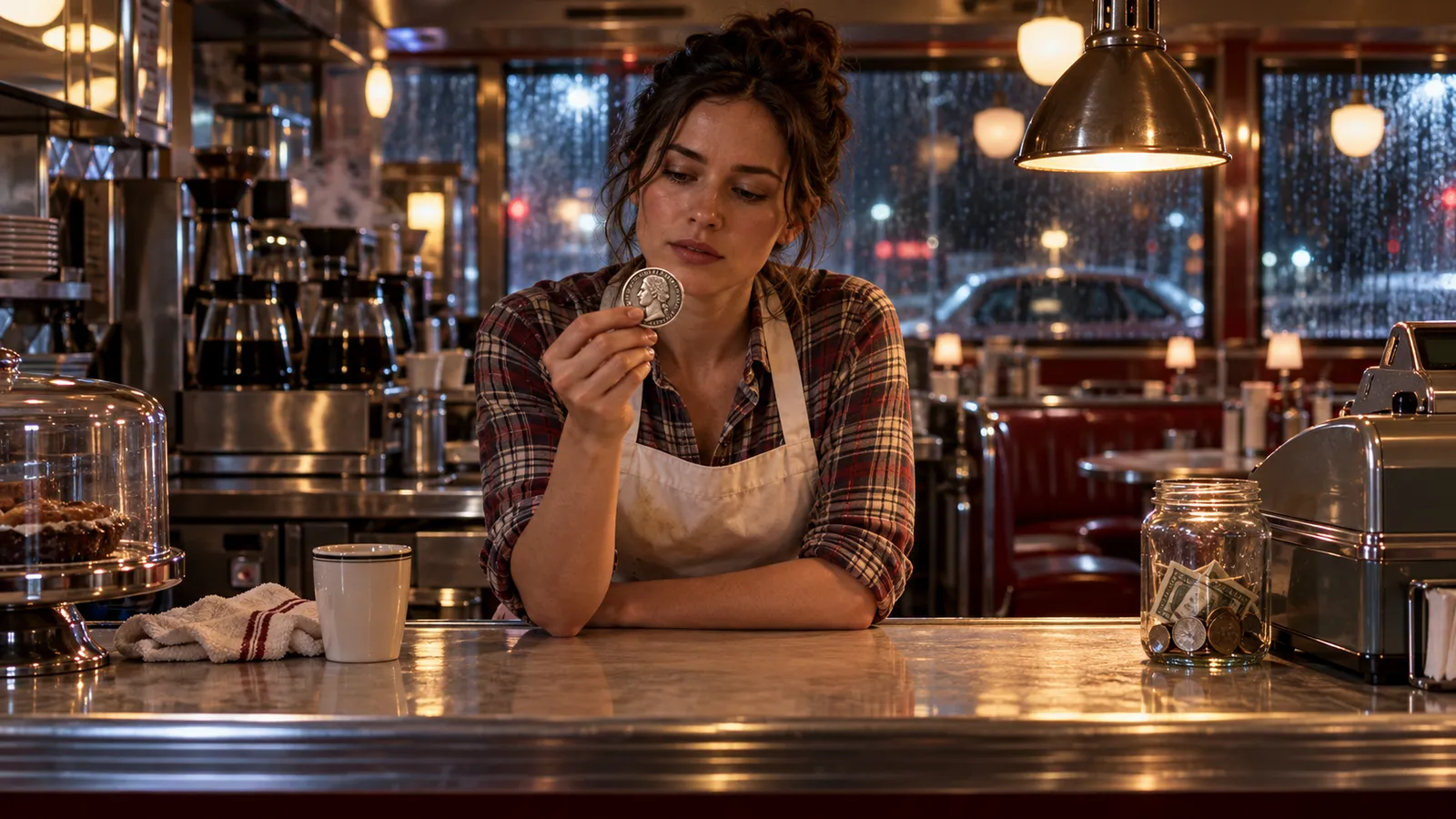
The morning after a silent trucker left a heavy silver dollar in my diner tip jar, I cleaned the grease off the rim and found geographic coordinates carved into the silver with a jeweler's needle.
Chapter 2: The Clockmaker's Loupe
The clock shop on Elm Street smelled of dried cedar shavings, whale oil lubricants, and seventy years of brass clockwork mechanisms.
It was four-forty in the morning when Garth tapped the brass knocker on the side entrance of Cheney Clock & Instrument Repair. Above the frosted door, a wrought-iron sign hung from chains, swinging slightly in the autumn river breeze.
A light flickered on behind the green curtain on the second floor. Two minutes later, bolts slid back with heavy mechanical clicks, and the door swung open.
Warren Cheney stood in the doorway wearing a brown wool cardigan over his pajamas, holding an electric jeweler's task lamp in one hand. He was seventy years old, with wire-rimmed bifocals resting on the bridge of an aristocratic nose and fingers that were unusually long and slender. For thirty-five years, Warren had been the county archivist, cataloging deeds and municipal charters by day while restoring carriage clocks and marine chronometers by night.
"Garth?" Warren squinted through his lenses, his eyes drifting from the cook's stained flannel coat to my face. "Nora. The diner hasn't caught fire, has it?"
"We need your microscope, Warren," Garth said, ushering me through the door before closing it against the cold. "And your ninety-six municipal tax index."
Warren led us into the back workshop. The room was dominated by two long mahogany workbenches fitted with padded leather armrests, surrounded by racks of miniature tweezers, staking sets, and rows of glass bell jars covering delicate gear trains. In the corner sat a heavy German stereoscopic binocular microscope mounted on a cast-iron boom arm.
I pulled the 1921 silver dollar from my coat pocket and placed it on the green cutting mat under the microscope's ring light.
Warren set his tea mug aside, pulled an adjustable stool forward, and swiveled the microscope head into position. He adjusted the coarse focus knob, leaned forward until his brow pressed against the rubber eye cups, and touched the fine micrometric dial. For several minutes, he examined the physical condition of the coin, noting the wear on Lady Liberty's hair curls and the rim dent near the second star.
"Interesting," Warren murmured after thirty seconds. His long fingers rotated the coin two millimeters using brass watchmaker's tweezers. "The reeding was removed on a bench lathe using a four-hundred-grit diamond file. Not an amateur job. Someone with precision machine shop training and access to fine engraving styluses."
"Read the rest of the rim, Warren," Garth urged softly, leaning against the wooden frame of the workbench.
Warren adjusted the high-power objective lens, illuminating the rim with an auxiliary fiber-optic wand. "The coordinates are remarkably clear. Forty-four degrees, eighteen minutes, twenty-two seconds north. Seventy-three degrees, fifty-four minutes, nine seconds west. Slip number four. And your father's initials, Leo Stanton, dated October twelfth, nineteen ninety-six."
He paused, his shoulders stiffening as he rotated the coin further along the curve toward the date numeral 1921.
"There is an auxiliary engraving," Warren said, his voice dropping an octave. "Very faint. Scratched with a secondary tool, perhaps a tungsten carbide scriber."
"What does it say?" I asked, my fingers clutching the edge of the workbench.
Warren reached for a pad of grid paper and a mechanical pencil. Looking through the stereo lenses with his right eye while keeping his left eye on the pad, he carefully transcribed six characters:
VFT-408
I stared at the letters. "VFT?"
"Valley First Trust," Warren whispered, taking off his glasses and rubbing the bridge of his nose. "The regional bank that held the municipal bonds for the Oakhaven resort development in the mid-nineties."
"Four hundred and eight was a safe deposit box number," Garth said, leaning both palms against the mahogany bench. "My brother had box three-twelve at the downtown branch before the bank collapsed. The boxes were numbered by tier."
Warren stood up from his stool and walked over to a towering wall of oak filing cabinets that lined the eastern wall of the shop. When the county courthouse downsized its records department in 2004, Warren had bought three cabinets of duplicate deed books and tax foreclosures at auction, saving them from the county incinerator.
He pulled open a deep metal drawer labeled 1995–1997 FORECLOSURES & AUDITS.
He flipped through stiff manila folders until he extracted a thin green legal binder tied with black ribbon. He brought it over to the desk, untied the ribbon, and spread a large blueprint across the cutting mat.
"This is the master shoreline survey for Lake Oakhaven, dated September nineteen ninety-six," Warren explained, running his finger along the blue drafting lines. "Here is the north basin. In nineteen ninety-six, the bank president was Calder Maddox. Maddox was the lead trustee on the municipal drainage fund. When the three hundred and eighty thousand dollars went missing from the escrow account, Maddox produced a boundary report claiming that Leo Stanton had improperly certified the wetland setback, allowing private investors to drain protected marshland for private cottages."
"My father told the town council he never signed that setback certification," I said, the memory of that bitter winter rising in my throat. "He swore the seal on the plat was a forgery."
"The grand jury refused to indict Maddox because your father could not produce his original field survey journals," Warren said, looking up at me through his glasses. "The sheriff's deputies searched Leo's office at the courthouse and reported that the field logs were gone. Without the logs to prove the boundary markers had been moved by the developers, the suspicion fell entirely on Leo. The state board took his surveyor's license in November."
"My father spent months retracing the shoreline on foot with his old hand compass," I recalled, remembering the cold grease smells of our kitchen in December of ninety-six. "He knew someone had forged his certification stamp. He told my mother that the truth was locked away where nobody without a boat could reach it."
"And Calder Maddox died three months later," Garth added quietly. "Massive coronary on his yacht in the Bahamas. The bank went into FDIC receivership, and the case was closed."
Warren turned back to the blueprint, pointing to a small rectangular structure sketched on the rocky bluff above the north inlet.
"Boathouse four," Warren said. "It was owned by Calder Maddox's private holding company. When the bank failed, the shoreline parcel was tied up in federal litigation for twenty years. No one has lived out there since ninety-six."
"Why did the trucker give this coin to me?" I asked, picking up the heavy piece of silver.
Warren looked at me with deep, solemn compassion.
"Because whoever had this coin knew that Calder Maddox didn't act alone," Warren said. "Or because someone who was there when your father hid the truth finally decided it was time to let the daughter know."
"We're going to that boathouse," I said, sliding the silver dollar carefully into my pocket.
Garth pulled his heavy brass truck keys from his coat and checked the dashboard clock on the wall. "The sun comes up in forty minutes. I've got a heavy crowbar, two spotlights, and a recovery rope in the bed of the pickup."
End of chapter 2