Mystery5 min read
The Woman Who Signed for My Packages
Every parcel I ordered was signed for by H. Carver, and nobody at my address has that name. I filed the complaint that would cost the building superintendent her job—before I learned what she was really doing with my packages.
Chapter 1: The Name on the Photograph
Every parcel I ordered was signed for by H. Carver. Nobody at my address has that name.
It was the second of October, a Friday, and I had been home from the hospital for forty minutes. I work nights in the lab at County, seven to seven, which means every delivery window in the world happens while I am unconscious. I had learned to read proof-of-delivery photos the way I read a blood panel at three in the morning. One field at a time. No guessing.
Delivered. Signed by H. CARVER.
The signature was not a scrawl. It was block printing. Each letter stood apart from the one beside it, and the period after the H sat exactly where a period belongs.
I opened the spreadsheet.
I had started it in August, after the second late box, because I keep things in columns when I cannot keep them in my head.
Order date, item, cost, promised date, actual date, proof type, signature.
Nineteen rows were wrong.
Sixteen of them said H. CARVER. The same two words in the same careful capitals, going back to the eighteenth of August.
Eight of those sixteen had eventually reached my door. Three days late, six days late, eleven days late, but they came, and the tape across them was still the shipper's tape.
Eight of them had not come at all. Signed for, scanned, closed out as delivered, and never on my mat.
The last three said nothing at all. No signature, no name. Just a photograph of my doormat with a box sitting on it, and then no box.
Work boots, a hundred and eighteen dollars, on a Thursday. A phone battery, thirty-nine, on a Tuesday. And on Tuesday the twenty-second of September at 1:14 in the afternoon, a hearing aid for my mother. Five hundred and twelve dollars.
I called her on my way down to the laundry room, because if I sat on the couch I was going to lose the whole day to sleep.
"They'll find it," Lorna said.
"It was photographed on my mat, Mom. Somebody has it."
"Then somebody has it." She said that the way she says the weather. "Daniel, I've gone two years. I can go a little longer."
That was the sentence that kept me awake. I did not want her to be good at waiting.
Lindell Court is forty-one units of brick on Dunmore Avenue, and the basement runs the whole length of it. Laundry at the near end, four machines, two of which take quarters and two of which have taken my quarters. I had been down there maybe nine times in eleven weeks and I had never once looked at the far end.
That morning the far door stood open about eight inches.
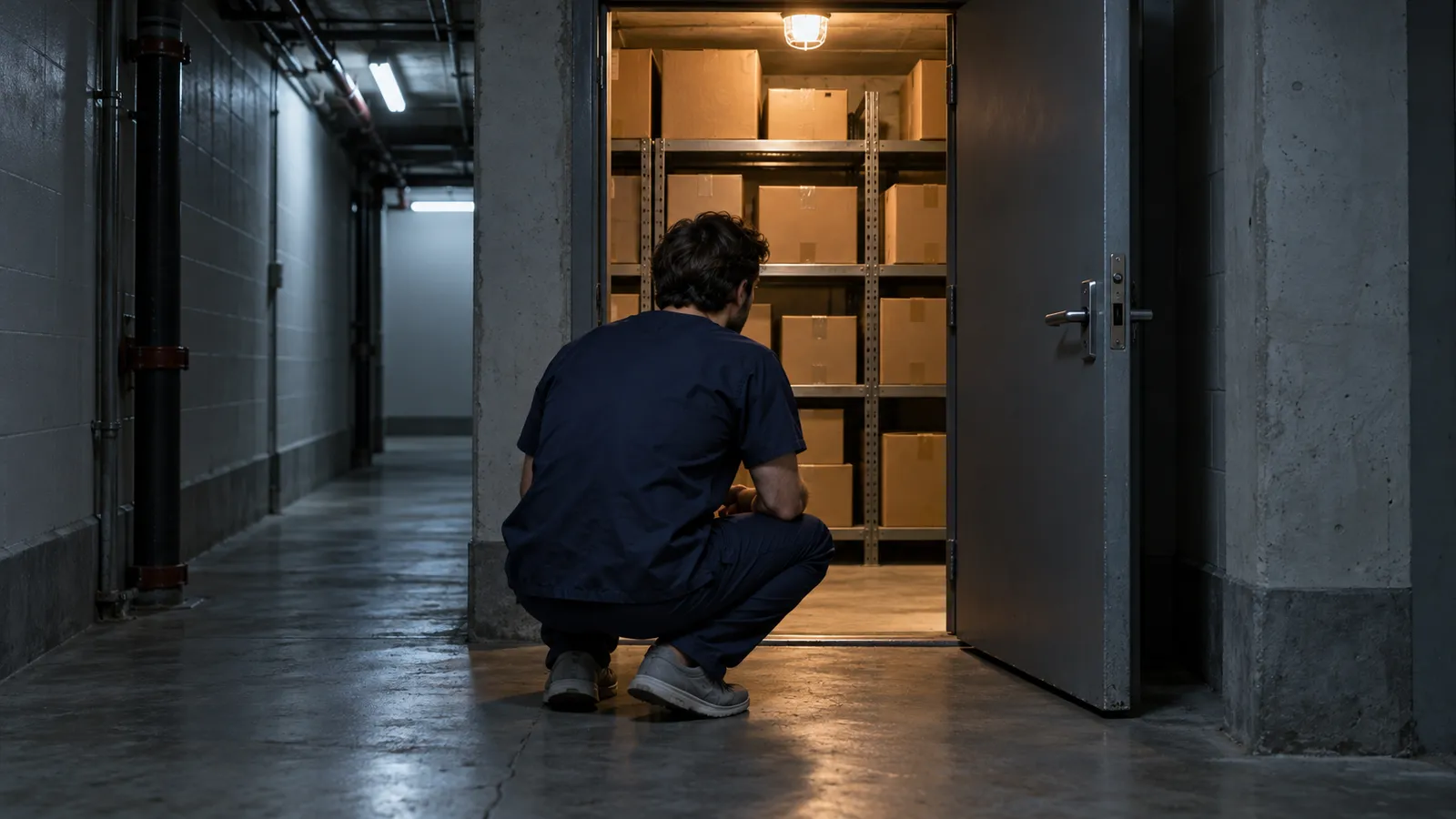
I could see steel shelving inside, the industrial kind, and on the shelves were boxes. Not junk. Not spare tile and paint cans. Shipping boxes, squared up with their labels facing out, and strips of masking tape stuck to the shelf edge under each one with writing on the tape.
A woman came out before I could get closer. Fifty-some, gray hair cut short, a tool belt, a flat carpenter's pencil behind her left ear. She pulled the door shut behind her, turned a key in it, and went up the stairs past me with a nod that did not stop moving.
A green notebook stuck out of her breast pocket. I remember that because she pushed it down with her thumb as she went by.
I stood there with my laundry basket and did arithmetic. Sixteen boxes signed by a name nobody in my apartment owns, eight of which I had never touched. Four shelves of boxes behind a locked door in a building where I pay twelve hundred dollars a month.
I did not do laundry. I went up to the lobby and started knocking.
Walt in 1A is retired and answers on the second knock. He listened to the whole thing with his hand on the doorframe.
"July was bad," he said. "July was terrible. Then it stopped for a few weeks. Three, about. Everybody figured somebody got caught."
"And then?"
"Then it started up again, only on different days." He shrugged. "You learn to be home, or you learn not to order things."
2C took longer. Priya opened the door with a dish towel over her shoulder and a kid yelling somewhere behind her, and when I said the words packages and signature her face changed before I finished the sentence.
"September twenty-ninth," she said. "A mask set for Milo's nebulizer. Sixty-two dollars, and I need the small size, and you cannot get the small size at a pharmacy here." She said it fast, like she had been holding it. "Photo of my mat. No box. The carrier told me to take it up with the shipper and the shipper told me to take it up with the carrier."
"Did any of yours get signed for?"
"Twice. Both of those came. Late." She stopped. "Why?"
"Because mine is the same split," I said. "The ones with no signature are the ones that are gone for good."
"Yours came too, then."
"Eight did. Eight more are signed for and sitting somewhere I've never seen."
I heard myself say it out loud and it sounded, for a second, like two different problems. Then I put it back together the way it had been in my head since the laundry room. Somebody with keys was taking boxes and writing a name on the ones she kept. That was the version that fit a locked room full of other people's property.
"Who is H. Carver?" I asked.
Priya looked at me like I had asked who the mayor was.
"Hollis," she said. "Hollis Carver. The super."
I went home and stood in my kitchen with the spreadsheet open and the ceiling fan going, and I worked out that the woman with the pencil behind her ear lived in the basement unit at the end of that corridor, directly below the bedroom where I slept through every single delivery.
Eleven feet under my bed, with a key to the whole building and four shelves I had already photographed in my mind.
Her name was Hollis Carver, and she had signed for sixteen of my packages.
End of chapter 1