Family4 min read
The Missing Name on the Family Monument
At the unveiling of our family granite monument, Uncle Douglas omits Aunt Marianne's name, claiming she disgraced the clan. Samuel digs into county records and discovers a 1982 deed proving Marianne saved the farm from foreclosure and Douglas owes her estate a $350,000 promissory note.
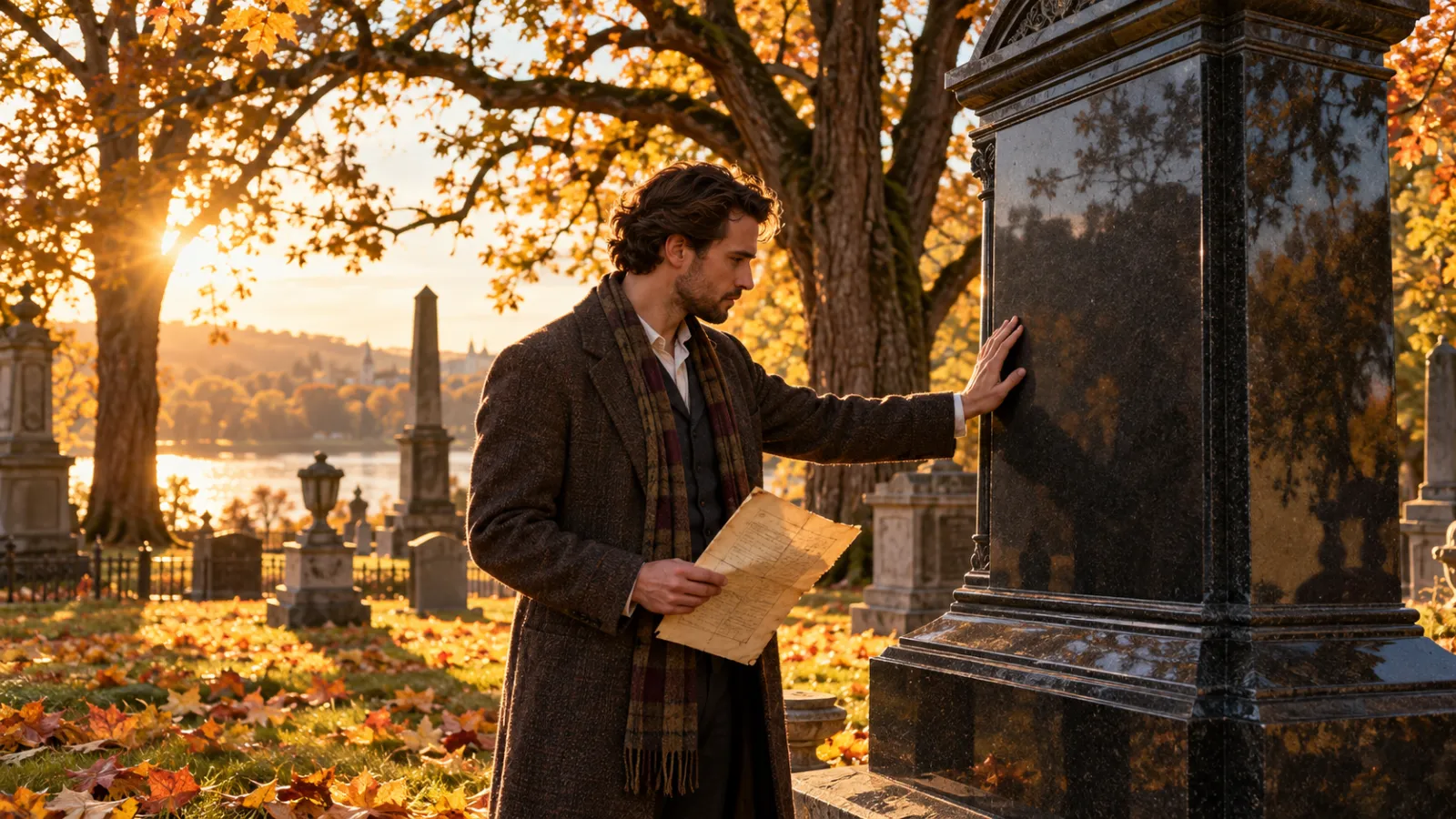
Chapter 1: Granite under the Autumn Oaks
When Uncle Douglas unveiled our family's granite monument at Oakridge Cemetery and I saw Aunt Marianne's name was omitted, he sneered that she disgraced the clan. He had no idea I would uncover the 1982 deed proving Marianne saved the farm and Douglas owed her estate $350,000.
The afternoon wind swept through the tall scarlet oaks of Oakridge Cemetery, scattering dry russet leaves across the grass. More than sixty members of the Sterling family had traveled to the rolling hills of Augusta County for the centennial gathering. Cousins from Richmond, second cousins from Roanoke, and aunts who had not seen each other in a decade sat on rows of white folding chairs. At the center of the grassy knoll, draped in heavy green velvet, rose the eight-foot monolith of polished Georgia black granite.
My uncle Douglas stood beside the covered stone like a monarch preparing to address his subjects. At fifty-eight, Douglas ran the Sterling Commercial Orchard and Grain Corporation, six hundred acres of rich limestone bottomland along the Middle River. He wore a tailored charcoal wool suit, hand-tooled leather boots, and a heavy silver belt buckle shaped like an ear of wheat. Every gesture he made was designed to project absolute authority.
"One hundred years ago, our grandfather Josiah broke this ground with a two-horse plow," Douglas announced into the portable wireless microphone. His booming voice echoed against the distant hillside. "For four generations, the Sterling name has stood for hard work, clean living, and financial solvency. Today, funded by the proceeds of our family enterprise, we carve that heritage into indestructible stone."
With a dramatic tug, Douglas pulled the velvet cord. The heavy fabric slid down with a soft hiss, falling into a heap on the manicured lawn.
A collective murmur of appreciation rippled through the gathered relatives. The granite stood tall and imposing, its mirror-smooth surface reflecting the pale blue Virginia sky. Deeply sandblasted letters filled the center face, inlaid with bright silver enamel. At the top was Josiah Sterling and his wife Sarah. Beneath them were their three sons, followed by their children and grandchildren, arranged in neat chronological order.
I stood in the third row beside my cousin Claire, my hands tucked into the pockets of my tweed jacket. My throat felt tight as my eyes scanned the generation of the 1940s.
My mother and father were there, their birth and death dates cleanly engraved above mine. Uncle Douglas was there, listed prominently with his commercial farm title. But between my father and Douglas, where the eldest daughter of Josiah should have been engraved, there was only a wide expanse of polished blank stone.
Aunt Marianne was not there.
Marianne had passed away just six months earlier at eighty-two. For forty-two years, she had served as a pediatric head nurse at the Augusta Regional Hospital, working double night shifts in the neonatal ward. When a tractor trailer crossed the highway divider and killed both of my parents when I was seven, Marianne was the person who opened her front door. She took me into her modest brick bungalow on Market Street, patched my scraped knees, read me American history textbooks, and paid for my college tuition out of her hospital savings.
"Claire," I whispered, turning toward my cousin. "Where is Aunt Marianne?"
Claire looked down at the program in her lap, her face pale. She was thirty-two, an accountant who worked in Staunton, and one of the few people in the family who never tolerated her father's arrogance.
"I asked him three weeks ago when the monument company sent the proofs," Claire murmured, her voice trembling slightly. "He told me he would handle the inscriptions personally."
I stepped out from the row of chairs and walked toward the base of the monument. Uncle Douglas was busy accepting handshakes and congratulatory pats on the back from our older cousins.
"Uncle Douglas," I said, keeping my voice calm and steady.
Douglas turned, holding a glass of sparkling cider. "Samuel. Good of you to drive over from Charlottesville. Not many high school teachers get to see their family name honored on an eighty-thousand-dollar piece of granite, eh?"
"Where is Aunt Marianne's name?" I asked, pointing directly at the blank gap between his name and my father's.
The small circle of cousins around us fell silent. Douglas took a slow sip of his cider, his expression hardening.
"Marianne is not on the stone because she chose to sever herself from the family legacy," Douglas said loudly enough for the front row to hear. "She made her own bed when she defied our father fifty years ago to marry a penniless mechanic from Baltimore. She lived in town, worked for wages, and contributed nothing to this farm."
"She was your older sister," I said, feeling the heat rise into my cheeks. "She raised me when my parents died. She spent forty years caring for sick children in this valley. She was Josiah Sterling's firstborn daughter."
Douglas stepped closer, his cold blue eyes narrowing. "This monument was paid for by the earnings of the Sterling farm, Samuel. Marianne never put a single dime into the expansion of this land. In fact, she turned her back on the enterprise. I am not spending family money to engrave the name of a rebellious sister who disgraced our traditions."
A few older relatives shifted uncomfortably in their seats, but nobody dared challenge Douglas. He controlled the land leases, the family trusts, and the employment of three cousins who worked on his grain elevators.
"She never disgraced anyone," I said quietly.
"Go home, Samuel," Douglas sneered, turning his back on me to shake hands with another cousin. "You teach history in high school, but you know nothing about real assets."
I stood before the cold black stone for another minute, looking at the empty spot where Marianne belonged. Then I turned and walked slowly toward my car, determined to find the truth.
End of chapter 1