Kindness5 min read
The Layaway Someone Else Paid Off
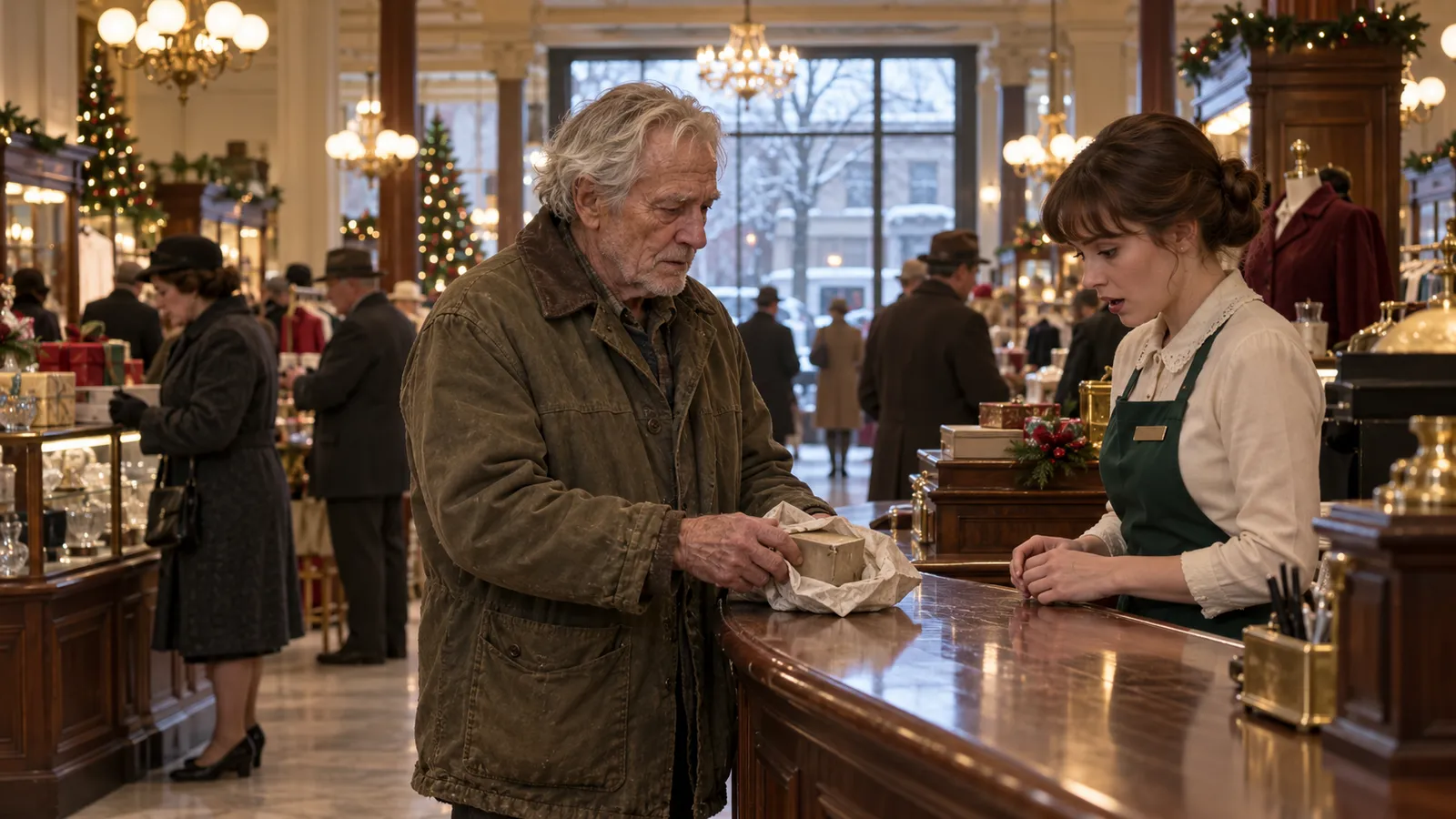
The morning the store manager ordered us to purge the overdue holiday layaway bins, an elderly man in a salt-stained coat walked up to register four and paid every single balance in cash.
Chapter 2: The Twenty-Three Calls
By Wednesday morning, the four thousand eight hundred and twenty dollars had been verified by the accounting vault, and twenty-three red cancellation tags lay curled in the wastebasket beneath my desk.
I sat in the small glass-walled office behind the layaway cage with the store's landline telephone and a printed call roster. Outside, the morning sales rush had begun, the distant hum of holiday shoppers filtering through the acoustic ceiling tiles.
My job for the next four hours was simple: call every name on the list and tell them their items were cleared for collection.
The first call went to Sandra Miller, an orderly at St. Joseph's Memorial who had put two winter parkas and three pairs of waterproof gloves on hold back in mid-October. Her voice answered on the fourth ring, sounding thin and raspy from an overnight shift.
"Mrs. Miller, this is Hannah from Miller & Sons," I said.
The line went completely dead for two seconds. When she spoke again, her voice carried the brittle, defensive edge of someone anticipating bad news.
"I know I missed the Friday payment, Hannah," she said quickly. "My transmission blew out on the bypass last Thursday. I have forty dollars cash coming on my Friday check. If you can just hold those coats until Saturday morning, I swear I'll—"
"Mrs. Miller," I interrupted gently. "Your layaway is paid in full. Both coats, the gloves, and the thermal socks. You can come pick them up whenever you're ready."
There was a sudden, sharp intake of air through the receiver. Then came a silence so heavy that I could hear the faint rhythmic ticking of a wall clock in her living room.
"Who paid it?" she whispered, her voice cracking. "Did my sister call the store?"
"An anonymous donor came to the counter yesterday morning," I explained, looking down at the ledger sheet. "He paid the entire balance. There's no fee, and there's no balance owing."
A quiet, muffled sob came across the wire, followed by the sound of a hand pressing against the microphone. "Thank you," she choked out. "My boys have been wearing two sweatshirts under their denim jackets all week. Tell whoever did it... tell them God bless them."
I spent the next three hours repeating variations of that exact conversation twenty-two more times.
I spoke to a machinist from the tube mill whose layaway held a twelve-inch red bicycle for his six-year-old daughter. I spoke to a retired school bus driver whose order held a winter comforter and two pairs of thermal boots. Some people wept openly. Others fell into stunned, disbelieving silences, asking three times if this was a collection agency trick before they allowed themselves to exhale.
By one o'clock, all twenty-three accounts had been signed off on the electronic register.
I took the brittle yellow slip of paper from my apron pocket and walked out to the parking lot where my older brother Joel was waiting in his 2012 Subaru wagon.
Joel had finished his morning chemistry lectures at Blackwood High and had his junior varsity wrestling practice scheduled for three-thirty. He sat in the driver's seat with the heater fan blowing warm air onto his work boots, holding a paper cup of gas station coffee in his lap.
"How bad was it?" Joel asked, taking the folded yellow slip as I climbed into the passenger seat.
"Every ticket was cleared," I said, leaning my head back against the headrest. "Forty-eight hundred dollars. He walked in, put down the cash, took the receipt, and walked out without giving a name."
Joel smoothed the fragile paper across his denim knee, adjusting his wire-rimmed glasses. The paper was translucent with age, smelling faintly of machine oil and cedar shavings.
"December twenty-fourth, nineteen ninety-four," Joel read aloud, his thumb tracing the purple date stamp. "Account number eight-twelve. One boys' wool duffel coat, one toddler fleece parka, one Lionel electric train starter set. Total balance: seventy-six dollars and forty cents."
He turned the slip slightly toward the gray daylight coming through the windshield.
"Look at the script on the signature line," Joel said, pointing to the purple fountain pen ink. "That's not an employee number. That's Martha Miller's personal bookkeeping mark."
I leaned closer. Martha Miller had founded the department store alongside her husband in 1948, running the customer service desk herself until she passed away in the spring of 1998. Growing up in Blackwood Falls, every child knew her reputation: she was a stern, churchgoing matriarch who demanded perfect inventory counts but was known to quietly slip five-dollar vouchers into the pockets of widowed mothers during the steel strikes of the late 1970s.
"Store records from ninety-four are in the mezzanine archive," I said, turning to look at my brother. "The old paper ledgers before the company went digital."
Joel took a sip of his coffee and looked at his dashboard clock. "I've got forty-five minutes before sixth-period lab. Let's go look."
We walked back through the employee service entrance and climbed the narrow iron stairs to the mezzanine storage room behind the administrative offices. The room was lined with floor-to-ceiling metal shelving holding green canvas-bound binders containing forty years of manual sales records.
It took Joel seven minutes to locate the 1994 holiday layaway logbook.
He carried the heavy binder over to the sorting table and flipped through the yellowing pages until he reached December 24.
Account number 812 was entered in Martha Miller's neat, sloping cursive.
The customer name column was filled out in firm pencil: Keith Hollowell — 414 Mill Creek Road.
In the margin beside the entry, Martha Miller had written a single line of micro-script in blue fountain pen ink: Shop closed Thursday. Two children at home. Paid in full by #41.
Joel looked down at the line, his finger resting beneath the penciled name. "Keith Hollowell. He worked at the forging plant for thirty years. My wrestling team used to buy scrap angle iron from their fabrication bay for bench press weights."
"The forging plant went bankrupt six years ago," I said, remembering the headlines that had dominated the local paper. "The pension fund was tied up in federal bankruptcy court for almost a decade."
"The settlement finally paid out six weeks ago," Joel said quietly, looking up from the old ledger. "State news ran a piece on it in October. The retired toolmakers got their lump-sum backpay after eight years of arbitration."
I stared at the name written in the margin thirty-two years ago.
Keith Hollowell had not come to register four to act like a benevolent millionaire tossing spare change to the poor. He had come because thirty-two years ago, on Christmas Eve, he had stood at that exact wooden counter with empty pockets, and a woman who had been dead for nearly three decades had refused to let his children wake up without winter coats.
"Mill Creek Road is three miles past the river bridge," Joel said, closing the heavy green binder with a soft thud that sent a puff of dust into the air.
"I'm going out there tomorrow afternoon," I said, folding the yellow carbon slip and placing it carefully into my coat pocket.
End of chapter 2