Kindness6 min read
The Layaway Someone Else Paid Off
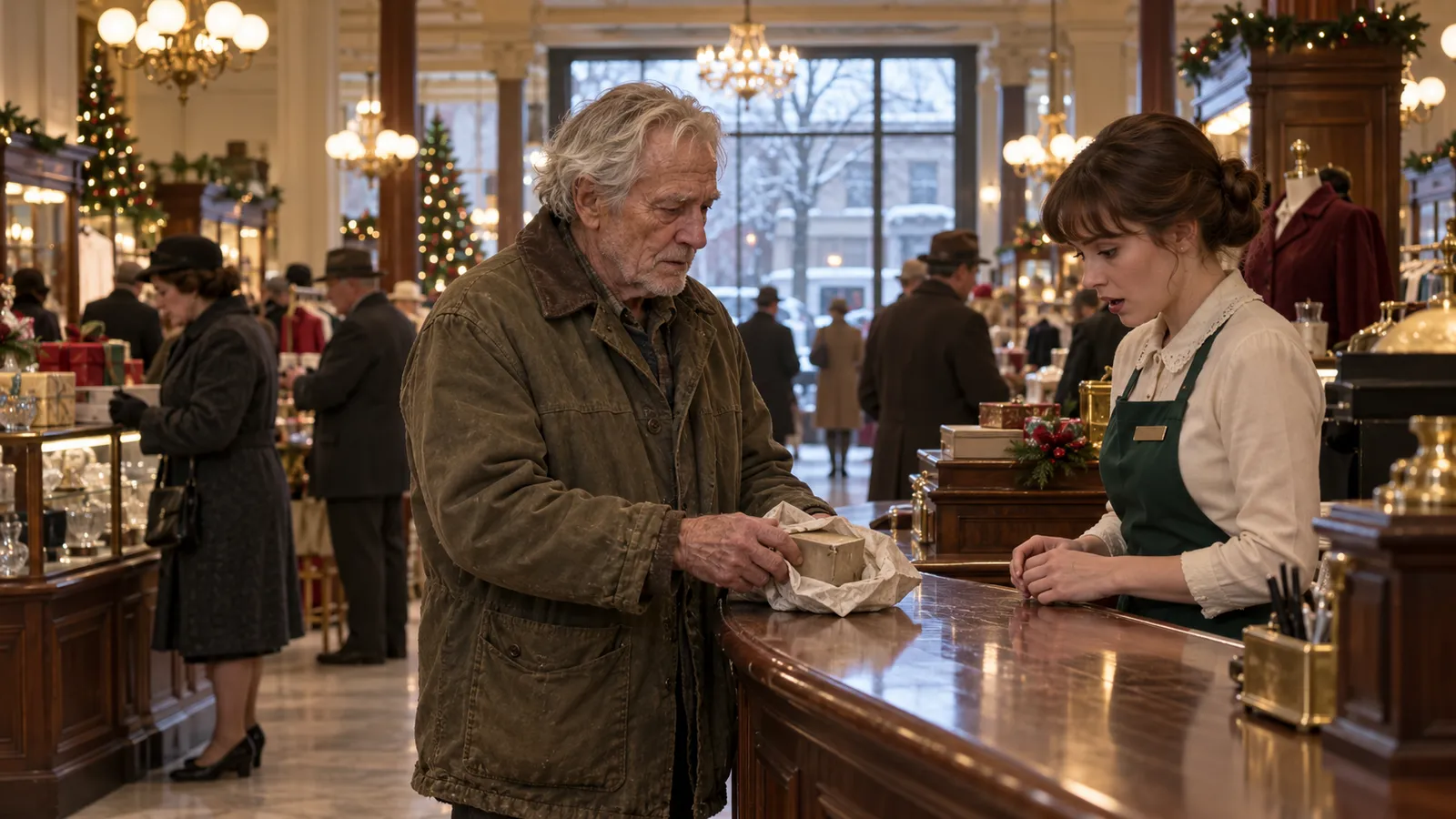
The morning the store manager ordered us to purge the overdue holiday layaway bins, an elderly man in a salt-stained coat walked up to register four and paid every single balance in cash.
Chapter 3: The Tool-and-Die Shop
Mill Creek Road branched off the state route three miles west of town, running alongside a shallow gravel creek that was already half-frozen with jagged winter ice.
On Thursday afternoon at three-thirty, the sky hung low and iron-gray over the rolling valley. Number 414 was a small white clapboard cottage built during the post-war industrial boom, with a cinder-block chimney and a corrugated metal mailbox leaning slightly toward the ditch. Set fifty yards behind the house, nestled against a stand of bare hickory trees, sat a rectangular pole-barn workshop with dark green siding and a galvanized tin roof.
A thin plume of pale gray woodsmoke curled from a stovepipe protruding through the workshop's gable.
I parked my station wagon on the gravel shoulder, turned off the engine, and stepped out into the biting wind. The only sound was the cold rush of the creek across the stones and the distant, rhythmic clang of steel striking an anvil from inside the shed.
I walked up the gravel drive, stepping around patches of frozen slush.
The workshop's sliding wooden door was pushed open three feet to vent the smoke. Inside, the air smelled rich and heavy with kerosene, coal embers, cutting fluid, and hot metal. A woodstove made from an inverted fifty-gallon steel drum glowed dull red in the corner, radiating a dry, crackling warmth across benches lined with heavy iron vises, drill presses, and racks of lathe tools arranged by size.
Keith Hollowell stood at a heavy oak workbench under an unshaded lightbulb. He wore the same olive canvas coat, its sleeves pushed up to the elbows, wearing thick leather welder's gloves as he filed the brass burner assembly of an antique kerosene heater.
He stopped filing when my shadow crossed the floorboards.
He did not jump, and he did not drop his tool. He set the brass fitting down on an oily rag, removed his leather gloves, and wiped his palms on his work apron. His gray eyes met mine with the steady, unblinking calm of an artisan who spent his life measuring tolerances in thousandths of an inch.
"Miss MacKenzie," he said quietly.
"Good afternoon, Mr. Hollowell," I replied, pulling my woolen scarf loose at my neck.
He looked past my shoulder toward the empty gravel driveway, as if checking whether I had brought an entourage of store executives or reporters with me. Seeing that I had come alone, his shoulders relaxed half an inch.
"Warren send you?" he asked, his voice low and raspy.
"No," I said. "Warren doesn't know I'm here. Warren thinks an eccentric donor from the country club paid the bill."
Keith let out a short, dry breath that might have been a laugh if there were any humor in it. He walked over to an overturned wooden milk crate, lifted an electric kettle from a hotplate, and poured steaming water into a chipped ceramic mug holding a tea bag.
"Tea?" he asked, gesturing toward a second mug on the shelf.
"No, thank you," I said.
I reached inside my coat, pulled out the brittle yellow carbon receipt from December 24, 1994, and laid it gently on the clean corner of his workbench.
Keith looked down at the slip. He did not touch it. For ten seconds, the only sound in the barn was the hum of the woodstove and the wind rattling the tin siding outside.
"You found the old ledger," he said, staring at the purple ink.
"In the mezzanine archive," I replied. "Account eight-twelve. Martha Miller wrote your name in pencil, and she wrote Paid in full by #41 in blue ink in the margin."
Keith pulled a metal stool out from beneath the bench and sat down heavily, resting his forearms against his knees. His gaze drifted away from the paper, fixing on the dark hickory woods visible through the open doorway.
"December twenty-third, nineteen ninety-four," he said, his voice dropping into a quiet, measured cadence that carried thirty-two years of weight. "I had three men working for me in a rented bay down on Water Street. We built custom stamping dies for the automotive suppliers in Cleveland. The prime contractor filed Chapter 11 on the twentieth of December. Owed my shop forty-four thousand dollars for three months of tooling."
He rubbed his right thumb over the scar tissue on his palm.
"The bank froze my operating account forty-eight hours later," he continued. "I had to tell three men with young families that their Christmas bonus checks were going to bounce, and that the shop was closing on Friday. By Saturday morning, Christmas Eve, I had six dollars and forty cents left in my billfold. That was every nickel I had in the world."
He pointed a blunt, calloused finger toward the yellowed receipt on the bench.
"My wife, Clara, had put three things on layaway at Miller's back in September," he whispered. "A wool duffel coat for our eight-year-old son, a little pink fleece jacket for our daughter, and a three-piece Lionel electric train set. The balance owing was seventy-six dollars and change. If I didn't pay it by noon on Christmas Eve, the store policy back then was to cancel the hold and keep the fifteen-dollar deposit."
He swallowed, his throat moving with difficulty.
"I drove my truck downtown with those six dollars in my pocket," he said. "I went down to the basement counter, and Martha Miller was standing there behind the register with her glasses on a silver chain around her neck. I put my six dollars on the counter, and I told her I was sorry, but I couldn't pay the rest. I told her to take the deposit, put the coats back on the shelf, and give the train to somebody who could afford it."
Keith paused, closing his eyes for two seconds.
"Martha didn't take the six dollars," he said softly. "She reached under the counter, brought out three large white gift boxes tied with red twine, and stacked them in front of me. Then she took out her fountain pen, stamped that yellow receipt, and wrote Paid in full by #41 across the front."
"Did she tell you who number forty-one was?" I asked.
"She looked me right in the eye," Keith said, looking up at me. "And she said: Keith, there are forty people in this valley who owe me money, and you're number forty-one. Take these boxes home to your children, and don't you ever dare come back into this store with your head down."
A tear formed in the corner of his weathered eye, but he did not wipe it away.
"I took those boxes home," he whispered. "My boy wore that wool coat for three winters. My daughter slept with that fleece jacket on her pillow. And that Lionel train ran around our tree every single Christmas until Clara passed six years ago."
"And you carried that receipt for thirty-two years," I said.
Keith stood up from the stool, walked over to a red Craftsman metal tool chest in the corner, and pulled open the top drawer. Inside, resting among precision micrometers, feeler gauges, and brass calipers, was a small compartment lined with green felt.
"I promised myself that if the good Lord ever gave me five thousand dollars that didn't belong to the mortgage or the doctor, I was going to walk up to that register and settle the account," he said. "The forging plant pension trust finally settled in October. My retroactive backpay check cleared on Monday morning."
He looked at me with an earnest, dignified humility that took my breath away.
"I didn't pay off those twenty-three bins to be a hero, Miss MacKenzie," Keith said firmly. "I paid them off because Martha Miller kept my family warm in nineteen ninety-four, and an honest debt doesn't expire just because the person who carried it is resting in the cemetery."
I reached out and placed my hand over his calloused knuckles on the bench.
"They're coming to pick them up tomorrow, Keith," I said softly.
Keith shook his head once, his jaw tightening. "They don't need to know my name. The debt was between me and that wooden counter. You let those children have their Christmas."
End of chapter 3