Relationship6 min read
The Visitor Log at Room 412
I found my husband's signature on the visitor log of Room 412 under "Family." We have been married two years, and I have never heard the patient's name in my life.
Chapter 3: The Girl with the Headphones
On Thursday afternoon at two o'clock, I walked through the main sliding glass doors of Mercy Valley for the second time in forty-eight hours.
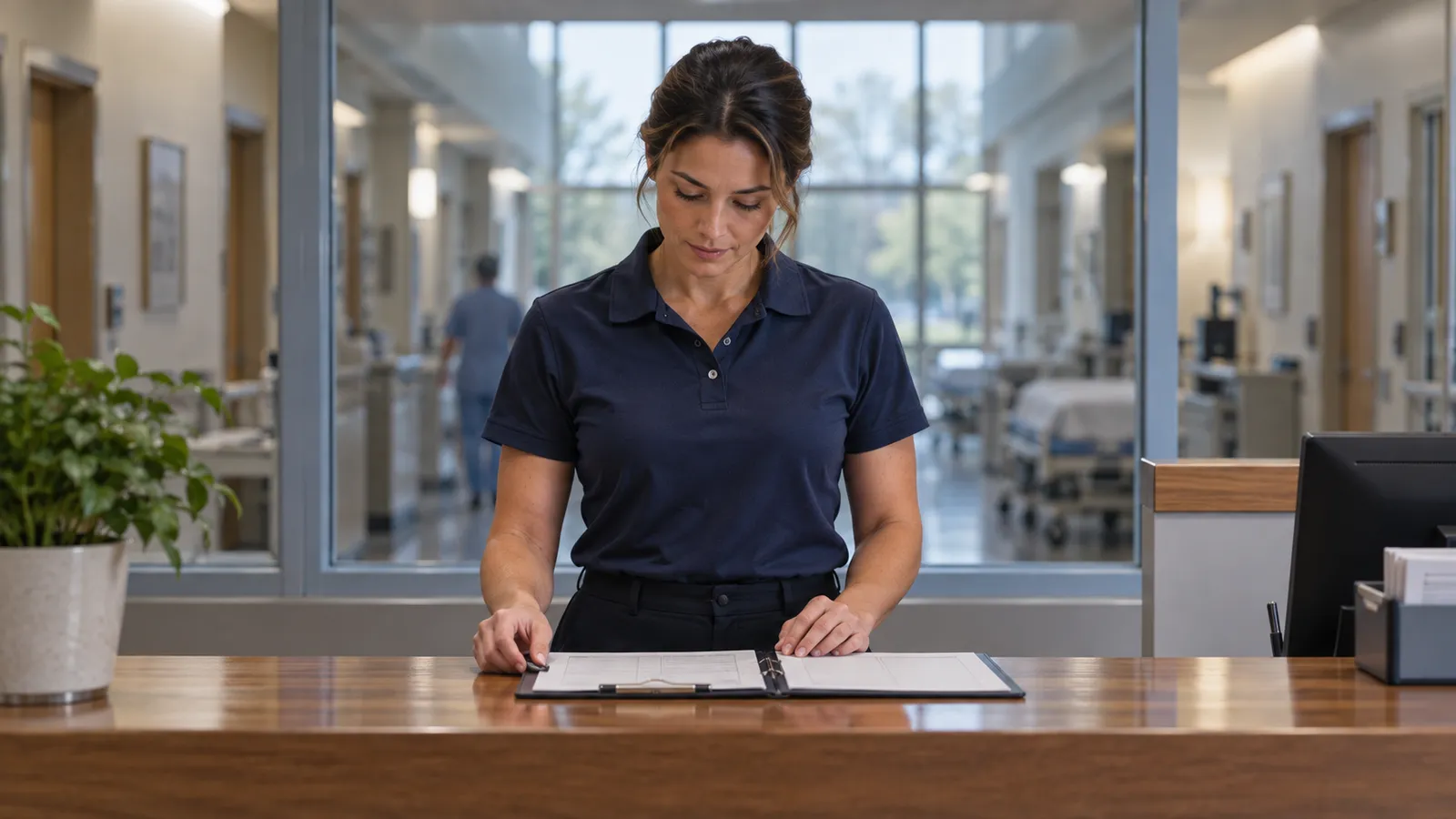
I wore my navy Lakeside polo shirt, dark slacks, and my clinical ID badge clipped over my breast pocket. My excuse was entirely professional: an equipment adjustment check on the pediatric braces I had delivered two days earlier, ensuring the lateral pelvic straps had been properly calibrated by the nursing staff before patient intake. In medical administration, a therapist checking her own clinic's work is unremarkable. No one questions a woman with a clipboard and clinical credentials.
The fourth-floor corridor was quieter than it had been on Tuesday. The afternoon medication carts had already made their rounds, and the carpeted runners down the center of the hall muffled my footsteps.
I walked past the nursing station where a younger aide was charting at a terminal. I did not stop. Instead, I continued down the east hallway toward Rooms 411 through 420.
Room 412 was on the right. Today, the heavy oak door stood halfway open.
I slowed my pace as I approached the doorframe, keeping my clipboard pressed against my ribs. In physical therapy, you learn to assess a patient's physical state in three seconds: spinal alignment, shoulder symmetry, muscle tone, and neurological posturing.
The woman inside was not the person my worst anxieties had imagined.
She sat propped in a specialized high-backed wheelchair near the window, bathed in the pale, overcast light of the autumn afternoon. She was twenty-eight or twenty-nine, slender to the point of fragility, with dark hair cut in an uneven bob that fell forward around her cheekbones. A gray cable-knit cardigan was draped over her hospital gown, pinned at the throat with a plain wooden button.
Her head rested slightly tilted against a molded cervical headrest. Over her ears sat a pair of oversized black foam headphones, connected by a coiled wire to a silver portable compact disc player on the rolling bedside table. Her eyes were half-closed, gazing through the windowpane at the bare branches of an oak tree in the courtyard.
Her right arm was bound in a supportive volar resting splint, anchored to a padded wheelchair tray. Every few seconds, the index and middle fingers of her left hand twitched against the cotton weave of her floral blanket, rising and falling in delicate, rhythmic intervals, like someone playing an invisible instrument.
Beside the CD player on the tray sat an open jewel case. The cover showed a photograph of an orchestra against a blue background: Mozart: Flute and Harp Concerto in C Major.
I stood motionless three feet outside the doorway, my breath caught high in my throat.
There was no glamorous romantic rival in Room 412. There was no secret life built on stolen luxury or clandestine affection. There was only a severely injured young woman sitting in a rehabilitation wheelchair, listening to classical flute music through foam headphones while autumn leaves tumbled across the wet grass outside her window.
"Vivian?"
A voice spoke from the doorway behind me. I turned to find Charge Nurse Maeve stepping out of Room 414, holding a blood pressure cuff and a digital thermometer in her hand.
"Hi, Maeve," I said, pointing down at my clipboard. "Just following up on the pediatric splints from Tuesday. Ken mentioned one of the pelvic straps needed a quarter-inch tension trim."
"He's in the second-floor therapy gym until three," Maeve said, stepping into the corridor. She followed my gaze toward Room 412 and her expression softened with an instinctive, protective tenderness. "Beautiful piece of music, isn't it? You can hear the woodwinds all the way down the hall when her door is open."
"Mozart," I said quietly.
"Second movement," Maeve nodded, leaning against the door jamb. "Nadia was a master's student in flute performance at the state conservatory. Top of her class, they said. She was scheduled for an audition with the symphony in Chicago the following spring."
I kept my hands resting flat against my clipboard. "Was?"
"Three years ago next month," Maeve said, lowering her voice out of clinical respect. "A terrible motor vehicle collision on the state highway. Black ice on an overpass. Severe closed-head traumatic brain injury, multiple cervical fractures, right-side hemiparesis. She spent nine months in acute coma, another year at the state university trauma center, and then was transferred here for long-term supportive management once her vitals stabilized."
The words hit my chest with the precise, dull force of a hammer wrapped in flannel. Three years ago. A motor vehicle collision on the state highway.
"Does she have family nearby?" I asked, keeping my tone strictly professional.
"Her father, Russell," Maeve said. "Retired bus dispatcher from the county transit terminal. He comes by every evening around six, after his shift at the municipal yard. Sits right in that vinyl armchair, drinks black coffee from an old thermos, and reads the local newspaper to her. Devoted man. He's been living on a modest pension trying to keep up with the deductible balances."
Maeve paused, glancing down at her watch before looking back into the room.
"And then there's the young man who visits on Tuesdays," she added casually.
My pulse surged against the side of my neck, but I kept my posture still. "A friend from the conservatory?"
"I don't think so," Maeve replied, shaking her head. "He doesn't talk about music. He's very quiet, very polite. Wears work boots and a jacket from the county engineering department."
"He comes in around seven-thirty on Tuesday nights, signs the family log, and just sits with her by the window," Maeve continued. "He brings her these remastered orchestral recordings. He'll sit there for forty-five minutes without saying more than a few words, just watching her listen. When she has sensory overload and her blood pressure spikes, the classical flute music is the only thing that brings her vitals back down to baseline."
"Does he say what his connection is to her?" I asked, my voice barely above a whisper.
Maeve looked at me, her brow furrowing slightly in thought. "He signed 'Family' on the register. Around here, when someone shows up every single week like clockwork and sits quietly in an unpadded chair, we don't interrogate them, Vivian. Families come in all kinds of shapes after a catastrophe like that. God knows Nadia needs every person who remembers she's still in this room."
Maeve adjusted the lanyard of her reading glasses and smiled warmly. "Head down to the second-floor gym. Ken should be finishing his gait training session with little Marcus by now."
"Thank you, Maeve," I said. "I'll go find him."
I turned and walked away down the corridor, but I did not take the stairs down to the second-floor gym. Instead, I pressed the elevator call button, stepped into the empty cab, and rode down to the ground floor in complete silence.
The affair hypothesis that had kept me awake on Tuesday night was dead.
Calvin was not sleeping with Nadia Preston. He was not leading a double life built on romance. What he was doing was something far darker, far heavier, and infinitely more deliberate.
He was visiting a girl whose body had been shattered on a state highway three years ago. He was bringing her classical flute recordings and sitting in the corner of her room in his public works jacket, keeping vigil over a life that had stopped in its tracks.
And he had kept every single minute of it hidden from me.
I walked out to the hospital parking lot into the brisk autumn air. The wind blew dry brown leaves across the asphalt, scattering them against the tires of my station wagon. I unlocked the door, sat in the driver's seat, and checked my watch.
It was 2:42 PM.
Tomorrow was Friday. The county public library's historical archives and microfiche room closed at five o'clock on weekdays.
I started the car and turned out onto the boulevard, knowing with absolute certainty where I would spend my lunch hour tomorrow.
End of chapter 3