Relationship6 min read
The Visitor Log at Room 412
I found my husband's signature on the visitor log of Room 412 under "Family." We have been married two years, and I have never heard the patient's name in my life.
Chapter 7: Two Chairs by the Window
Sunday afternoon arrived under a high, pale blue sky that held the crisp stillness of late October.
At two-fifteen, Calvin turned our station wagon into the visitors' lot at Mercy Valley. He parked in the middle row, switched off the ignition, and sat with both hands on the wheel. He wore clean dark denim, brown leather boots, and his dark brown corduroy jacket. His face was pale, his jaw set in a hard line, but his eyes were clear.
I reached across the console, rested my hand over his knuckles, and squeezed.
"We go in together," I said.
He nodded once, swallowed, and pushed open his door.
The fourth-floor corridor was bathed in warm, slanted sunlight streaming through the windows. The lemon wax and clean linen smelled familiar now, ordinary rather than menacing.
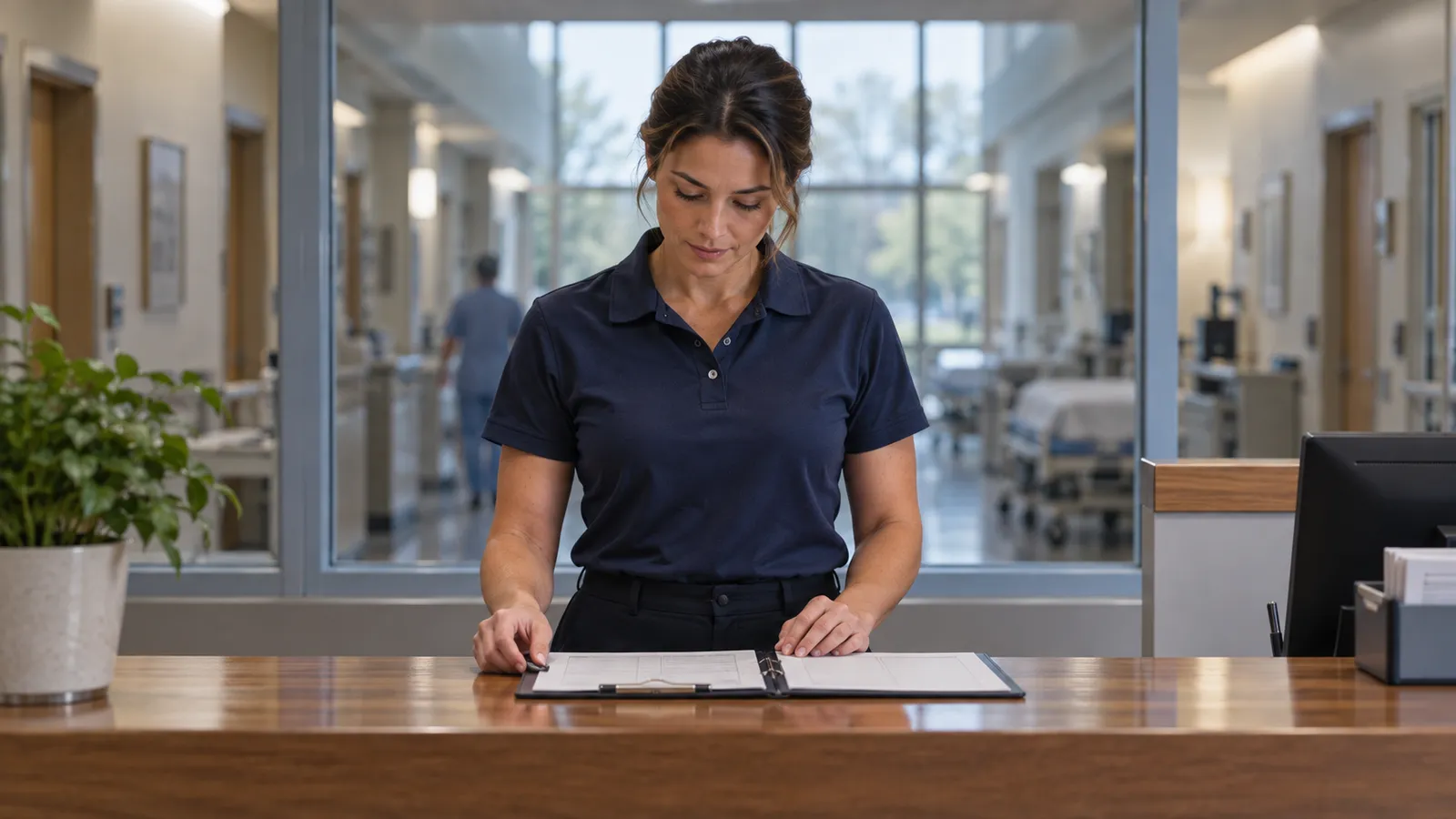
Charge Nurse Maeve sat behind the central station with her reading glasses in her gray hair, reviewing an electronic chart. When our footsteps approached, she looked up, her gaze shifting from Calvin to me with quiet clinical curiosity.
Calvin reached for the aluminum binder on the counter. He took the purple click-top pen from the ceramic cup.
On the line for Room 412, he wrote the date: 10/18/26. Under arrival time, he wrote 2:25 PM. In the visitor column, his left-slanted cursive flowed across the paper, the looped capital C anchoring his surname: Calvin Aldridge.
When his pen reached the column labeled Relationship to Patient, he did not write Family.
He wrote: Friend.
He set the pen down on the open page and turned to look at me.
I picked up the pen. Directly beneath his signature, on the next available line, I printed my own name in neat lettering: Vivian Aldridge. Under relationship, I wrote: PT / Friend.
Maeve watched my hand move across the paper. She did not say a word. She simply reached out with one finger, turned the binder toward herself, and gave us a small nod.
"Room 412," she said softly. "Her father arrived twenty minutes ago."
We walked side by side down the east corridor. Our footsteps were synchronized against the runner carpet, neither of us hurrying, neither of us hesitating.
The heavy oak door to Room 412 was propped wide open today.
Inside, afternoon sun flooded across the linoleum, warming the pale yellow walls and the tall window. Nadia Preston sat in her high-backed tilt chair, dressed in a fresh cream-colored sweater. Her foam headphones rested around her neck, and from the silver CD player on the stand, the opening allegro of a Telemann flute fantasia floated into the room, delicate and clear.
Sitting in the brown vinyl armchair beside the radiator was an older man in a faded tweed jacket with worn elbow patches. He was sixty or sixty-one, with thinning silver hair, deep lines around a weathered mouth, and broad shoulders rounded by physical labor. Between his boots sat an old green thermos.
When our shadows crossed the doorway, the man looked up from the folded sports section of the morning newspaper.
Calvin stopped three feet inside the threshold. His shoulders braced instinctively, as if preparing for an impact.
"Mr. Preston," Calvin said, his voice quiet but steady. "Good afternoon."
The older man folded his newspaper with deliberate slowness and set it on the windowsill. His dark eyes moved across Calvin's face, studying the tension in his jaw, before shifting to me.
"Calvin," the man said. His voice was a low, gravelly rumble, worn down by transit dispatch radios and hospital corridors.
Calvin took a breath. "This is my wife, Vivian. She's a pediatric physical therapist at Lakeside."
Russell Preston stood up from his chair. His knees made a faint creaking sound, but his movements had the unhurried dignity of a man who had weathered life's worst blow and remained standing. He extended a broad, calloused hand toward me.
"Pleasure to meet you, Vivian," he said, clasping my fingers in a firm grip.
"It's an honor to meet you, Mr. Preston," I said.
Russell looked back at Calvin, holding my husband's eyes for five long seconds. The silence in the room was filled only by the cascading trill of the solo flute.
"I'm glad you brought her, son," Russell said softly.
Calvin blinked. His chin jerked upward slightly in disbelief. "You... you knew?"
A faint, tired smile touched the corners of Russell's mouth. He sat back down in the vinyl armchair and picked up his thermos cup, turning it between his rough palms.
"I saw you at the preliminary hearing at the courthouse in December twenty-three, Calvin," Russell said quietly. "You were sitting in the back row with two broken ribs, holding your side, watching the troopers project the road temperature charts. You looked like a man who wanted the judge to sentence him to twenty years."
Calvin stared at him, his lips parted, unable to find words.
"When you started showing up here in May after Nadia was transferred," Russell continued, "Nurse Maeve asked if I wanted security to bar you from the floor. She thought you were a reporter or some stranger from the news."
Russell shook his head slowly.
"I told her to leave you be," Russell said. "I know what guilt looks like. I've seen men eat their own livers out from grief after a winter accident."
"You didn't cause that freeze on the bridge, Calvin," Russell added, looking toward his daughter. "Black ice doesn't ask for permission. But you came here anyway, week after week, bringing these recordings."
He pointed a blunt finger toward the CD player on the stand.
"Her mother, Maria, spent twenty years teaching Nadia how to breathe through the woodwinds," Russell whispered. "When Nadia was in the coma, the monitors would scream whenever a cart banged in the hall. But the first night you put that Mozart disc in the tray... her heart rate dropped ten beats in four minutes. Her breathing evened out. The brain damage took her speech, Calvin, but the music reaches places doctors can't touch."
Russell gestured toward two gray plastic visitor chairs stacked neatly against the closet door. "Pull up a seat. The kettle on the radiator is warm."
I walked over to the stack, lifted the top chair, and set it beside the window on the left side of Nadia's wheelchair. Calvin retrieved the second chair and placed it beside mine.
I looked at Nadia. Her profile was calm in the afternoon light. Her right arm lay in its padded volar splint on the tray, the fingers curled in a spastic flexion pattern common to trauma.
"May I?" I asked Russell softly, gesturing toward her arm.
"Please," Russell said, watching me with quiet respect.
I sat down and reached out, letting my warm fingertips rest along the dorsal surface of Nadia's right forearm. As a physical therapist, I did not force the limb open. Instead, I applied gentle, rhythmic myofascial pressure along the deep flexor tendons, using the slow circular technique that releases neuromuscular tone without pain.
Within sixty seconds, the defensive rigidity in Nadia's wrist began to soften. The tight clawing of her hand relaxed, her knuckles uncurling until her fingers rested open and flat against the padded tray.
Nadia's dark eyelashes fluttered. Her head turned three inches on the molded cervical rest, her gaze fixing on the yellow leaves outside the glass. On the blanket, her left fingers tapped three times in perfect synchronization with the flute cadence.
Calvin sat down in the plastic chair beside me. His hands rested on his knees, his shoulders dropping as the invisible iron bands that had bound his chest for three years finally loosened their hold.
I reached across the space between our chairs, took his right hand into mine, and laced our fingers together.
The grief was still in the room. It would always be in the room. Maria Preston was gone, Nadia's career on the concert stage would never be restored, and the bridge at Mile Marker 44 would remain a dark scar on the county map.
None of that could be undone.
But as the afternoon sun crept across the linoleum, warming our joined hands, Calvin was no longer sitting in the dark alone.
We sat together by the window, three chairs in a quiet circle, listening to the flute sing into the autumn afternoon.
The end