Family7 min read
The Birthday Cake Betrayal
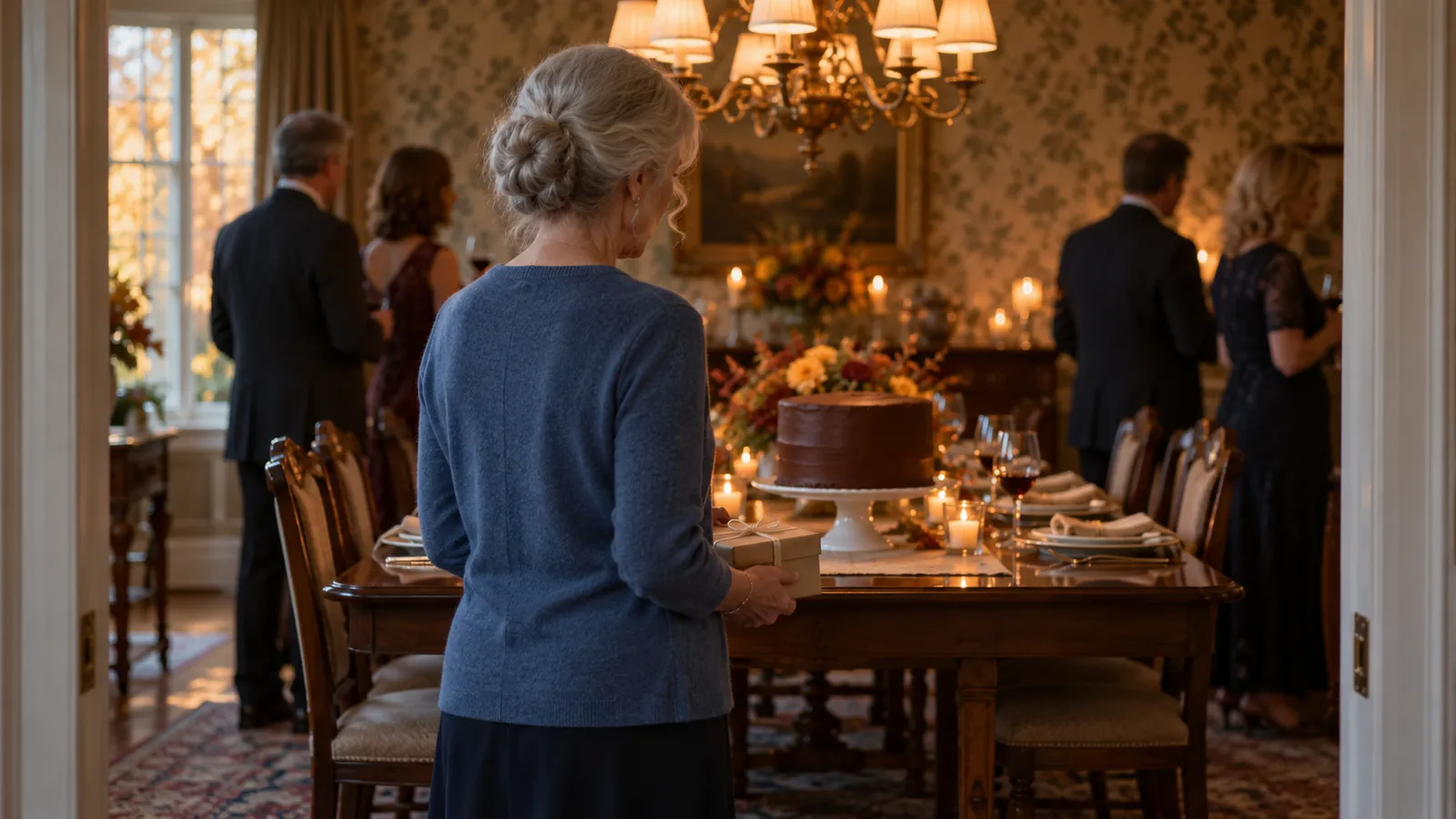
I walked into my own dining room on my sixty-seventh birthday and found my family singing happy birthday to another woman. The cake on the table was the one I baked that morning. I had already signed the papers.
Chapter 5: The Emptying
Jessica started packing on Sunday morning, the day after.
She was in the dining room by half past seven with a tape gun and a box of black markers, and she had the china cabinet half emptied before I got downstairs.
"I made coffee," she said. "Sit down. I've got this."
Inside an hour she had a system. Newspaper for the plates, bubble wrap for the stemware, the label written on the top and one side so you could read it in a stack.
She is good at it. It is what she did for a living.
That was the first stage and it lasted four days.
On Monday she wanted my agent's name.
"Not to fight," she said. "To understand the timeline. There's always a timeline."
I gave her the name. She wrote Vuong on the back of her hand.
On Tuesday it was the inspection. Buyers walk over inspections constantly, she said. A radon number, a roof, a panel not to code.
Wednesday she asked whether the Fletcher Street lease was month to month.
"It's a year," I said.
"Okay." She wrote that down too. "A year is nothing. People break leases every day of the week."
On Wednesday a truck pulled in and two men put a ladder against the back of the house and cleaned the gutters. Afterward there was a receipt on the counter with a maintenance plan stapled to it. First visit the fourth of November.
I looked at that receipt for a while.
She straightened as she went. In the upstairs hall she squared three boxes against the baseboard and turned them until every label faced out. In my bedroom she set the lamp back in the middle of the nightstand after I had moved it, and the nightstand was going to the church.
Twice she wrote DECIDE LATER on a box and carried it to the foot of the stairs instead of to the pile.
By Wednesday evening the dining room walls were bare gray and she had four boxes lined along the baseboard with two inches between them, even, the way you set a table.
Fifty-four boxes in the house. Thirty-eight years. I had expected more.
The key on the red ribbon lay on the sideboard until sometime Tuesday. Then it was gone and nobody said anything about it.
Michael came and went with loads. He carried, and on Monday in the kitchen he said, "Mom, look—" with his arms full, and then the box slid and he had to go.
On Thursday the sixteenth he took a load out to the storage unit on Olentangy and Jessica came and found me at the kitchen table with a folder of her own.
Not blue. Green.
"Sit with me," she said, and she laid three pages out and squared them to the edge of the table.
A letter from a credit union in Dublin, dated Tuesday the fourteenth. Pre-approved. Three hundred and forty thousand.
"And my mother is putting in sixty-five," she said. "That's not a loan, that's hers, from when she sold the condo. Four hundred and five thousand, Margaret. Twenty over the appraisal."
"The appraisal from April the eighth," I said.
Her hand went flat on the table.
"Howard Pike read it to me," I said. "On the twenty-third of September. All eleven pages, out loud. Then he asked me whether Michael knew."
She did not move for a moment. Then she went on, because she had come in here to go on.
"Close by the first of December. You keep your room and the sunroom for as long as you want them, and this time it goes in writing. A real attorney. A life estate, recorded." She turned the second page toward me. "I looked up the words."
They were written out in her hand at the top of the page, spelled correctly.
"Jessica," I said. "I signed on Friday the tenth."
"I know. That's six days."
"It closed. The funds moved that afternoon. Possession transfers on the fifteenth of November." I put my hands in my lap. "It isn't mine to sell."
"Everything has a window." She said it fast and reasonable. "Mutual release. You call Vuong, you say the seller changed her mind, you eat the earnest money and you pay her commission out of pocket. It's a Tuesday afternoon."
"It isn't a window. I don't own this house."
"You're sitting in it."
I brought the manila envelope back from the counter and set it in front of her.
She read it the way you read something you intend to find the flaw in. Settlement statement. Buyer's names. The recorded copy with the county stamp on the corner. Then she put one finger on the line with the date on it and left it there.
"The tenth," she said.
"Yes."
"You baked that cake on Saturday morning."
"I did."
"For my mother."
"No."
She looked up at me.
"For me," I said.
She set the pages down and squared them against the table edge with two fingers. I do not believe she knew she had done it.
Then she sat back and her hands stopped, and I had never once seen that.
"Did you ever once think about where we would go?" she asked.
I owed that an answer and I gave her the one I had.
"Once," I said. "In the parking lot afterward, for about as long as it takes to find your keys. I told myself you are thirty-five and he is forty and you both draw a paycheck. Then I stopped thinking about it, because I wanted to stop."
"That's all of it."
"That's all of it."
She nodded. She was not angry. That was worse than angry.
"When I was twenty-three," she said, and this time she kept going.
"My mother was living with a man in Hilliard. Three bedrooms. I had the back one. Fourteen months I was in that room, working the paint counter at a hardware store on Cemetery Road.
"I came home on a Thursday and there were six contractor bags on the driveway with my clothes in them. He had changed the front lock and not the back. So I came in the back, and my mother was at the kitchen table with her coffee, and she said, 'Jess, don't make it worse.'
"I slept in my car eleven nights. The lot behind a church on Trabue, because the lights stay on all night there. Then a woman from work rented me her basement room. Three hundred a month, cash, no paper. She could have put me out any Sunday she liked, and she knew it and I knew it, and it sat in the room with us for a year and a half.
"I kept my clothes in the trunk of the car that whole time. Not in a closet. In the trunk, in the bags."
She said all of it flatly, the way you read out a parts list.
"There was never one piece of paper anywhere with my name on it. Not a lease. Not a deed." She looked at the gray wall. "People think that year was about money. It was about whose name is on the paper."
"I was never going to live in a house again that I was not on the paper for. That's the whole thing. That's it."
Then: "You never asked me. Michael told you I had a bad year. That is what we call it at Thanksgiving."
The refrigerator cycled on behind me. I let it run.
"I'm sorry that happened to you," I said.
It was true, and it was not the size of what she had put down on the table, and I knew that while I was saying it.
I did not say I was sorry about the house.
She knew I hadn't. I meant her to know.
"You could have handed that folder back to me in June," she said. "You could have said no. I would have taken a no. I took one, remember. I put the pen away."
"You did."
"You let it sit in a drawer for three months and then you sold the house out from under all of us on a Friday."
I did not have anything for that.
She picked up her green folder and then set it down again, and her mouth did something I have no word for.
"Did Michael know?" she said. "What was actually in it. Because I gave it to him in the car before I brought it in to you, and he said it looked fine, he said he'd read it that night, and he never once asked me about the—"
She stopped.
She looked at the bare gray wall, and then at the hutch, which nobody had moved.
She did not finish it and she did not ask it again.
Michael's truck came up the driveway at ten past four.
End of chapter 5