Family6 min read
The Birthday Cake Betrayal
I walked into my own dining room on my sixty-seventh birthday and found my family singing happy birthday to another woman. The cake on the table was the one I baked that morning. I had already signed the papers.
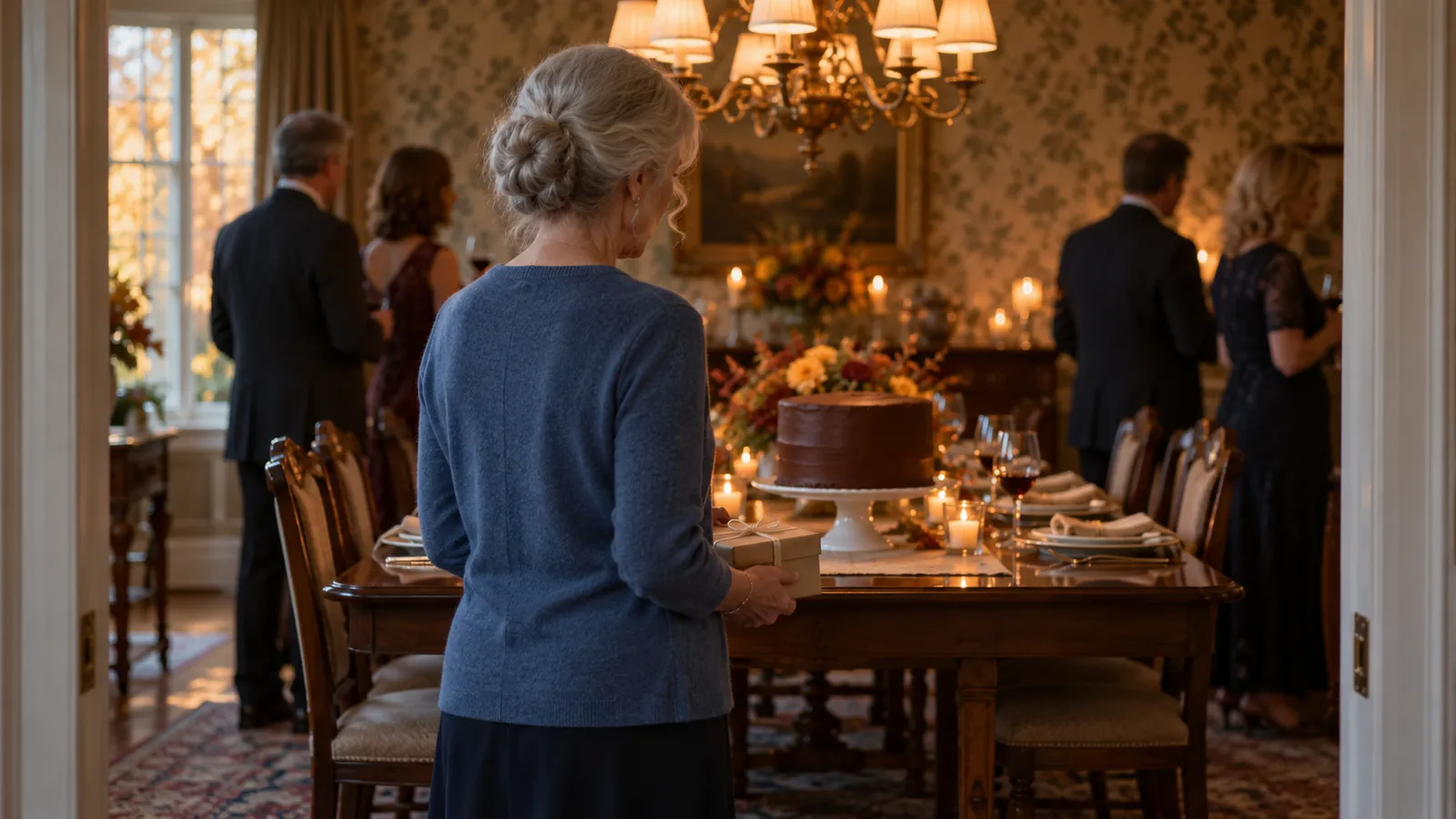
Chapter 6: Fletcher Street
He came up the outside stairs at ten past two on Saturday, the eighth of November, and knocked, even though the door was standing open four inches because I had been letting the paint smell out.
A grocery bag in one arm. A white shirt, on a Saturday.
"Hi, Mom."
"Come in."
He came in and then he stopped, because there is not far to come. The front room measures eleven feet by thirteen. He stood in the middle of it holding the bag and turned once, all the way around, the way a man turns in a room he is pricing.
"It's clean," he said.
"It is."
He looked for somewhere to put the bag down. There are eighteen inches of counter beside the sink and the dish rack takes nine of them. He held it a while longer and then set it on the floor against his shoe.
"Sit down," I said.
There are two chairs in that room. The green wing chair is under the window on the west wall, thirty-three inches across the arms in a space of forty-one. The other is a dining chair out of Harrow Lane, the one with the loose back leg, and it stands by the door.
He looked at the wing chair and sat down in the dining chair. I do not believe he decided anything. He got it right anyway.
I picked the bag up off the floor and went through it at the counter, because that is what you do with a bag.
A rotisserie chicken, still warm through the plastic. A half gallon of two percent. A box of the green tea with the lemongrass in it. Six apples in a red mesh sleeve, the big ones, the kind that go soft and sweet by Thursday.
"Thank you," I said.
I put the chicken in the refrigerator. The rest stayed in the bag on the counter, and it was still in the bag when he left.
"You could have told me," he said.
He had carried that up the stairs with him. It came out fast and it came out first.
"I could have," I said.
"That's it?"
"I could have told you. I didn't."
He waited for the part that comes after. There was no part that comes after. The radiator ticked twice behind him and he glanced at it as though it had interrupted.
"Mom, look—" he said. "Where are you even supposed to live? This is a one-bedroom over a parking lot. Is it safe? Does the street door lock?"
"The street door locks. There are four units. The woman below me grades papers at her kitchen window until eleven at night."
"You should have let me help. I'd have helped you find something."
"Something better than this."
"Yes."
"Better than this is eleven hundred a month and heat not included," I said. "I looked at four. This one has a radiator that works and a window that faces west."
He had an answer for that and did not use it. I noticed that he didn't. Then he went to the next one.
"She pushed this," he said. "You know Jess. She gets an idea and she runs it like a job and she does not hear no. I'm not making an excuse. I'm saying what it is."
He set it down in the middle of the room and waited to see whether I would pick it up.
"She brought me the folder in June," I said. "With a cup of tea."
"Right. Exactly."
"That is all I am going to say about Jessica."
I had been carrying a question since the twenty-third of September, since Howard Pike squared eleven pages on his kitchen table and asked me his.
"Michael. Did you read it?"
"Read what?"
"The folder. She gave it to you in the car before she brought it in to me."
He went still in a particular way, both hands flat on his knees.
"She did," he said.
"Did you read it?"
"I looked at it."
"How much of it?"
He took his time. I will give him that much. He did not make anything up.
"The tab," he said. "The tab said estate planning. I opened it in the car and it was a stack of pages and we were already late, and I said it looked fine, and I told her I'd read it that night."
"And that night?"
"I meant to."
"Did you ever read it?"
"No."
"Not in July. Not in September."
"No."
"Not after the eleventh of October."
He looked at the window. "No."
Eleven pages. Twenty minutes if you are a slow reader, and he is not a slow reader. He reads contracts for a living and tells people so at parties.
"It sat in my hall drawer from the fourteenth of June to the twenty-third of September," I said. "Under the tape measure. I walked past that drawer every day and I knew exactly where it was."
He raised his head.
"I did not want to know what was in it either," I said. "I had three months of not wanting to know. You had five. That is the arithmetic, and it does not come out in my favor by much."
"Then why are we—"
"Because I finally read it."
He put a hand over his mouth and took it away again.
"Tell me it's all right," he said. "Tell me we're all right, Mom."
That is my word. I said it about my chair in the sunroom in January with my coat on. I said it about the dining room. I said it three times in one July about apples.
"I am not going to say that."
"Mom—"
"I said that in that house for three and a half years and it was not true one single time. There is no use left in it."
He sat with his hands open.
"You are forty years old," I said. "You will be my son on the fifteenth of November and you will be my son in April, and I do not know yet what that comes with. That is what I have. I am not going to build you something better out of nothing so this afternoon goes down easier."
He nodded, slowly, the way a man nods at a figure he will have to carry back to somebody else.
Then his hand went to his pocket. He brought the phone out and turned it face up on his knee and looked down at it.
The screen was black. Nothing had come in. He looked at the black screen for four or five seconds, the way he has looked at it at my own table with people talking, and then he put it away.
That is the last thing I noticed about my son that day.
He stood and the loose leg knocked twice against the floor. At the door he stopped with his hand on it.
"Can I come back Saturday?"
I thought about it long enough to be uncomfortable for both of us, and I let it be uncomfortable.
"I'll be here Saturday at two," I said. "The door will be unlocked. I can promise you the door. I can't promise you I'll be glad, and I am not going to practice being glad before you get here."
"Okay," he said. "Okay."
He went down the outside stairs. I heard his truck start in the lot and I did not go to the window, and that took something.
Denise Vuong called on Thursday about a final walkthrough.
End of chapter 6