Family4 min read
The Empty Crib in the Attic
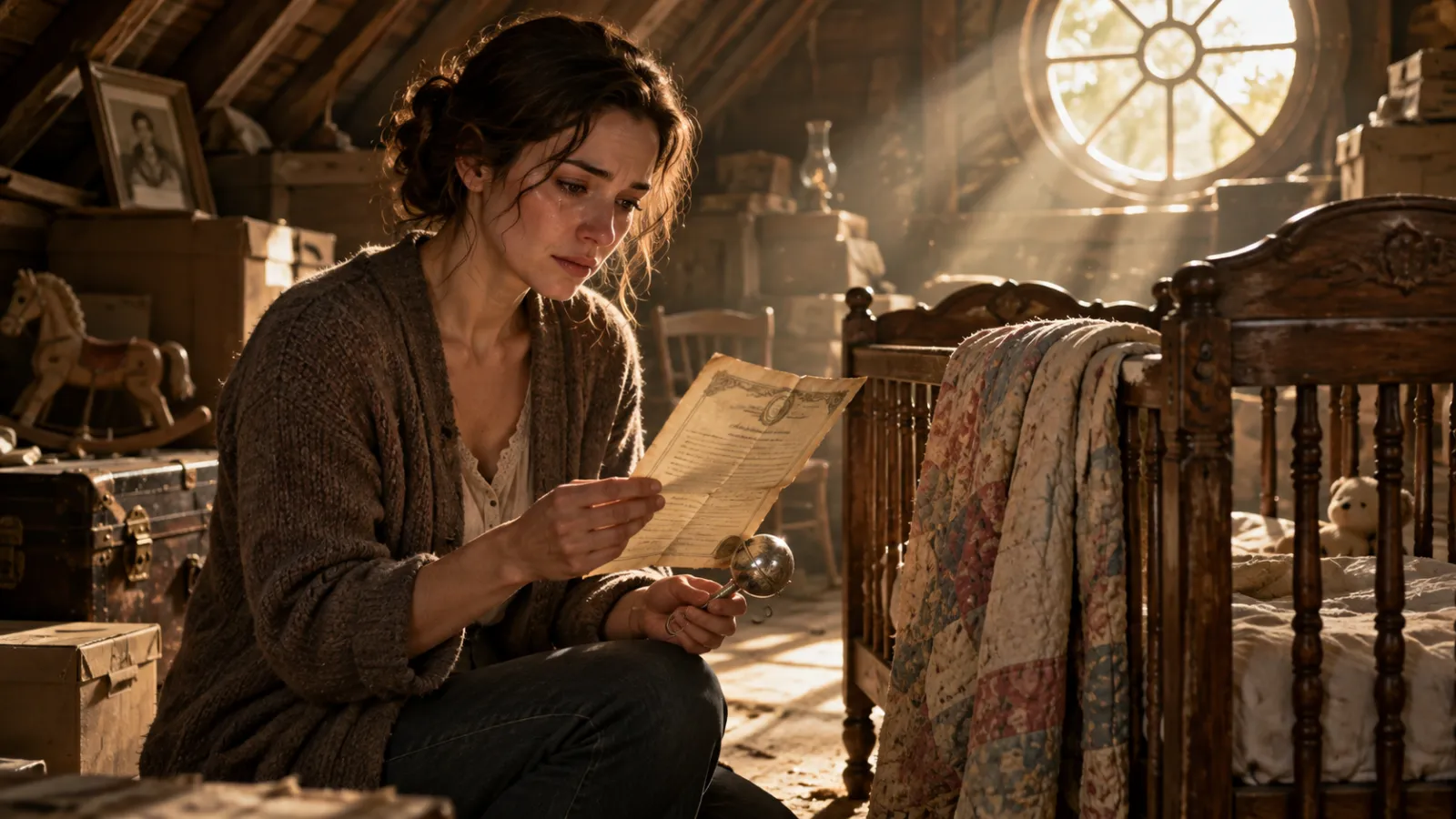
While clearing out her late mother's attic in Granville, Ohio, thirty-two-year-old Joanna discovers a padlocked oak crib containing an old birth certificate bearing her exact name—dated three years before she was born. Digging into the town's past reveals an unforgettable sacrifice.
Chapter 3: Whispers in Granville
The Granville Public Library stood at the corner of South Main Street, its tall sandstone steps flanked by blooming chrysanthemums in heavy stone urns. Inside, the quiet hum of the heating registers and the familiar smell of floor wax and aged cardstock offered a brief sense of order, though my pulse raced as we climbed to the local history room on the second floor.
Mrs. Gable, the reference librarian who had known Mom for forty years, adjusted her horn-rimmed glasses when Caleb asked for the microfiche reels covering the winter of 1994.
"December ninety-four," she said softly, her fingers pausing on the drawer handle. She glanced at me, her expression shifting from professional courtesy to something guarded and solemn. "That was the winter of the ice storms. The county lost power for nearly a week before Christmas. Take machine number three by the window, children. Let me know if the lamp needs adjusting."
Caleb carried the plastic cassette to the reader. The motor whirred as the film spooled across the glass plate, black-and-white negative images of grocery advertisements, high school basketball box scores, and town council notices flickering across the green-tinted screen. Caleb turned the manual dial slowly, advancing through early December.
Then he stopped.
"Right there," he whispered.
The front page of the Granville Sentinel for Thursday, December 22, 1994, filled the illuminated glass. Above the fold, a stark black headline spanned four columns:
Tragedy on Welsh Hills Road: Tenant Farmhouse Consumed in Midnight Blaze. Two Adults Perish; Four-Year-Old Child Dies After Rescuing Infant Sister.
My breath caught in my throat. I gripped the edge of the metal desk until the steel bit into my palms.
"Read it, Caleb," I said, unable to pull my eyes away from the grainy photograph of a charred stone chimney standing alone against a field of white snow.
Caleb leaned close to the screen, his voice low and steady as he read the reporter's words into the quiet alcove:
"In the early morning hours of Sunday, December 18, during a blinding blizzard that dumped ten inches of heavy snow across Licking County, a wood-stove chimney fire consumed the two-story tenant farmhouse leased by David Miller, 30, and his wife Sarah, 28. Volunteer firemen from Granville and Newark struggled through drifted country roads, arriving to find the wooden structure completely engulfed. Both David and Sarah Miller perished on the upper floor from smoke inhalation."
Caleb paused, swallowing hard before continuing.
"Firefighters discovered four-year-old Joanna Claire Miller lying in a snowdrift fifty yards from the burning porch. The young girl had suffered catastrophic smoke inhalation and third-degree burns, but beside her, shielded inside a heavy wool quilt and resting in a wooden bushel basket, volunteer rescue crews discovered an unnamed fourteen-month-old infant girl. The infant was hypothermic but alive. Dr. Arthur Henderson, who accompanied the volunteer response, transported the surviving infant directly to Licking County Memorial Hospital."
The room seemed to shrink. The whirring of the microfiche motor was the only sound left in the world.
I was not a stranger.
I had spent my entire adult life believing I was a child from somewhere else, an orphan adopted by Miriam and Thomas to fill their empty home. But the dates aligned with terrifying, beautiful clarity. October 14, 1993. Fourteen months old in December 1994.
The four-year-old girl who died in the snow was my biological older sister.
"Jo," Caleb said, his voice thick with emotion. He reached over and gripped both of my shoulders. "You weren't an adopted replacement. You were David and Sarah's second baby. You were the sister she saved."
Tears blurred the glowing screen. The singed baby bonnet in the attic had not belonged to a distant stranger. It had belonged to the little girl who walked through fire and snow to carry me out of a collapsing house.
"Why didn't Mom tell me?" I whispered, wiping my wet cheeks with the sleeve of my sweater. "Why did she lock the crib? Why did she keep the bonnet hidden in an empty box?"
"Because you were an infant," Caleb said gently. "And because surviving something like that leaves a mark that can crush a person if they aren't ready to carry it. Mom wanted you to grow up whole."
We rewound the reel, returned it to Mrs. Gable with quiet thanks, and walked out into the chilly afternoon air. We walked down South Main Street toward Prospect, our boots crunching against fallen sycamore leaves. Neither of us spoke until we stepped into the warm entryway of the Broadway Diner to catch our breath.
Behind the counter, Martha Higgins, who had served coffee in Granville for fifty years, wiped down the polished stainless steel counter. She looked up and gave us a warm, tired smile.
"Afternoon, Caleb. Afternoon, Joanna," Martha said, setting two glasses of ice water on paper napkins. Then she looked closely at my red eyes and the tension in Caleb's shoulders. Her smile softened into something tender and knowing.
"You kids look like you've seen a ghost," Martha murmured quietly, leaning over the counter. "Or did you finally open that old metal box in Miriam's cedar closet?"
"Martha," I said, my voice shaking. "Did you know about the fire on Welsh Hills Road?"
Martha sighed softly and folded her apron towel. "Everyone who lived in Granville in ninety-four knows about that night, honey. Your cousin David was a good boy, and little Joanna was the brightest child on the north ridge. When Miriam and Thomas took you in from the hospital, the whole town agreed to let Miriam raise you without people whispering on the street. Miriam wanted you to have a normal childhood, not be known as the miracle baby from the fire."
Martha touched my hand across the counter. "If you want the whole truth, Jo, go out to Newark Road. Dr. Henderson was the one who pulled you from that bushel basket. He's the only one left who saw it with his own eyes."
End of chapter 3