Family4 min read
The Empty Crib in the Attic
While clearing out her late mother's attic in Granville, Ohio, thirty-two-year-old Joanna discovers a padlocked oak crib containing an old birth certificate bearing her exact name—dated three years before she was born. Digging into the town's past reveals an unforgettable sacrifice.
Chapter 6: Carrying Her Name
Sunday morning arrived with a clear, pale blue sky and a crisp wind that swept the last golden leaves from the sugar maples along Broadway. The village bells of the Presbyterian church tolled ten o'clock as Caleb and I drove up the winding cemetery lane toward the southern crest of Sugarloaf Park.
The old burial ground sat on a high ridge overlooking Granville, surrounded by a border of towering white pines whose needles carpeted the slope in fragrant rust-colored mulch. In the valley below, the white church spires and brick rooftops of the village looked peaceful in the morning light.
We walked along the second terrace until we found the row of gray granite markers shaded by a pair of Austrian pines. Three stones stood together in the grass: David Miller, Sarah Miller, and between them, a smaller headstone carved with a simple wild rose along the upper border.
I knelt in the damp clover and read the inscription carved into the granite:
Joanna Claire Miller October 14, 1990 – December 18, 1994 Beloved daughter and guardian sister. Love never faileth.
I laid a spray of white freesia and fresh cedar boughs across the base of the stone. My hands were steady now. The knot of fear that had twisted in my stomach since yesterday morning was gone, replaced by a deep and quiet reverence that filled the cold autumn air.
"Thank you, Joanna," I whispered, resting my palm against the cool, polished stone. "I have your name, and I have your days. I promise I will live them well."
Caleb knelt beside me and gently placed a smooth river stone from Mom's classroom jar on top of the marker. "She would be proud of you, Jo. Every child you help walk at the hospital carries a little piece of what she gave you that night."
We stayed on the ridge for a long time, listening to the wind sigh through the high pine branches. When we finally stood up and walked back to the truck, the village below felt different to me. It was no longer just the town where I had grown up as an adopted daughter. It was the valley where an extraordinary four-year-old girl had walked through a winter storm so that I could live to see thirty-two autumns.
That afternoon, Caleb and I climbed back into Mom's attic on Maple Street.
Together, we carried the quarter-sawn oak crib down the narrow staircase, maneuvering the heavy posts through the doorways and out to the bed of Caleb's pickup truck. We drove down to his cabinet shop on Burg Street, where the scent of cedar shavings, beeswax, and mineral spirits always brought an instant sense of calm.
We set the crib on two sturdy sawhorses in the center of the workshop. For three hours, we worked side by side in companionable silence. Caleb handed me fine-grit sandpaper, and I carefully smoothed the minor scuffs left where the iron chain had pressed against the top rail for thirty years. Caleb checked every mortise-and-tenon joint, tightening two small walnut dowels at the corner posts so the drop-side gate moved as smoothly as silk.
When the wood was clean, we dipped soft flannel rags into a tin of warm linseed oil and amber paste wax. As we rubbed the oil into the dry oak, the wood drank it eagerly. The grain woke up beneath our fingers, revealing the rich, glowing honey tones of the quarter-sawn timber. Every spindle gleamed in the late afternoon sun streaming through the shop windows.
"Look at that," Caleb said softly, wiping his brow with the back of his forearm. "It was never meant to be hidden in the dark."
"No," I agreed, running my fingertips along the smooth, oiled railing. "It was meant to hold life."
We carried the crib back to the house on Maple Street before sunset. We did not take it back up the attic stairs. Instead, we set it in the corner of the downstairs parlor beside the south-facing bay window, right where the warm morning light would strike it first thing every day.
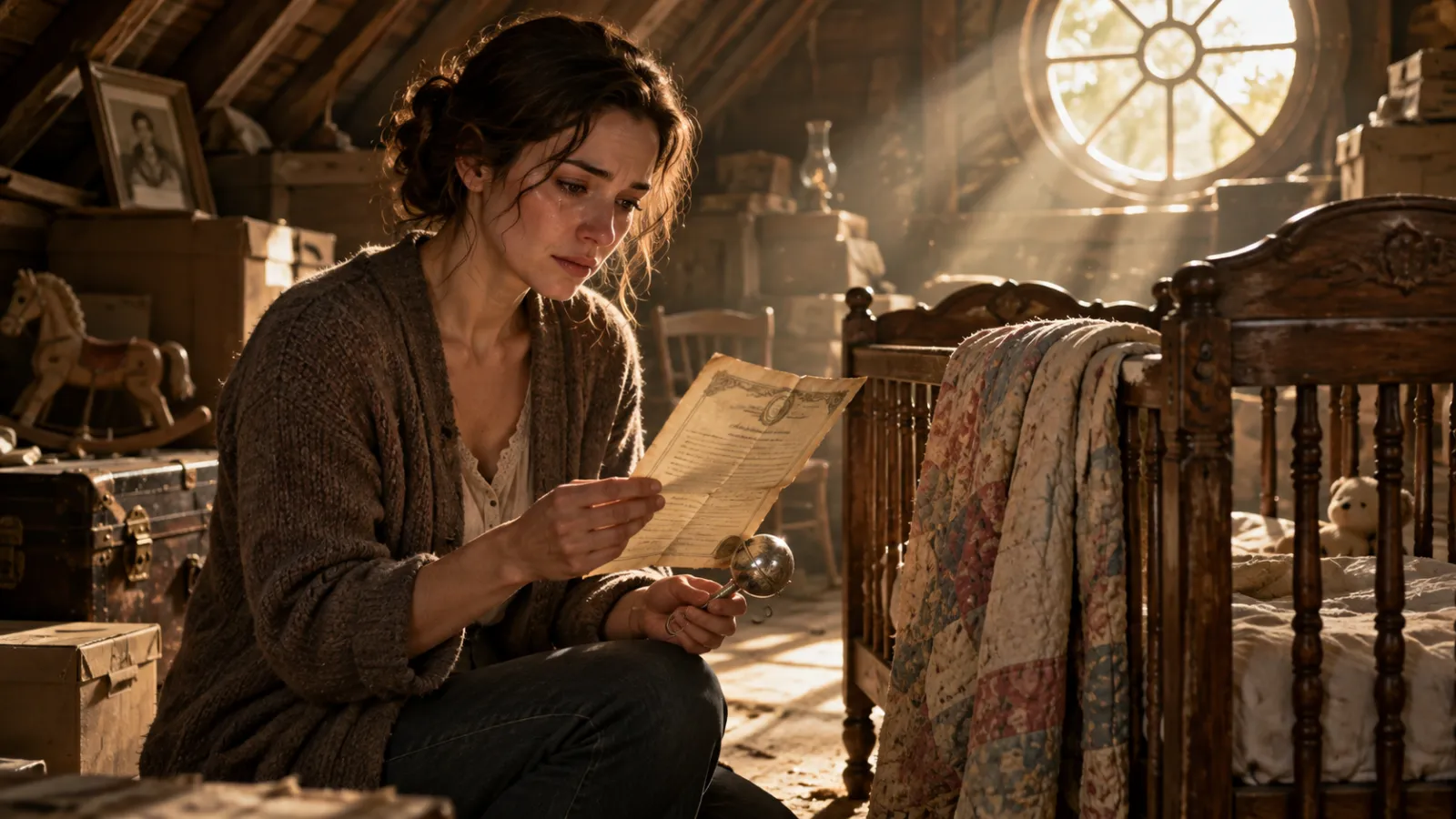
Inside the crib, on the bare slatted support, I placed a clean runner of ivory linen sewn by Mom's own hands. At the center of the runner, I set the polished sterling silver rattle, its engraved initials shining brightly in the lamplight.
Beside the crib, on the small cherry side table, I placed a wooden frame. Inside the frame, behind protective museum glass, was the scorched baby bonnet, its charred lace preserved alongside the letter Mom had written in green ink thirty years ago.
I stood by the parlor window as evening fell across Granville, watching the streetlamps flicker to life along Maple Street. There was no padlock on the oak crib anymore. The iron chains were gone, discarded in the metal recycling bin behind Caleb's shop.
I was Joanna Claire Miller. I was the baby in the snow, the daughter raised by Miriam's patient hands, and the sister who had been given the greatest gift one human being could offer another. I smoothed the lapels of my coat, turned off the parlor lamp, and stepped into the kitchen with my brother, knowing that the name I carried was a promise I would keep for the rest of my life.
The end