Mystery5 min read
The Obituary That Ran a Week Early
My mother's obituary ran a week before she died. No funeral home placed it, it was paid in cash weeks early, and it ended with a sentence only she and I ever used. I traced who filed it — and found the answer was a question she had run out of other ways to ask.
Chapter 1: Tuesday's Paper
My mother's obituary ran on a Tuesday. She died the following Monday.
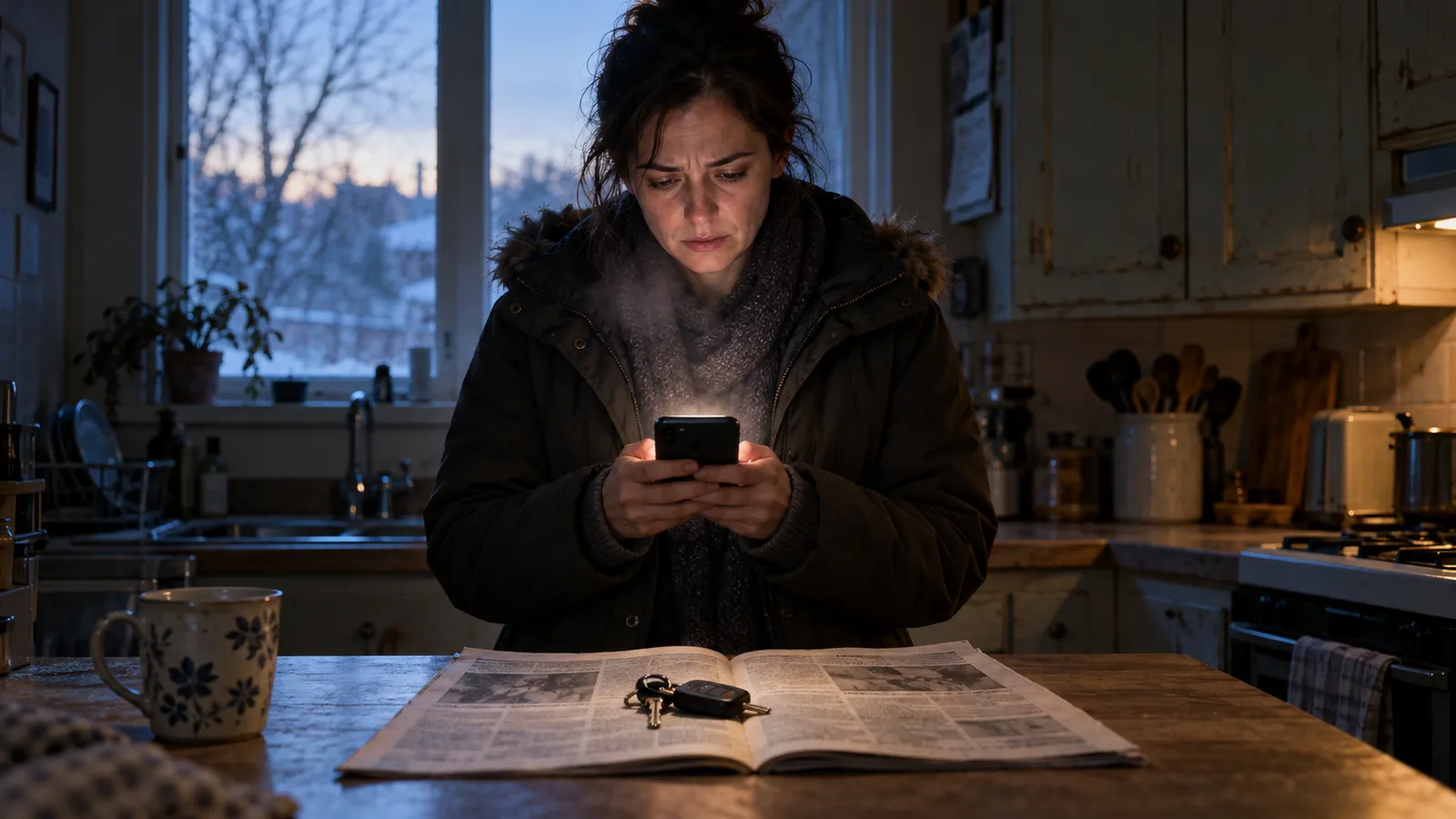
I read it on Wednesday morning, in my kitchen in Ashfield with my coat already on, because I had never gotten out of the habit of opening the Hartsboro Beacon before work. Four ninety-nine a month, paid every month since the spring of 2022, and I had never told anyone, including her.
The obituaries ran Tuesdays and Fridays. I read them the way other people check the weather.
SINCLAIR, Margaret Ann, 74, of Hartsboro, died Sunday at her home on Lennox Street. She was born in Perry County and worked thirty-nine years in the payroll office of the Hartsboro City Schools. She was preceded in death by her husband, Walter. She is survived by her son, Dale, of Hartsboro, and her daughter, Nora Jean. No services are planned at this time. She asked that the porch light be left on.
I read it four times. The fourth time, only the last sentence.
Nobody said that but us. When I was in high school and worked the closing shift at the pretzel counter in the mall, she left the kitchen dark and the porch light burning, and that was the whole conversation we had about it for three years. Leave the porch light on. I had never heard my brother say it in his life.
I sat down on the kitchen floor with my coat on and my keys in my hand.
Something else was wrong with it, and it took me a minute to find, because the thing was so short. Every obituary in that paper ended the same way. Arrangements by Riverbend Funeral Home. Arrangements by Keller & Sons. It was practically the paper's punctuation.
Hers had no arrangements line at all.
I called the house.
I had not dialed that number in four years and my thumb knew it anyway. It rang five times. I was composing the thing I would say to Dale, something about how he could have called me, something with enough acid in it to cover what was underneath, and then the ringing stopped and my mother said, "Sinclair residence."
Her voice. Thinner at the top than I remembered, a little wind in it, but hers.
I did not say anything.
"Hello," she said. "Is somebody there?"
"Mom."
A pause. A television somewhere behind her, and under that a low mechanical sigh, in and out, like a slow bellows.
"Nora," she said.
"You're alive."
"Of course I'm alive."
"The paper says you died on Sunday."
Another pause, longer. When she spoke again her voice had gone careful in a way I remembered from my whole childhood, the voice she used when the bank called.
"Who told you to call?"
That was not the question. That was nowhere near the question. I stood up off the floor.
"Nobody told me to call. I read it. It's in Tuesday's paper, Mom, it's in the Beacon, it has your middle name in it. It says you died at home."
"Papers make mistakes."
"It's not a mistake, it's a paid notice. Somebody wrote it."
"Then they'll fix it." The television got louder, then softer; she had changed channels or moved the phone. "It's twenty-two degrees here. They salted Lennox so heavy you can taste it."
"Mom."
"I have to go, Nora. I have a girl coming to do my hair."
"On a Wednesday?"
"She comes Wednesdays."
"Somebody put your death in the newspaper and you have to go do your hair."
"I'm tired," she said, and that was true; I could hear that it was true. "You sound the same."
Then she hung up on me.
I stood there with the phone against my ear for a while. The slow bellows sound stayed in my head. I did not know yet what it was, and I would not have admitted I was afraid to.
I called Dale.
It went to voicemail, which is what Dale's phone did. His recorded voice gave the name of his company and the hours they answered the shop line. "It's Nora," I said. "Call me about Mom. Call me today." I hung up before I could give him a reason not to.
Then I did the thing I actually knew how to do.
I audit hospital bills for a living. Eleven years. You learn that nobody lies on purpose as often as they lie by process. A wrong number in a column got there because somebody typed it, somebody approved it, and nobody read it. You stop asking people what happened and start asking who entered it.
Somebody had entered my mother's death.
At nine o'clock I called the Beacon. A recording offered me circulation, advertising, news tips, and obituaries. I pressed four.
"Obituaries, this is Esther."
"My name is Nora Sinclair. There's an obituary in yesterday's paper for Margaret Ann Sinclair of Lennox Street."
"Yes," she said. Not let me look. Just yes.
"She's my mother. I spoke to her forty minutes ago."
The line went quiet. Not the quiet of someone confused. The quiet of someone sitting down.
"Say that again, please," she said.
"My mother is alive. I called the house. She answered the phone. The notice says she died Sunday."
"Spell the last name for me."
"S-i-n-c-l-a-i-r. Margaret Ann. Seventy-four."
I heard paper. Not keys — paper, the flat shuffle of a stack being gone through by hand.
"I have it," Esther said. "I set that notice myself."
"Then I need to know who gave it to you."
"Ms. Sinclair," she said slowly, "I'm going to ask you to come in."
"I'm two hundred and ninety miles away."
"I understand. I'd still rather you came in, because what I can tell you over a telephone and what I can show you across a counter are two different amounts." A pause. "I've had this desk thirty-one years. I have never run one early."
I was already pulling my coat straight. "Who filed it?"
"That's the part I can't say on the phone," she said. "We're on the second floor above the old pharmacy on Market. I'm here at eight."
I left Ashfield at eleven that night with a thermos and a printout of my mother's obituary on the passenger seat, and the only thing I was sure of was that somewhere in that building there was a piece of paper with a name on it.
End of chapter 1