Mystery6 min read
The Obituary That Ran a Week Early
My mother's obituary ran a week before she died. No funeral home placed it, it was paid in cash weeks early, and it ended with a sentence only she and I ever used. I traced who filed it — and found the answer was a question she had run out of other ways to ask.
Chapter 2: The Obituary Desk
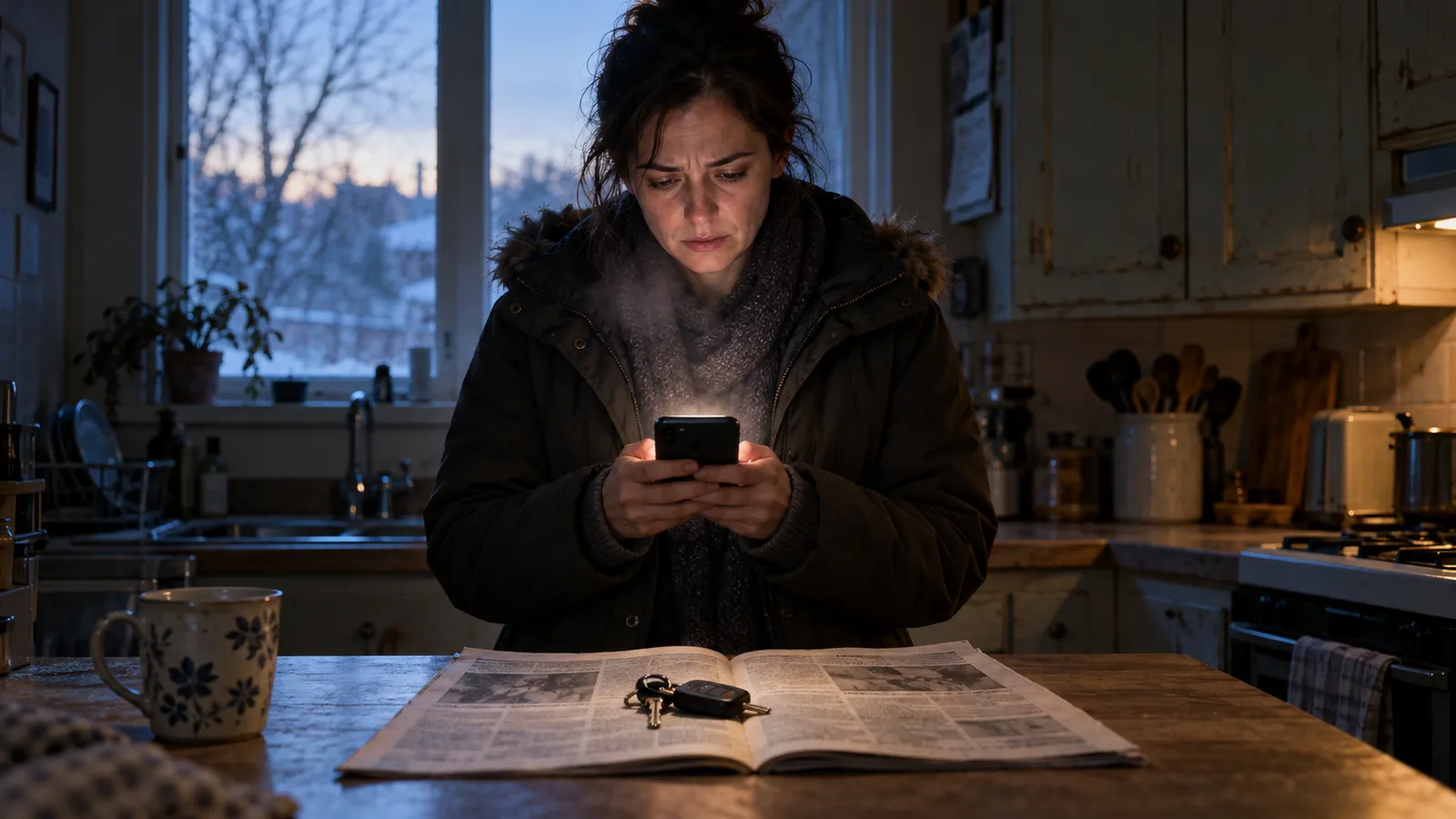
The Beacon's office was on the second floor above a pharmacy that had been closed so long the window decals had gone the color of weak tea. I got there at seven forty and sat in the car until the lights came on upstairs.
I had driven five and a half hours through wet snow and I had spent most of it building a case.
Here is what I had: a notice nobody would write by accident, with a sentence in it that belonged to me. Here is what I wanted: a name I could hold.
The stairwell smelled like radiator dust. At the top, a glass door said BUSINESS OFFICE, and behind it a woman in a gray cardigan was taking the cover off a laser printer. She had a red grease pencil behind her ear.
"Ms. Sinclair," she said, before I said anything. "You drove."
"I drove."
"Esther Davenport." She did not offer her hand right away, and when she did, she held mine a second longer than the handshake needed. "I'm sorry for the shock of it. Coffee's bad. There's a chair."
The office was one long room with four desks and three of them empty. Hers had a wire rack of stacked forms, a stapler with a strip of masking tape on it that said OBITS, and a metal file drawer with the sliding label holder worn silver.
"Before you ask me again," she said, sitting down, "I want you to understand what kind of desk this is, because it'll save us both an hour."
"I'd rather have the name."
"I know you would." She folded her hands. "Two kinds of death notices come to me. The first kind comes from a funeral home. They send me a form over their account, I set it, I bill the home, and at the bottom I put Arrangements by and the home's name. That's most of them. That's nine out of ten."
"Hers doesn't have that line."
"No, it doesn't." Esther nodded slowly, like I had passed something. "Most people never notice that line in their life. The second kind is family-placed. A person walks up to that counter with a death in the family and no funeral home involved yet, or no funeral home at all, and they fill out a slip, and they pay at submission. Cash or card, right then. We don't bill a private party."
"How much?"
"Depends on the length. Hers was one hundred eighty-six dollars."
"Paid when?"
"At submission."
"Which was when?"
And there it was: the first thing she would not hand me. She looked at the window for a second.
"Weeks ago," she said.
I sat forward. "Weeks."
"Yes."
"My mother was alive weeks ago. My mother is alive right now."
"I'm aware of that, Ms. Sinclair. I've been aware of it since nine twelve yesterday morning, and I'd like you to know I have not had a comfortable night either." Her voice stayed level the whole way through. "There's a field on the slip for a requested publication date. We added it years ago for out-of-town deaths, where a family wants the notice to run the same week as the service back home. Somebody fills in the date, the slip goes in that drawer, and on the morning of that date I set it and it runs."
"So somebody wrote a date in a box and you printed my mother dead."
"Somebody wrote a date in a box and I printed exactly what I was given, which is the only promise this desk makes." She let that sit. "We verify funeral-home notices against the home. We do not verify a family-placed notice against a death certificate. Thirty-one years, and I've never needed to. I'll be telling my publisher that this week, and he's going to want to know why I don't, and I'm not going to have a good answer."
"Then help me."
"I'm trying to."
"Who filed it?"
"I can't tell you that."
"It's my mother."
"It's a submitter's name on a document in a case where the subject of the notice is alive." She said it without heat, like reciting the only line that applied. "That means the woman on Lennox Street has an interest in this, and she is not you, and she has not told me what she wants. If I hand you a name across this counter and you drive to somebody's house with it, I have made this desk into a rumor mill. I won't."
"You printed that my mother is dead."
"Yes. And I'm going to correct it." She pulled a form out of the wire rack and uncapped the grease pencil. "I can run a withdrawal. Friday's paper, same page, no charge. The notice published March 10 for Margaret Ann Sinclair was submitted in error and is withdrawn. The Beacon regrets the error. I'd like your permission as family, since I can't get it from a submitter I'm not willing to discuss."
"Why would you need my permission to unprint something that isn't true?"
"I don't, strictly," she said. "I'd rather have it."
So I gave it to her, and I want to be honest about that, because of what came after. I told a woman to put a correction in a newspaper and I never once asked who it would reach, or what it would end.
"Can you tell me anything?"
Esther capped the pencil. "I can tell you three things, and I've thought about which three." She held up a finger. "It was family-placed. No funeral home touched it." A second finger. "It was paid in full at submission, in cash." A third. "It was filled out by hand, here, at that counter, by a person who stood where you're standing."
Cash. I turned that over. Cash is what you use when you don't want a card statement with a newspaper's name on it. Cash is local. Cash is somebody who can walk up a flight of stairs on Market Street on a weekday.
Dale lived twenty minutes from my mother's house. Dale, who had not returned my call.
I was already most of the way to a story, and the thing about a story is that it eats evidence. I had an explanation for the porch light by the time I reached the stairwell — she must have said it to him once, she must have said it to everybody, how would I know what she said in four years.
"One more," Esther said, as I got to the door.
I turned around.
She had the drawer open. Not far. She was looking down into it, at a stack of slips on edge, and she had the grease pencil pressed against her bottom lip.
"The handwriting on that slip crosses its sevens," she said. "Through the stem, like a European would. I notice because I set type off these by hand and a crossed seven is a thing you see maybe twice a year."
"Why does that matter?"
"I don't know yet that it does," she said. "But you asked me who stood at that counter, and that's the only thing about them I'm free to tell you."
I went down the stairs into the salt and the gray light with that in my hand like a coin I could not spend. Dale printed in square capitals, the way a man fills out a work order. Dale had never crossed anything in his life.
Whoever stood at that counter had kept a ledger for a living.
I knew exactly one person like that. I had spoken to her the previous morning. And instead of saying her name out loud in that stairwell, I got in the car and drove to my brother's house.
End of chapter 2