Mystery6 min read
Seat 14B Was Always Empty
A transit manager sent to shut down a failing commuter line finds one rider who has bought two tickets for the same early train for nine years. He assumes fraud. The answer is in a nine-year-old memo signed by his own boss.
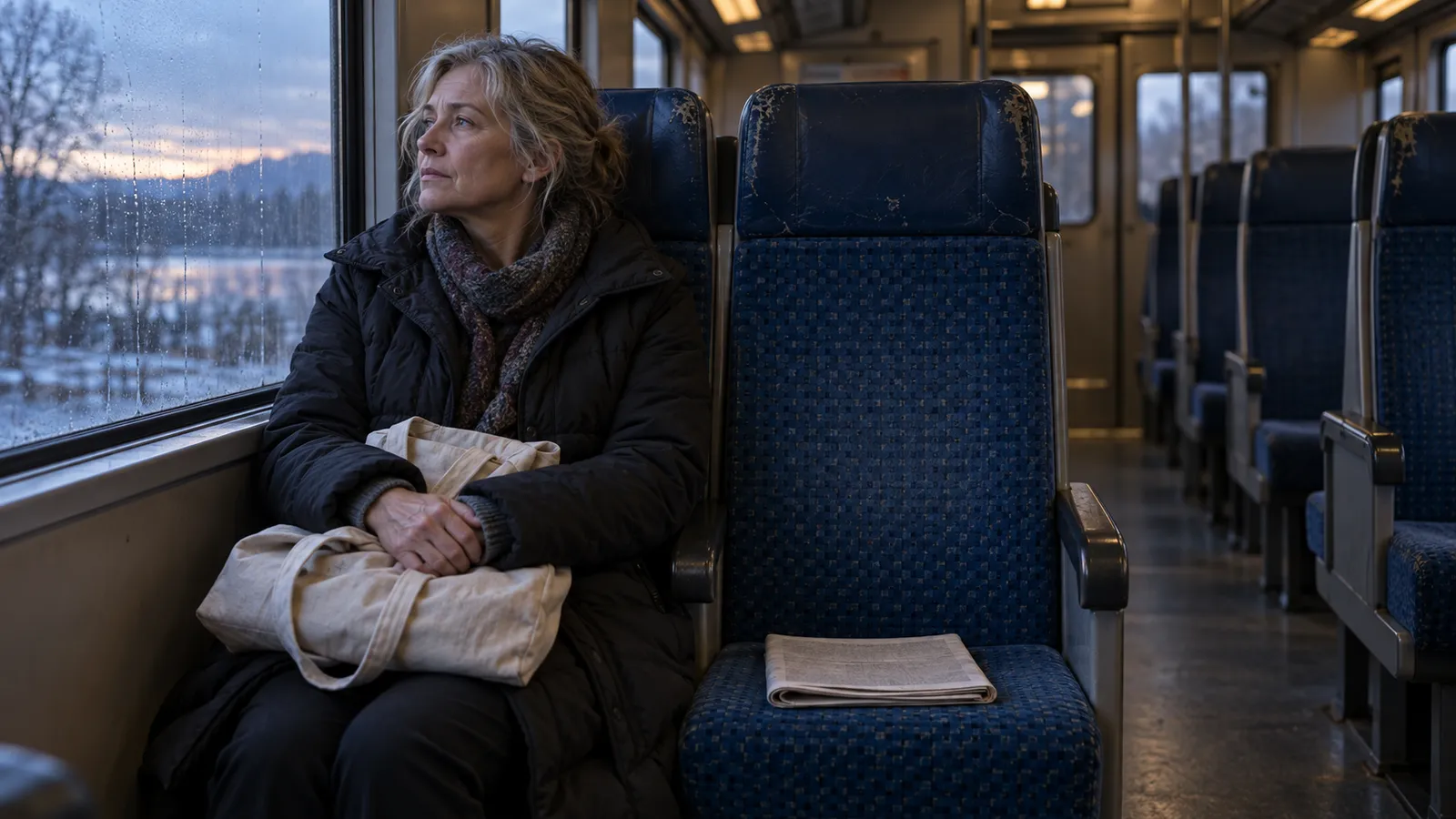
Chapter 2: Door Three
The North Vale platform at five fifty-five in the morning in late October is a concrete slab with four light poles and a shelter with one bench in it, and the frost comes up through the soles of your shoes.
I parked at the far end of the lot in my own car and wore my own coat, a gray thing with a torn pocket lining, because an authority jacket on that platform would have been the same as shouting.
I had my tally counter in my left hand. It is a chrome mechanical clicker with a thumb lever, and I have carried one since 2004, when I learned that the automatic passenger counters miss anyone who boards behind a stroller. Two hundred thousand clicks, maybe. It is the only tool I have ever fully trusted.
She came at 6:02.
Dark quilted coat, flat shoes, a canvas tote with a hospital logo faded almost out of it. Fifty-eight looked like fifty-eight on her: tired in the way that is work and not sorrow. She did not hurry and she did not look at the board, because she knew what the board said.
At the validator she stopped and held her card against the reader.
Beep.
She did not move her hand. She waited for the display to clear, four seconds, maybe five, and held the card against the reader again.
Beep.
Then she put the card in her coat pocket and walked up the platform. Nobody turned around. The man with the thermos did not look up. The two nurses from the second shift kept talking. In nine years, apparently, not one person on that platform had ever found it strange, which told me something I did not have a word for yet.
I clicked the counter. Twenty-one boardings. One of them was her.
She walked past the first set of doors on car two and the second set, and she boarded at the third, the one at the rear vestibule, and I understood that she had been boarding at that door long enough that her feet did it without her.
I let a woman with a backpack go ahead of me and went in after her.
Car two of a Vale Line set is forty-eight seats in pairs, high-backed, blue, the fabric worn pale at the headrests. She went eleven rows down on the right and sat in 14A, the window seat.
Then she took a folded newspaper out of her tote. The free commuter paper, the one they still stack in a wire rack at Ardmore Street. She folded it once more, into quarters, printed side down, and she laid it on the seat beside her.
14B.
She did not put her tote there. She did not put her tote in 14B for thirty-one miles. She held it on her lap the whole way with both hands on the handles, and the folded paper lay on the empty seat beside her like something set down at a table for a person who was coming back.
At Mill Crossing a teenager in a hoodie started to drop into 14B and she said, "That one's taken," without any heat at all, and he moved one row up, and that was the end of it.
I sat four rows behind her with the tally counter in my fist and watched a woman protect an empty seat for an hour.
The conductor came through at Quarry Road. Ray, eighteen years on the line, a man who checks tickets the way other people breathe. He scanned the teenager. He scanned the two nurses. He reached Adele Whitaker and he said, "Morning," and he scanned nothing at all, and he kept walking.
I followed him up to the vestibule.
"Ray. Row fourteen on the right."
"Mrs. Whitaker."
"You didn't scan her."
He looked at me then, properly, and something closed in his face. "Her card's good."
"She deducts two fares. Every morning. I need the second one accounted for."
"Then account for it," Ray said. "I've been told not to ask her about it since before I had this run."
"Told by who?"
"Whoever told the man before me." He pulled the door release and looked out at Quarry Road going by, the cold-storage warehouses and the chain-link and the long unshouldered bend where Route 9 climbs. "Peter. Don't."
Twenty-two years, and I had built a career on the idea that don't is not an answer a public agency gets to give.
I waited until Ardmore Street and I did it on the platform, which was the worst possible place, and I knew it while I was doing it.
She came down the steps and I said, "Mrs. Whitaker? Peter Hensley, operations, Vale Line." And then, because I had a clipboard under my arm, I took the clipboard out from under my arm.
Everything in her went flat. Not frightened. Flat, the way a shop goes dark.
"Your card deducts two adult fares every weekday morning," I said. "It has for nine years. There's no companion registration and no second rider. I have to ask you what the second fare is for."
She looked at the clipboard. "Is it short?"
"Is what short?"
"The money. Am I short."
"No, ma'am. You've overpaid the authority eight thousand and fifty-five dollars."
"Then it's paid," she said. "I'm late."
"That isn't how a fare works. A fare is a ticket for a journey, and if there's no second journey, then there's a reason you're buying one, and I need it on paper."
"No, you don't," she said. And then, with absolutely no edge in it, which is what made it land: "You need it for Thursday."
She knew the agenda. Of course she knew the agenda; discontinuance notices are published and she had read one before. She went through the gate and up into the concourse and did not look back, and I stood there with a clipboard in my hand like a man holding a hat.
At two that afternoon I filed a revenue-protection referral on card 7732. Unexplained recurring duplicate deduction, no companion authority, requesting account review.
I wrote it in four minutes. I told myself it was the clean thing: you cannot audit a line and leave a nine-year anomaly undocumented, and a referral is a question, not a finding.
A referral is not a question. Revenue protection suspends a registered card within twenty-four hours of a referral, pending interview. I knew that. I have known that since I helped write the procedure in 2015.
I went back out to the depot that night because the Thursday package still wasn't written and my office is quieter at eleven.
Gus was on the shop floor with the overnight crew, in the pit under car two with a drop light, seventy-one years old and still doing four nights a week because his pension is what pensions are. He cleaned those cars for thirty years before that. He has a brass luggage tag wired to his belt loop and he writes on a work order like he is carving it.
"You filed on Mrs. Whitaker," he said, from under the car.
Nothing moves faster than a depot.
"I filed on a card number."
"Mm."
He came out from under the car, slow, hand on the frame, and he did not argue with me. He walked to the parts desk, put on his glasses, and went through the clipboard of closed work orders hanging on its nail, and he pulled one out and held it where the light was.
Block capitals, pressed hard enough to go through to the second sheet.
RETAIN SEAT SHELL 14B — DO NOT SCRAP — PER NOTICE 07-14 FILE.
"That's mine," Gus said. "Two thousand nineteen. Done it again in twenty-three."
"What's Notice 07-14?"
"It's a service change notice."
"For what?"
He put the work order back on the nail and squared it with his thumb.
"Records room," he said. "Ardmore Street, basement, nineteen-ninety boxes on the north wall. Read 07-14 before you read anything else you write."
End of chapter 2