Mystery7 min read
Seat 14B Was Always Empty
A transit manager sent to shut down a failing commuter line finds one rider who has bought two tickets for the same early train for nine years. He assumes fraud. The answer is in a nine-year-old memo signed by his own boss.
Chapter 4: The Same Sentence
The notice tells you where to go. I wrote that line too: present photo identification at the Ardmore Street customer office.
So on Thursday I was inside that office at seven fifteen, four minutes before the 6:10 gets in, and she came through the door at twenty past with the printout in both hands.
"I paid cash this morning," she said. "Two tickets." She held up the receipt. Two adult singles, 5:58 a.m., $8.50.
"I know. I'm sorry."
"I have eleven minutes."
I went behind the counter and lifted the suspension myself, which took forty seconds, and turned the screen so she could see the word ACTIVE on it.
"That's done. It was my referral, and it was wrong. I've noted that the account has been in good standing for nine years."
She looked at the screen a while. "You went to the records room. Gus told you to."
"Yes." I pulled a chair out from the wall. "I'd rather hear it from you than a county engineer's letter."
She sat down. Not because I had earned it, but because she had been standing since quarter past five.
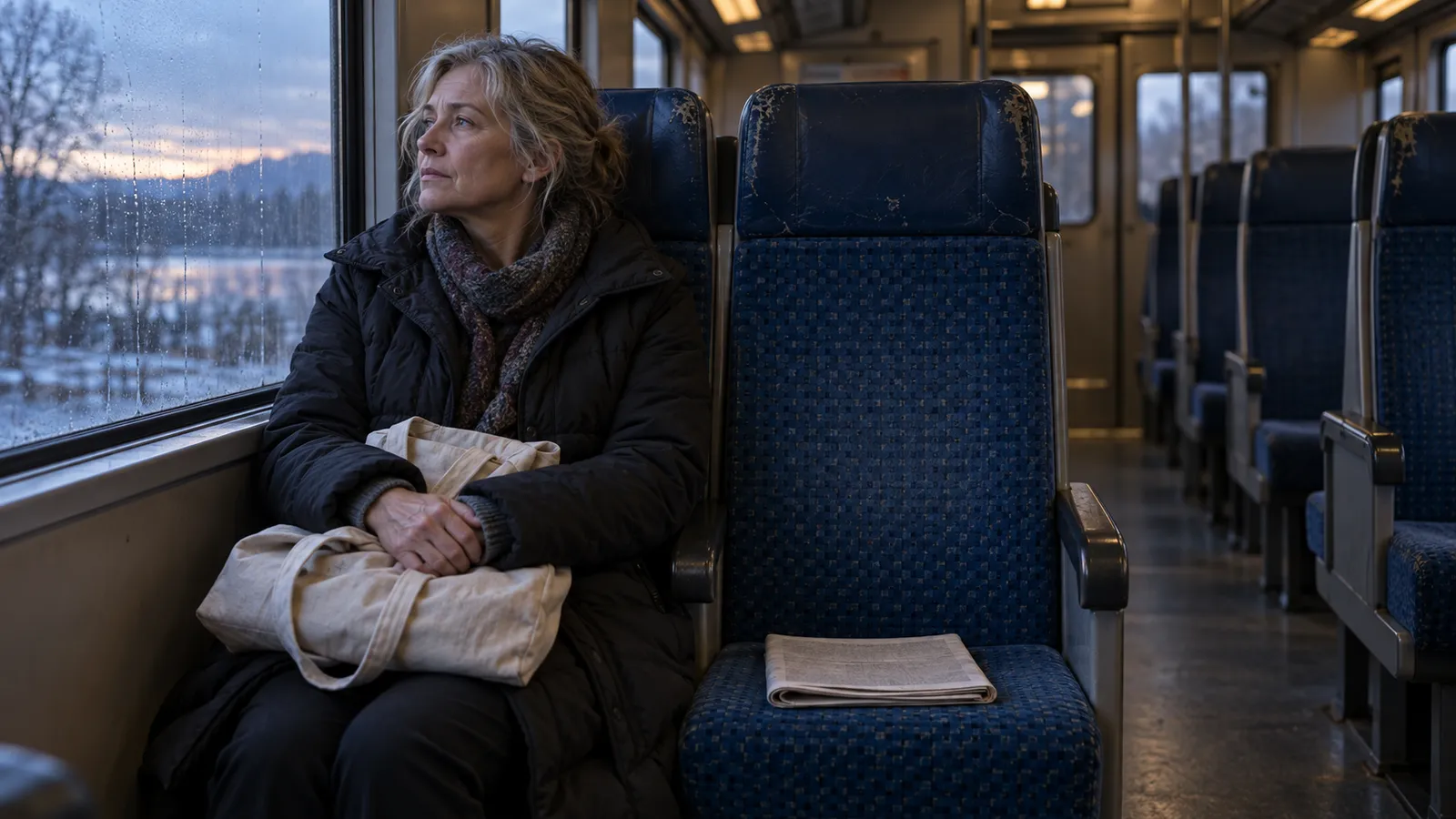
"He was twenty-two when we started," she said. "He got on at the cold store at Quarry Road. Nights first, then receiving, which started at six thirty. We took the five forty, both of us, every day, two years. He had fourteen B and I had fourteen A, because the window side has the heater pipe under it. It runs hot in winter."
"He gave you the warm seat."
"He gave me the warm seat." She said it like a correction to a form. "He read the free paper and folded it and left it on the seat for me on the way home, because I don't buy a paper. In four, face down, because the ink comes off on your hands."
She had eleven minutes. She spent four of them on the paper.
"In March they taped the notice to the glass at the terminal," she said. "Jonah read it out to me on the platform. Passengers may use the six ten. He asked the man at the window what time the six ten got to Quarry Road. Six forty-eight. His shift started at six thirty."
"He asked for a shift change."
"Twice. They had six men on receiving and the trucks came when the trucks came. The supervisor told him to sort out his own transport." She turned her hands over in her lap. "He bought a scooter for four hundred dollars from a man at the plant. For five weeks I told him to sell it. On the ninth of May he was on the bend at Quarry Road at six twenty-two, and a gravel truck came around the inside of it."
She did not cry. I think she had done all of that years ago, in rooms without transit officials in them.
"They put a guardrail up in the spring," she said. "And made it thirty miles an hour. For the next one."
I did not say I was sorry. She had not asked for it, and the word would have been load-bearing in a way I had no right to.
"The second ticket," I said.
"I went back to work on the twenty-second, on the six ten, because there wasn't anything else." She stopped, and started again, lower. "And I got to the validator and I couldn't make myself buy one ticket. He'd paid out of that card for two years. So I bought two. And I sat in fourteen A and put the paper on fourteen B, and nobody said anything to me."
"Nobody has said anything for nine years."
"Ray's never asked me once. The driver before him used to say good morning to the seat." She almost smiled, and it went. "I know what it is. Four twenty-five a morning for a seat nobody sits in. I'm not confused, Mr. Hensley. I'm his mother and I pay for his seat, and the day somebody tells me in writing that I can't, I'll stop."
"You've overpaid us eight thousand and fifty-five dollars. I can refund it."
"Then don't." It was the only time her voice came up. "If you give it back, it's finished. It's a ticket while I'm buying it."
I have signed eleven service discontinuances in eleven years, and told people in church basements that the 4:15 was not coming back. Nobody had ever put a sentence under me like that one.
"The six ten is on the board agenda this afternoon," I said.
"I know. The notice will say the six thirty-five." She put her tote on her shoulder and checked the clock, and she had three minutes. "He'd have been thirty-three in August."
She went up the steps to the laundry.
I went up to Thorne's floor at eleven with the three pages from 07-14 in my bag.
She reads the last page of a document first. She took my package, turned it over, read the recommendation page, set it on the green blotter and picked up her pencil.
"It's clean," she said. "Who's the fare anomaly?"
"A rider named Adele Whitaker. The anomaly is that she's been paying us double since 2017 and we've been taking it."
The pencil stopped. She did not pretend not to know the name. That is the part I want on the record.
I put Notice 07-14 on the blotter, turned so the signature faced her. She did not touch it.
"I signed that in March of 2017," she said. "Train 902 carried fourteen people an hour at nine percent recovery and we were four million short on the operating side. I had the numbers I had, and I would sign it again on those numbers." She set the pencil down. "I also know what happened in May. The general manager put the county's letter on my desk and asked whether we were exposed. We were not exposed. That is the word he used, and it is the word I used back."
"Her son had a six thirty shift. Your notice told him to use the six ten. It got to Quarry Road at six forty-eight."
"I know what it got there at."
"Then why does my package say passengers may use the six thirty-five?"
"Because that is the sentence." She folded her hands. "I'm not going to perform for you, Peter. If I reopen 2017 I reopen sixty notices behind it. The grant is conditional on a system-wide recovery figure of fourteen percent and we are at thirteen point one. Marcus goes in March. Put it in front of them this afternoon and in four months nobody in this building sends you to a church basement again."
It was not a bribe. It was worse: an accurate description of how a career works here.
"The two hundred fourteen is wrong," I said.
She looked up.
"Seventy-one thousand four hundred of it is the cost of opening North Vale Terminal before six. The agent's early shift, the lights, the de-icing, the first inspection. The template charges all of it to the first scheduled departure. It did in 2017, when it was sixty-eight nine against the five forty. I copied the cell. You copied the cell. Whoever had the desk before you copied it."
"The first departure requires the building open."
"So does the six thirty-five. Kill the six ten and the building still opens at five thirty, and the seventy-one four lands on the six thirty-five the next morning with nothing changed but the name on the line."
I put the second sheet down.
"Discontinuing the six ten avoids a hundred sixty-eight six and gives up twenty-six thousand of revenue. The real saving is a hundred forty-two six. The package claims two hundred fourteen. If the board adopts it on that number and anybody ever reruns the arithmetic, that is the exposure. Not the county's letter."
She read the sheet top to bottom and made two green marks.
"And the recovery figure?"
"Still short, so I've put the rest in." I gave her the last page. "The eleven twenty and the one fifty off the midday. Six boardings and nine. Ninety-six thousand and a hundred four. And the operations manager post at Ridge Street converted to a depot supervisor post, forty-four thousand fully loaded. Two hundred forty-four against a hundred forty-two six. It clears fourteen percent with room."
She looked at the page a long time.
"The operations manager post," she said, "is yours."
"Yes."
"You understand there is no version of this where Marcus's job is also yours."
"Yes."
She squared the pages against the edge of the blotter and slid the signature block across the desk with my name already typed under the line, because she had had it typed on Monday.
End of chapter 4