Family4 min read
The Second Will in the Toolshed
The morning after we buried our father in Wayne County, my older brothers shoved a rusted steel toolbox into my chest, produced an outdated 2012 will for our 50-acre farm, and ordered our stepmother out by Sunday. But inside that battered box lay a secret my father left behind.
Chapter 2: Fifty Acres of Black Dirt
The toolshed stood twenty yards behind the main barn, banked into a low rise of limestone and wild blackberry brambles. My father had framed it himself out of rough-sawn white oak in the summer of 1984, before Bradley went to college and before I was born.
I paused by the barn doors and looked out across the western fields. Fifty acres of rich black dirt rolled toward the tree line, dark and moist under the pale autumn sky. For forty years, Arthur had worked this ground until he knew every low swale where water pooled and every rocky shoulder that could snap a plow shear. He had rotated clover and winter wheat, hauled aged manure, and treated the soil like a living creature that deserved respect.
To Bradley, that dirt was just unmined gravel and square footage for a contractor yard. Bradley had never dropped to his knees to crumble a fistful of topsoil between his palms. When Dad's breathing grew ragged last January and medical bills piled on the sideboard, Bradley offered to buy the north twenty acres for fifty cents on the dollar, claiming he was doing the family a favor.
When Dad told him the land stayed whole or not at all, Bradley stopped answering his phone. Nathan had been even colder in his quiet way, sending spreadsheets showing the estate tax advantages of putting the acreage into a commercial partnership where Bradley held controlling voting shares.
"Arthur is being sentimental," Nathan had written in an email that Martha accidentally printed. "A farm producing sixty bushels of soybeans an acre cannot justify the property tax. Liquidation is the only rational exit."
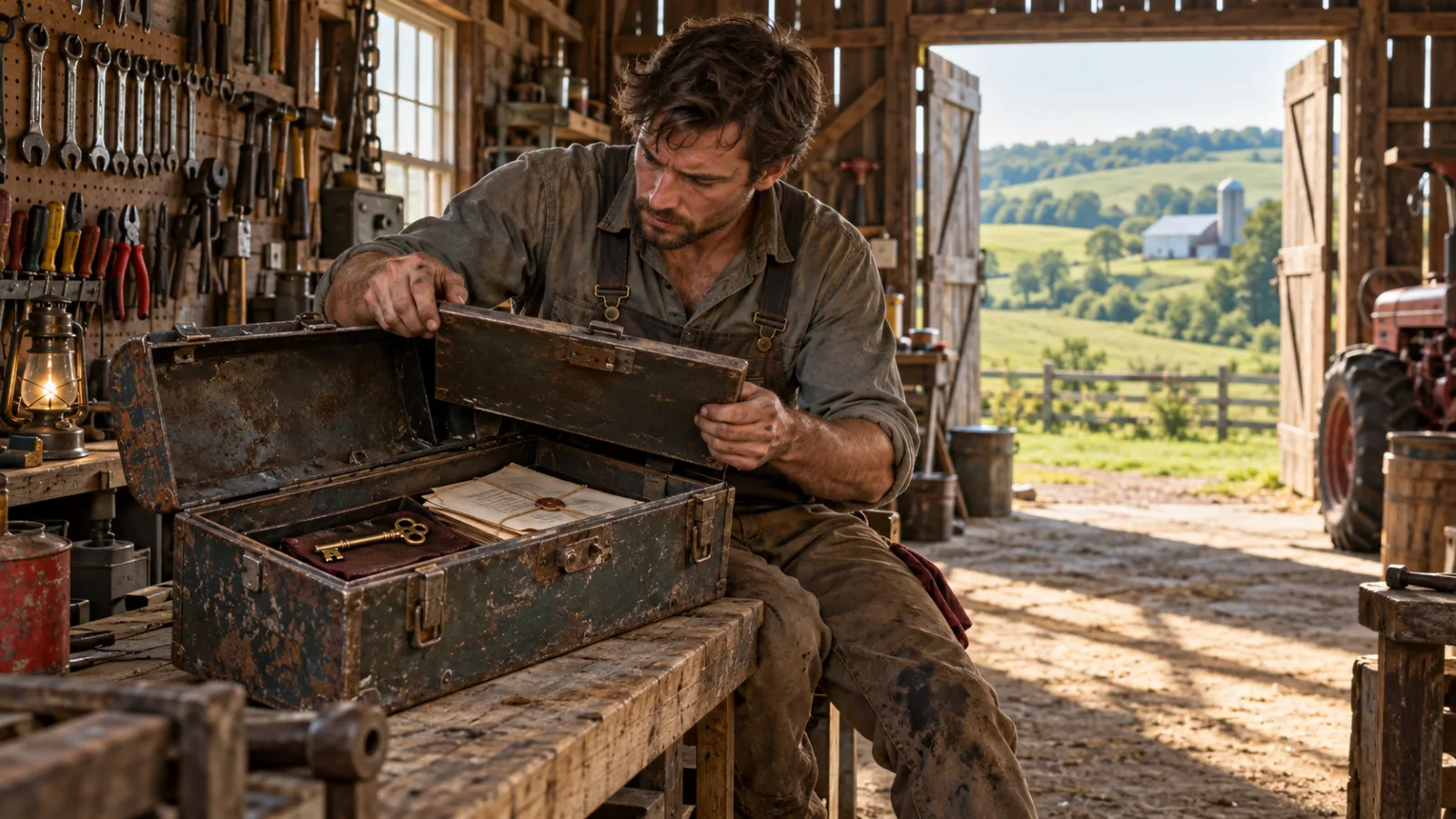
I pulled open the heavy oak door of the shed and stepped inside. The familiar smells of my childhood rose up: boiled linseed oil, paraffin wax, sweet sawdust, and the sharp scent of cutting fluid. On the wall hung rows of hand planes, polished crosscut saws, and racks of forged open-end wrenches arranged by thirty-seconds of an inch. Everything was clean, dusted, and positioned with exactness. Even in his final months, when his lungs burned with every breath, Dad came out here just to run an oiled rag over his chisels.
I carried the heavy steel toolbox over to the workbench in the center of the room. The bench was four inches of solid sugar maple, scarred with knife marks and dark circular rings from coffee mugs. I set the box down on the wood and switched on the overhead inspection lamp.
The toolbox was a 1968 industrial Craftsman cantilever model, painted in battleship gray that had worn down to bare steel along the edges. A thick film of blackened machine grease and sawdust coated the seams and latches. Dad had carried this box in the bed of his old Ford pickup for three decades, using it to repair balers in the field and assemble custom furniture.
Bradley thought he had handed me a heavy piece of scrap metal to insult my trade. He believed that because I worked with my hands instead of managing subcontractors, thirty pounds of greasy steel was all I was worth.
I reached for a bottle of mineral spirits and a clean shop rag from the shelf. Working slowly, I wiped down the outer casing, removing years of grime from the piano hinges and brass corner brackets. Underneath the grease, the steel was remarkably smooth, without the deep pitting usual on an antique tool chest.
When I lifted the twin cantilever trays, they unfolded with a clean precision. Inside lay Arthur's everyday tools: a set of forged ignition wrenches, a six-inch steel rule, a brass center punch, and knurled feeler gauges.
I took the tools out one by one, setting them on a shop towel. Then I reached into the main compartment to lift out the lower tray.
That was when my mechanic's hands caught the first discrepancy.
As a machinist, I had spent twelve years measuring engine tolerances down to the thousandth of an inch. You cannot spend that much time with micrometers without developing an instinct for proportions.
I set my fingertips against the inside bottom floor of the steel chest. Then I reached my other hand underneath the outer base to gauge the thickness between the two surfaces.
The measurement felt wrong. From the outside, the box stood eleven inches high from its rubber feet to the top rim. But the internal depth of the main compartment measured barely nine inches.
I picked up Arthur's steel rule and set it upright against the inside wall. It bottomed out at nine and one-quarter inches. I transferred the rule to the exterior side panel. The outer depth was ten and three-quarter inches.
An inch and a half of vertical space was missing.
A standard toolbox floor is stamped from single-layer eighteen-gauge sheet metal, less than a sixteenth of an inch thick. There was no mechanical reason for an inch and a half of dead space beneath the lower tray.
I tapped the bottom panel with the brass handle of my pocketknife. Instead of the ringing ping of sheet steel, the box produced a dull, muffled thud, like striking dense hardwood covered in lead.
Dad was a master woodworker who had spent decades building secret drawers into dining sideboards and hidden compartments into clocks. He knew how to hide things where nobody thought to look.
I pulled an inspection mirror and a penlight from the tool rack on the wall. Peering down into the corners of the toolbox, I began searching for whatever Arthur had built into the bottom of the steel frame.
End of chapter 2