Family4 min read
The Second Will in the Toolshed
The morning after we buried our father in Wayne County, my older brothers shoved a rusted steel toolbox into my chest, produced an outdated 2012 will for our 50-acre farm, and ordered our stepmother out by Sunday. But inside that battered box lay a secret my father left behind.
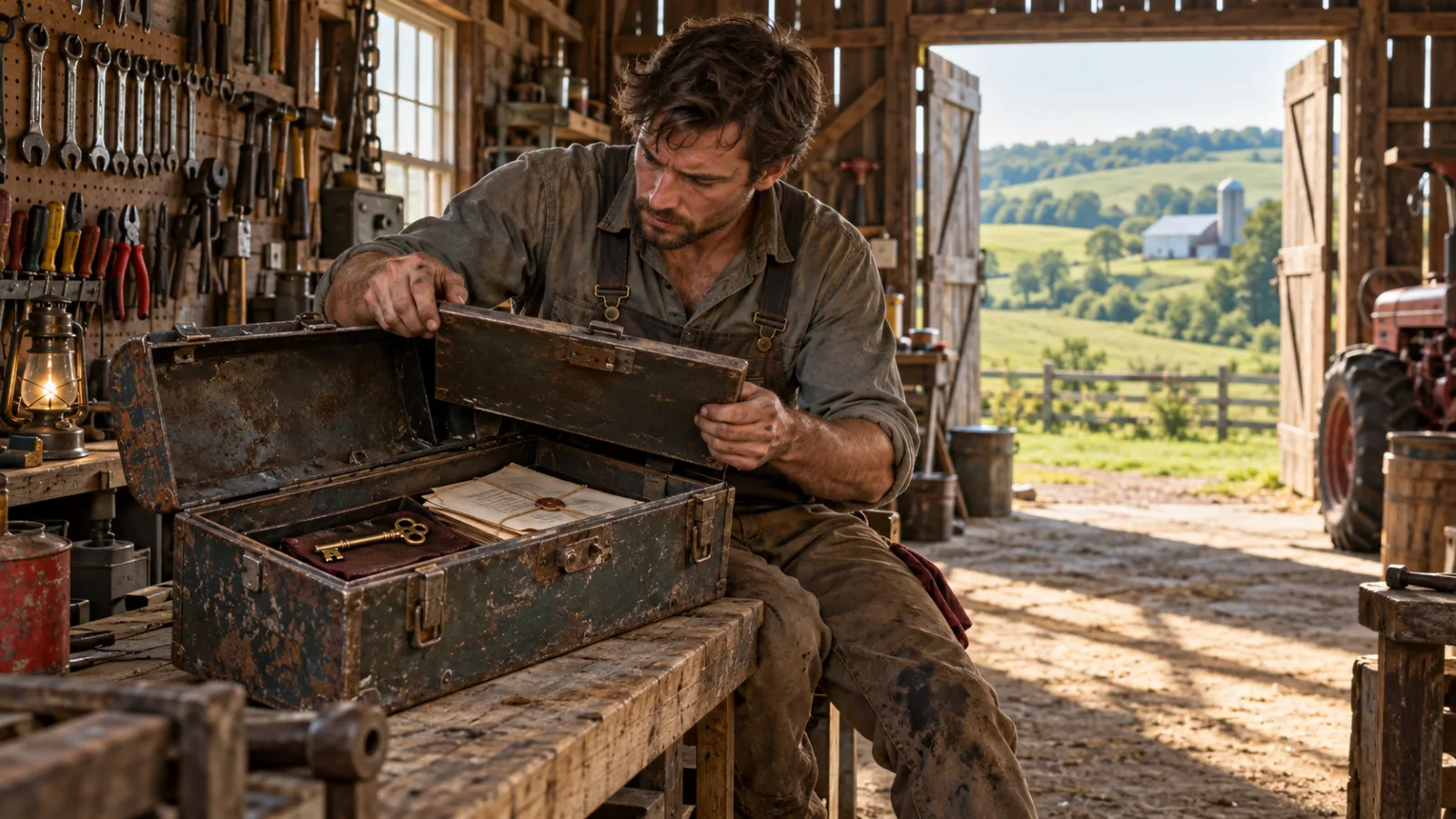
Chapter 3: The Rusted Latch
The penlight beam cut across the grease-stained metal corners, picking up details invisible to the naked eye. Under the magnifying glass of my inspection mirror, I examined the four steel rivets securing the bottom tray to the outer chassis.
Factory rivets on a 1968 Craftsman box are pressed flush by hydraulic dies at the manufacturing plant in Illinois, leaving a distinct cross-hatched tool mark. But three of these rivets had been ground smooth, drilled out, and replaced with miniature hex-head socket screws turned from solid brass.
Whoever had worked on this chest had blued the brass with gunsmith chemicals to match the aged steel. To a contractor like Bradley, looking for an excuse to throw scrap at my feet, it looked like thirty years of accumulated grime. To a mechanic who had spent twelve years rebuilding transmissions, it was a deliberate signature.
"You crafty old fox," I whispered aloud, the sound swallowed by the rafters of the shed.
I pulled a set of miniature Allen keys from my leather roll. Inserting a three-thirty-seconds hex wrench into the first brass screw, I gave it a gentle quarter-turn counterclockwise. It resisted, held fast by a bead of dried beeswax, then broke free with a tiny pop.
I removed the four corner screws one by one, setting them carefully inside a brass jar lid so they would not roll into the floor cracks.
With the fasteners out, the bottom tray should have lifted free. I gripped the steel lip with needle-nose pliers and pulled upward. Nothing budged. The tray remained tight against the casing.
Directing the beam of light along the rear seam where the hinge met the back panel, I ran my thumbnail along the groove. I felt a slight spring tension beneath the center baffle.
Dad had not merely screwed a false floor into the box. He had installed a mechanical lock, the kind he used on his cherry-wood jewelry chests.
I reached for a flat brass feeler gauge, sliding the thin slip of metal along the seam until it struck an obstruction four inches from the left corner. There was a microscopic detent pin recessed inside the bracket.
Pressing inward on the gauge, I felt a spring compress. At the same moment, I slid the bottom floor plate toward the front latch.
With a soft, oiled click, the false bottom released.
The metal plate slid forward on two hand-machined brass tracks, revealing a shallow compartment lined with green jeweler felt. The felt was completely clean, untouched by grease and dust.
Lying in the center was a heavy, square-headed brass key and a thick white linen envelope.
I picked up the key first. It was cold and heavy in my hand, with two precision side notches and a deep center groove. Stamped into the brass in crisp block letters were the words: Millersburg Farmers Bank & Trust, Safe Deposit Vault #142.
Beside the key lay the envelope, sealed with a dollop of red paraffin wax. Written across the front in my father's handwriting was my name: For Owen. Open when they come for the dirt.
My hands trembled slightly as I broke the wax seal. Inside the envelope were two folded sheets. The first was an official carbon billing receipt from the office of Clara Vance, Attorney at Law, on East Jackson Street in Millersburg. The receipt was dated August 14, exactly two months before Dad died.
The receipt listed a single line item: Consultation, drafting, execution, and vault deposit of Last Will and Testament, revoking all prior instruments.
Tears pricked my eyes as I unfolded the second sheet, a letter written in my father's hand:
"Owen, my boy," the letter began. "If you are reading this in my shop, it means I am resting in the churchyard and Bradley has already shown up with that shameful paper from 2012. I know my eldest son. Bradley measures a man by how much concrete he can pour and how many people he can push around. And Nathan will do whatever Bradley tells him as long as there is a spreadsheet to hide behind."
I took a slow breath, listening to the wind rattle the dry cornstalks beyond the barn.
"They think because you work with wrenches and grease that your mind is simple," Dad had written. "They forgot that a mechanic understands how things fit together better than any lawyer in Canton. I made this box for you because I knew neither of your brothers would touch dirty tools long enough to find what was inside."
The letter continued:
"The 2012 will Bradley holds was drawn up when I was angry and foolish, years before Martha brought light back into this house. She gave me eighteen years of unconditional love and washed my feet when I could no longer walk. I will not have her cast into the street like an unwanted dog."
"Go to Clara Vance at the bank in Millersburg. Take this key. Box 142 holds my true and final testament, witnessed and registered with the county clerk. Show them what an honest craftsman leaves behind. Look after your mother, Owen. She has only you."
I sat on the wooden stool, holding the paper against my chest. Outside, the November wind whistled through the oak siding, but the cold no longer reached me.
I closed my fingers around the heavy brass key. Sunday noon was three days away. Bradley and Nathan thought they had won, but Arthur had left one final gear turning in the dark.
End of chapter 3