Family4 min read
The Second Will in the Toolshed
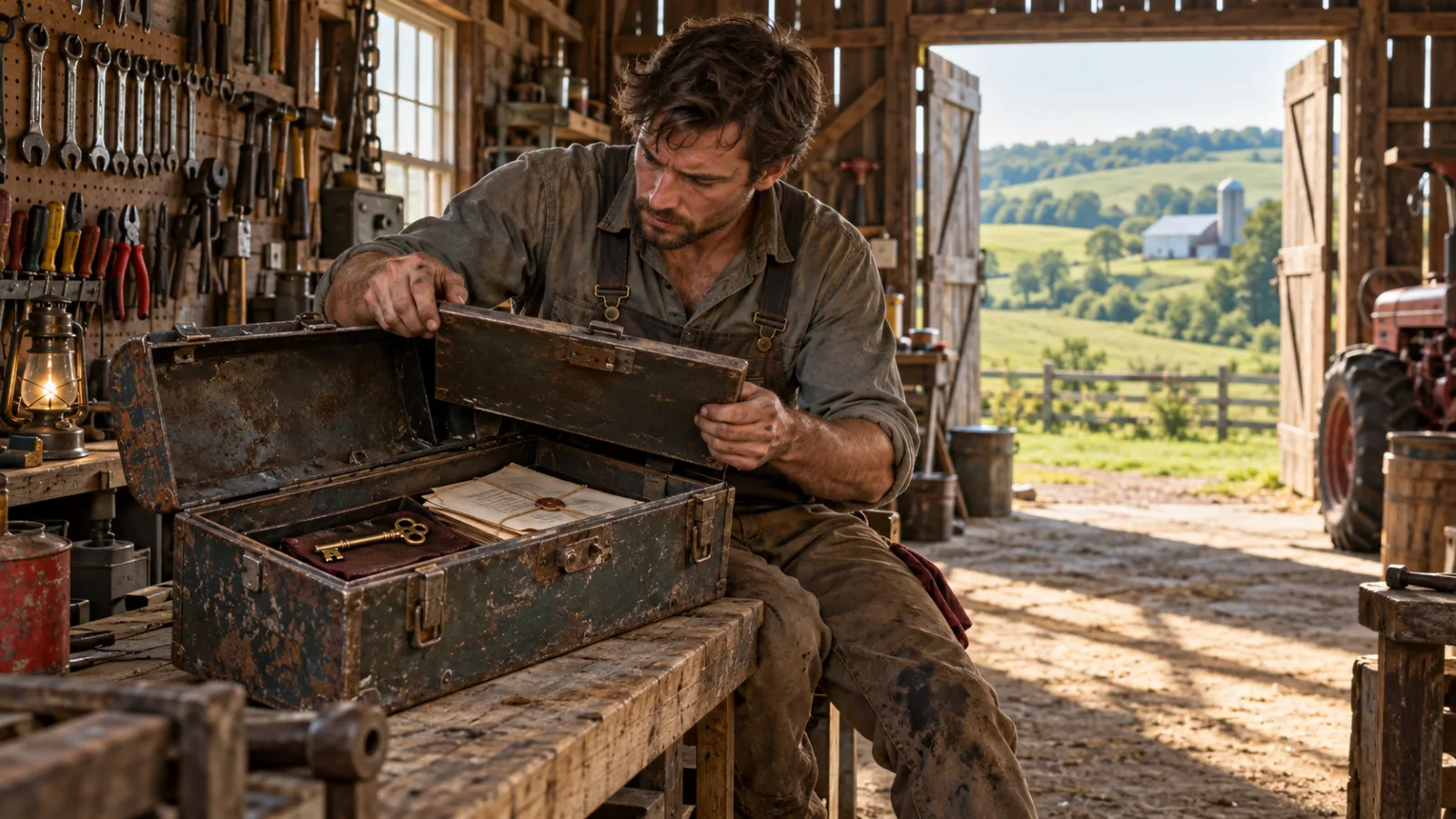
The morning after we buried our father in Wayne County, my older brothers shoved a rusted steel toolbox into my chest, produced an outdated 2012 will for our 50-acre farm, and ordered our stepmother out by Sunday. But inside that battered box lay a secret my father left behind.
Chapter 4: The Deposit Box in Millersburg
Friday morning brought a heavy frost that silvered the stubble fields along County Road 77. I left the farmhouse before sunrise, quietly backing my Chevy truck down the lane so the sound would not wake Martha.
The drive into Millersburg took forty minutes, winding through rolling hills past whitewashed Amish farmsteads and horse buggies in the morning mist. Millersburg Farmers Bank & Trust occupied an imposing limestone building on the town square, its arched windows dating back to 1902.
At eight-forty-five, a maroon sedan pulled into the parking stall beside my truck. Clara Vance stepped out, clutching a leather briefcase against the freezing wind. At sixty-two, Clara had practiced probate law in the county for thirty-five years. She had iron-gray hair in a sensible bun, wire spectacles, and the keen gaze of someone who had watched three generations of Ohio families fight over topsoil.
"Morning, Owen," she said, shaking my hand with a firm grip. "Your father told me you would be the one holding that brass key. He said if Bradley got his hands on the toolbox, he would probably throw it at you."
"That is exactly what he did," I said. "Yesterday morning at the kitchen table. He gave Martha until Sunday noon to pack."
Clara shook her head, her jaw tightening. "Bradley always was all engine and no steering. Come inside. I had the vault custodian pull the security register yesterday when you phoned."
We walked through the brass revolving doors into the bank lobby. The warmth inside smelled of radiator heat, polished marble, and old paper. Clara spoke with the vice president, and within minutes we were escorted down the carpeted spiral staircase into the subterranean vault.
The vault door was a three-ton wheel of burnished steel swung open on massive oil-bath hinges. Inside, floor-to-ceiling rows of brushed-steel safety deposit boxes caught the recessed lights.
A clerk in a navy blazer guided us to the third column. He inserted the bank's master key into the right cylinder of box #142. I inserted Arthur's square-headed brass key into the left cylinder.
We turned them in unison. The heavy dual tumblers fell back with a satisfying mechanical click.
The clerk slid the dark steel sleeve from its housing and carried it into a private viewing booth, pulling the door closed behind him.
Clara unlatched the steel box lid. Inside lay a thick legal packet bound in navy bond paper, tied with red twill tape.
"Arthur wanted you to read it in my presence," Clara said softly, sliding the packet toward me.
Untying the tape, I opened the folder. The first document was a formal Certificate of Mental Competency signed by Dr. Henry Caldwell at Wooster Community Hospital, dated August 12. Dr. Caldwell certified under oath that Arthur was fully oriented, lucid, and possessed complete testamentary capacity.
"Arthur insisted on that," Clara explained. "He knew Bradley and Nathan would try to claim undue influence. That certificate closes the door on any mental incapacity challenges before they can file a motion."
Beneath the certificate lay three pages covered in Arthur's fountain-pen cursive: Last Will and Testament of Arthur James Miller.
Paragraph One was blunt and unequivocal:
"I, Arthur James Miller, do hereby explicitly revoke, cancel, and declare null and void all prior wills, codicils, and testamentary dispositions made by me, including specifically a certain document drafted in June of 2012."
"There it is," Clara said. "The 2012 document Bradley is waving is officially legal scrap paper. It has zero standing in any probate court in Ohio."
I turned to the second page, where Arthur laid out the division of his life's work.
To Martha, he granted an irrevocable, deeded life estate in the farmhouse, the garden, and the domestic outbuildings. The will stipulated that she could never be removed or evicted for as long as she lived. Furthermore, the estate created a living trust to cover her utilities and medical care, funded by agricultural rental revenues.
To me, Arthur devised the entire fee-simple title to the fifty acres, the barns, and all mechanical equipment, subject only to Martha's life estate.
And to Bradley and Nathan, Arthur left a very specific choice.
"To my eldest sons, Bradley and Nathan," Arthur had written, "who found no time to visit their dying father but plenty of time to inquire about land developers, I bequeath the option to lease ten acres of northern pasture at standard county rates. Provided that every dollar of their lease payments shall be paid directly into Martha's care trust. Should either Bradley or Nathan contest this will or harass Martha, their share of my estate shall be reduced to one dollar, and they shall be permanently barred from setting foot upon this land."
Clara watched me as I read the final paragraph, where Arthur's signature sat flanked by the seals of two independent county magistrates.
"I have the emergency probate filing ready," Clara said, her voice steady. "I will file the expedited petition and request for temporary restraining order at the Wayne County Courthouse in Wooster before two o'clock. By three, the probate judge will sign the emergency stay."
She closed her briefcase with a crisp snap.
"You go home to your farm, Owen. Tell Martha she can unpack whatever boxes she started. When Bradley shows up on Sunday, we will be waiting."
End of chapter 4