Kindness6 min read
Someone Plowed My Driveway at Four in the Morning
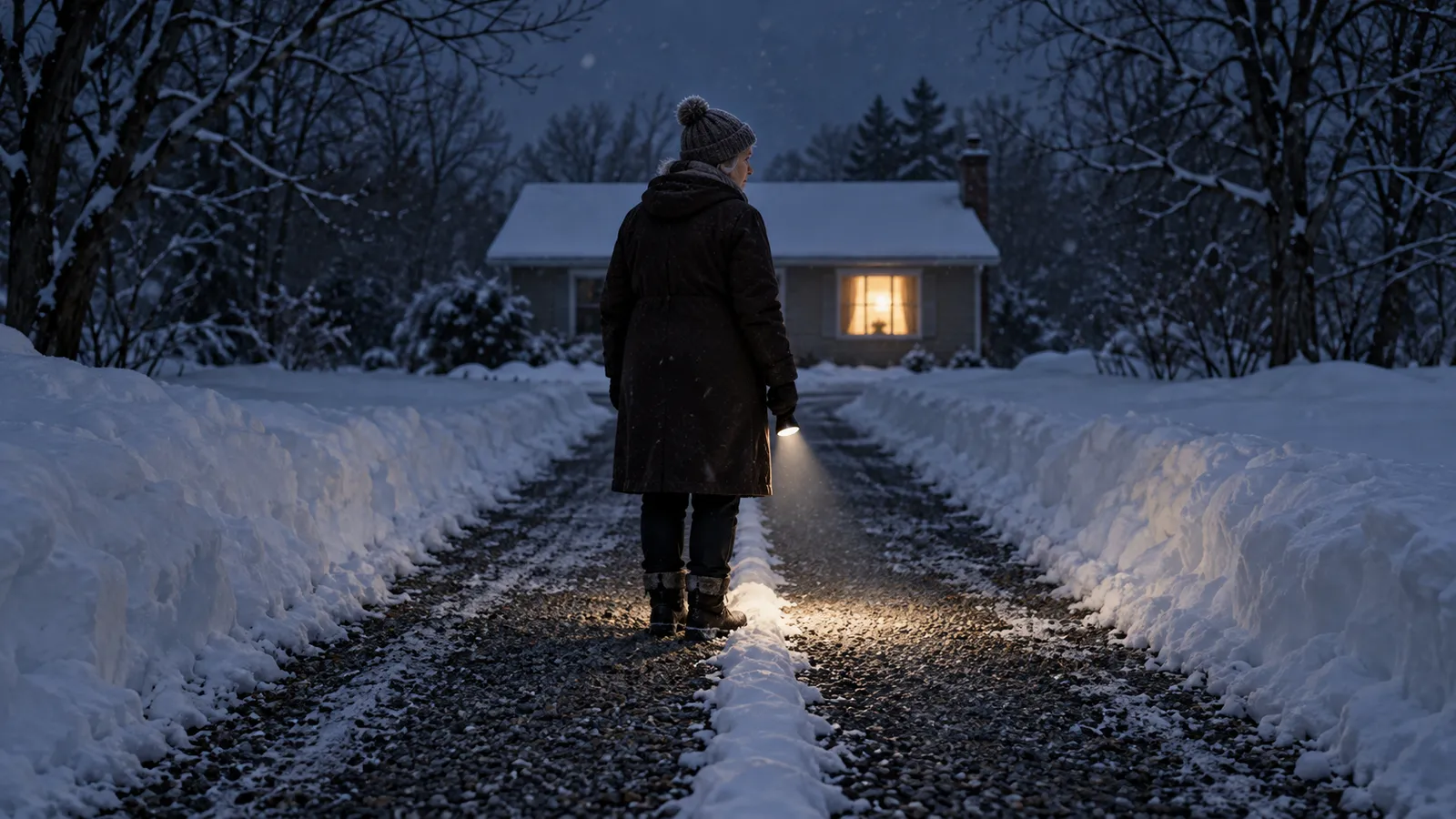
Somebody cleared my driveway at four in the morning, on the exact three days a week I go to dialysis, and never knocked. Almost nobody knew my schedule. Finding out who had it was the easy part.
Chapter 2: Redmond & Son
Dialysis is four hours in a chair. People assume it is restful. It is four hours of having nothing to do but think, with a machine beside you making a soft regular noise like something breathing in its sleep.
That Wednesday I thought about the seam for all four of them.
Marisol came by around eight thirty to check my pressures. She is the one who taped the Christmas cards to the window frame in December and never took them down, and she talks faster than anybody in that building.
"You're quiet," she said.
"Who plows your lot?"
She clicked her pen twice, which is a thing she does.
"The county has a fella. He does the schools too, and the library." She frowned at the machine, wrote something. "Walter, I think. He's in before anybody. One morning I came at four forty for the overflow shift and he was out there salting the walk in the dark with his truck running."
"Walter what?"
"I don't know his last name, Louise." She laughed. "Why, is he cute?"
"I'm sixty-eight."
"That's not a no."
She went off down the row, and I sat there with the word county turning over.
On the way out I stopped in the vestibule, which is the little glassed-in box between the two sets of doors where everyone waits for their ride, and I looked at it properly for the first time in three months.
There is a bulletin board with a flu-shot notice and a card for a grief group that meets on Tuesdays. There is a rack of pamphlets about phosphorus. And taped flat against the inside of the glass, facing out at the drop-off lane so the van drivers can read it from the curb without getting out in the weather, there is a laminated sheet with the county medical-transport route on it.
ATWOOD, L. — 14 QUARRY RD — 5:40 — M/W/F.
My name, my road, my time, my days, at eye level, eighteen inches from the door, where it has hung since the first week of October and where I have walked past it ninety times without once reading it.
It had never been a secret. It had just never been read by anybody who cared.
I stood there until the van driver tapped the horn.
Dale called me back that night about his sister's hip, and when he was done I asked him something I had been building up to all afternoon.
"Dale, the plow truck that does the schools. Green pickup, county work. Who is that?"
There was a pause on the line of exactly the kind I used to get from drivers who had rolled through a stop sign.
"That's the county fella's truck," he said. "Does the lots."
"I know what he does. I asked who he is."
"Louise."
"Dale."
He blew out a breath. "I figured you knew. I figured that's why you've been going the long way around Lower Mill for three years."
Now. I am going to put this part down plainly, because it is the part everybody wants to walk around, and I have never found walking around it to be any use.
On the third of February, 2023, at five fifty-two in the morning, I was driving in to the bus barn on Mill Road. I had done that drive five days a week for thirty-one years. It was dark and the road was wet and I was at about thirty-five miles an hour because of the curve by the old feed store.
A pickup came toward me and crossed the center line and did not come back.
It did not hit me. It hit the car behind me, a blue sedan, head on, and I was out of my car and in the road with my phone in my hand before I had decided to be.
The pickup driver was twenty-three and his name was Cody Redmond and he had been drinking since the night before. The woman in the sedan was named Dana. She was thirty-nine. They got her out and she lived, and she has a cane now and she does not have much use of her left arm, and that is as much as I am going to say about what happened to her because it is hers and not mine.
What was mine was ninety seconds of road.
The defense said the sedan had swerved. They said it twice, in two different ways, and they had a man with a diagram. And I sat in that courtroom in November and said no, the sedan held its lane, the truck came across and stayed across, and there were no brake lights. None. Not before, not during. I said I was a dispatcher for thirty-one years and my entire job was knowing what order things happened in and how long they took, and that I would swear to the sequence.
That was the piece that did it. The lawyers said so afterward in the hallway, which I wish they had not done where I could hear it.
He got seven years.
I have never lost one hour of sleep over saying it. I want that understood before I say anything else, because of what comes next. I would say it again tomorrow, word for word, in the same chair.
What I did do, without ever once admitting it to myself, was stop driving down Lower Mill Road. Three years of going around by Orchard, which adds four minutes and a bad left turn, and if you had asked me why I would have told you the Orchard light times out better.
"Redmond," I said to Dale.
"Walter," Dale said. "The father." And then, because he is a decent man and could hear what he had just done, "Louise, I don't know a thing about it other than that."
Thursday he drove me down Lower Mill Road at four in the afternoon in his sedan, going about twenty-five, both of us pretending this was about picking up a part.
It is not much of a road. Six houses, a culvert, and the county equipment yard where they keep the sand pile under a tarp.
The truck was parked beside a pole barn on the last property, nose out, the way a man parks when he leaves before daylight. A green F-250 gone chalky on the hood from fifteen winters. The plow was down on the gravel in front of it, and even from the road, in the flat afternoon light, I could see the notch in the cutting edge where four inches of steel was simply gone.
And on the driver's door, in white letters that had been good work once, it said:
REDMOND & SON
Except the second half of it was wrong. The first word stood up dark and clean. The rest had been taken down to a ghost — not painted over, not covered with a magnet. Scrubbed. You could see the circles where somebody had gone at it with a wire brush and then stopped partway, the way you stop when you realize you are not going to be able to finish and you are not going to be able to leave it either.
Dale didn't slow down and I didn't ask him to.
"Seen enough?" he said.
I had. For three winters I had been driving four minutes out of my way to avoid a road, and for two months a man on that road had been getting up at half past three to clear mine.
End of chapter 2