Kindness5 min read
Someone Plowed My Driveway at Four in the Morning
Somebody cleared my driveway at four in the morning, on the exact three days a week I go to dialysis, and never knocked. Almost nobody knew my schedule. Finding out who had it was the easy part.
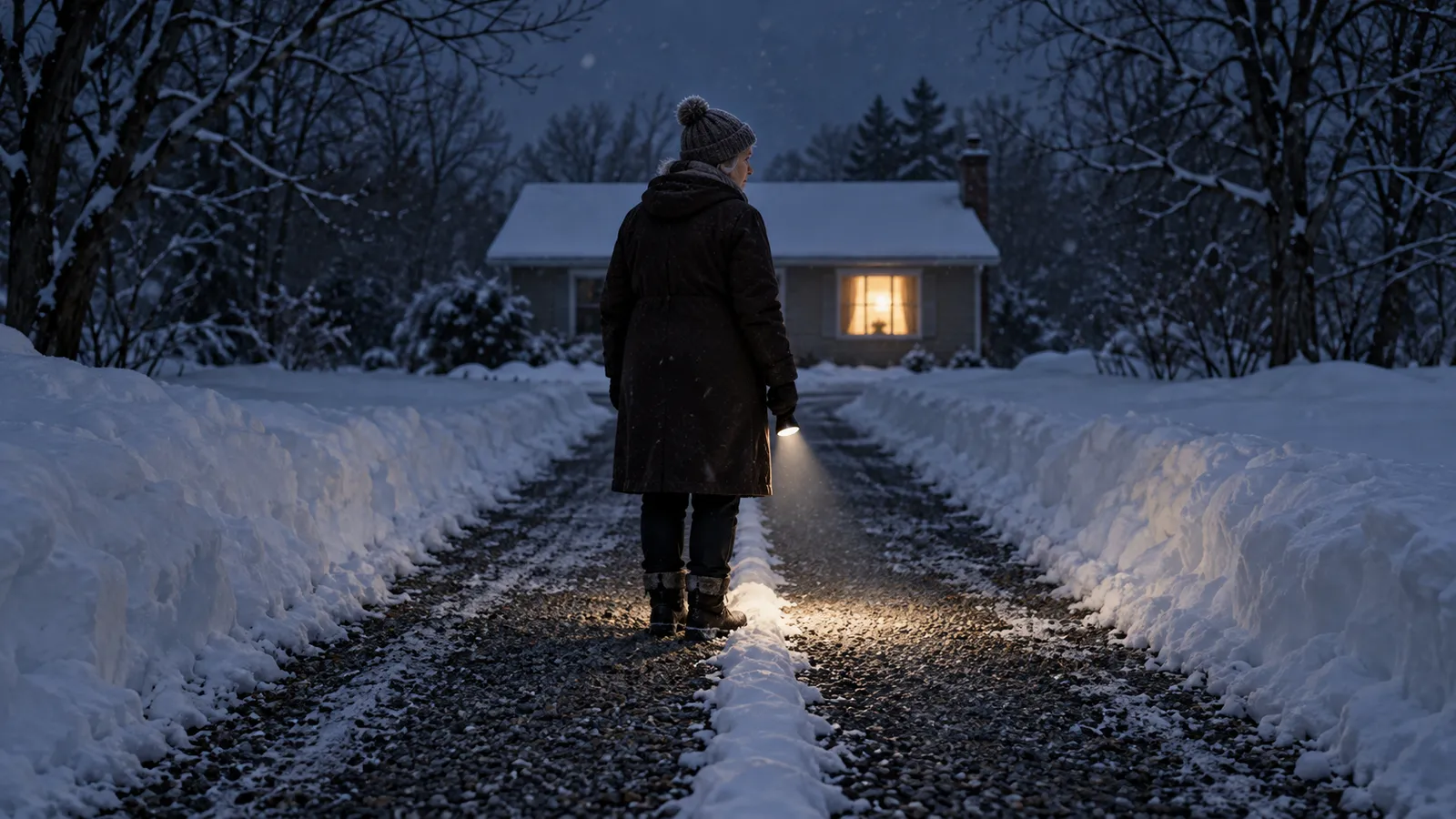
Chapter 4: The Porch Light
It came in off the lake at about nine on Thursday night and it did not stop until almost noon on Friday.
Twenty-one inches at the airport. More than that on Quarry Road, because Quarry Road runs along the open side of the Hadley field and whatever falls there gets picked up and put somewhere else, usually in front of my house. By first light I had a drift at the corner of the porch that came up past the mailbox post, and the county plow had been through once at some point in the night and thrown a berm across the mouth of my driveway about four feet high and as hard as a curb.
The van dispatcher called at five fifteen.
"We're not getting up Quarry," he said. "Not today, Mrs. Atwood. I've got two buses stuck on the east side already."
"I understand."
"They'll reschedule you."
I called the two plow outfits in the book. The first one laughed, not unkindly. The second one had a girl answering the phone who said they were running residential at a hundred and ten dollars and the soonest she could put me on the list was Monday afternoon, and she was sorry, and she sounded like she meant it.
I called Dale. His truck was still on blocks in the barn and the transmission was still on the floor beside it and he had called four places himself and gotten the same Monday.
Then I sat at the kitchen table with my coffee and the back of the feed-store calendar and did the arithmetic that people on dialysis do and don't talk about.
Wednesday was my last treatment. Missing Friday makes Monday a long way off. It is not a thing where you feel fine and then you are in trouble; it comes on in order, the way everything does. By Friday night my ankles had gone thick and my rings would not turn on my fingers, and I was getting up every forty minutes because I could not lie flat without feeling like I was breathing through a wet cloth.
Marisol called me at seven on Friday evening. She was still at the center.
"I've got the overflow chair tomorrow," she said. "Seven fifteen, Saturday. It's yours if you want it, but Louise, I have to ask you straight. Can you physically get out of your house?"
"I'll get out."
"Don't say yes to me if it's no."
"Marisol."
"Okay," she said. "Seven fifteen."
I hung up and I sat in my husband's chair in the front room with the lamp off and looked out at the yard, which was blue and perfect and absolutely impassable, and I thought about the fact that there was exactly one man in Pine County who would be awake at four in the morning anyway.
Here is the part I did not expect to be the hard part.
It was not pride, exactly. I have been proud my whole life and I know the shape of it. This was that for three years the arrangement between me and that family had been that I owed them nothing, and the clean thing about owing nothing is that you never have to go stand on anybody's porch.
If I asked him, that was over.
I sat there until about eleven turning it over, and what finally moved me was not noble. It was that I did not want to spend another night sitting up in a chair because I could not lie down.
I called Dale at seven on Saturday morning and asked him to drive me down Lower Mill Road.
The kitchen door was the one with the path shoveled to it, so that is the one I knocked on. Seven twenty in the morning and the sky just going gray.
He opened it in a flannel shirt with his coffee in his hand and he did not say a word. He stood there and waited, which I have come to understand is the most courteous thing he could have done.
Behind him I could see the kitchen. A table with one chair pushed in and one pulled out. A calendar on a nail. And on the refrigerator, up at the top where a man would have to look at it every time he opened the door, a school photograph of a boy about nine years old in a red collared shirt, with his hair combed wet.
I made myself look at it for a second and then I made myself stop.
"I told you to stop plowing my driveway," I said.
"You did."
"I'm asking you to plow it."
He put his coffee down on the counter inside the door.
"I'm not offering you anything for it," I said. "I'm not paying you, because you won't take it and I'd be insulted if you did. I'm not writing anything for anybody. Tomorrow is exactly like yesterday. I have treatment at a quarter past seven and I cannot get off my own road."
"Let me get my coat," he said.
That was the whole of it. He did not say of course and he did not say I'm glad you came and he did not say the thing I had been braced for the entire ride over, which was thank you.
It took him fifty minutes, because of the berm. He had to come at it from the side in six or seven passes, backing up into the road each time, and twice he got out and chipped at the pile by the mailbox with a spade because the plow would not break it.
Dale and I sat in Dale's car at the end of the road with the heater on and watched, and Dale said, "Huh," once, and nothing else, for fifty minutes.
When he was done he backed into the road and set the brake and left it running, and I got out of Dale's car and walked up my own clean driveway with the thermos I had brought.
He rolled the window down and I shook my head and pointed, and he pushed the door open instead. The heater was roaring the way it had been in the dark three weeks before.
I poured the cup and handed it up to him through the open door.
"It's got sugar in it," I said. "I didn't know."
"Sugar's fine."
He held it in both hands, the way you do when your hands have been out in it.
"Walter," I said.
He looked at me.
"I'm going to leave the porch light on," I said. "At four. So you can see what you're doing out there."
He turned the cup around once.
"All right," he said.
I took the empty cup back and he pulled the door shut and backed down to the road, and the plow went away up Quarry Road with the beacon turning, and I stood in the yard in twenty-one inches of snow with an empty thermos and watched him go until the light of it was gone behind the Hadley field.
Then I walked back up the driveway to the house.
It was clean all the way to the stone, pushed right, toward the field, and down the middle of every pass, dead center, ran a four-inch ridge of white that the blade could not reach.
I left it exactly where it was.
The end