Kindness6 min read
Someone Plowed My Driveway at Four in the Morning
Somebody cleared my driveway at four in the morning, on the exact three days a week I go to dialysis, and never knocked. Almost nobody knew my schedule. Finding out who had it was the easy part.
Chapter 3: What Neither of Us Came For
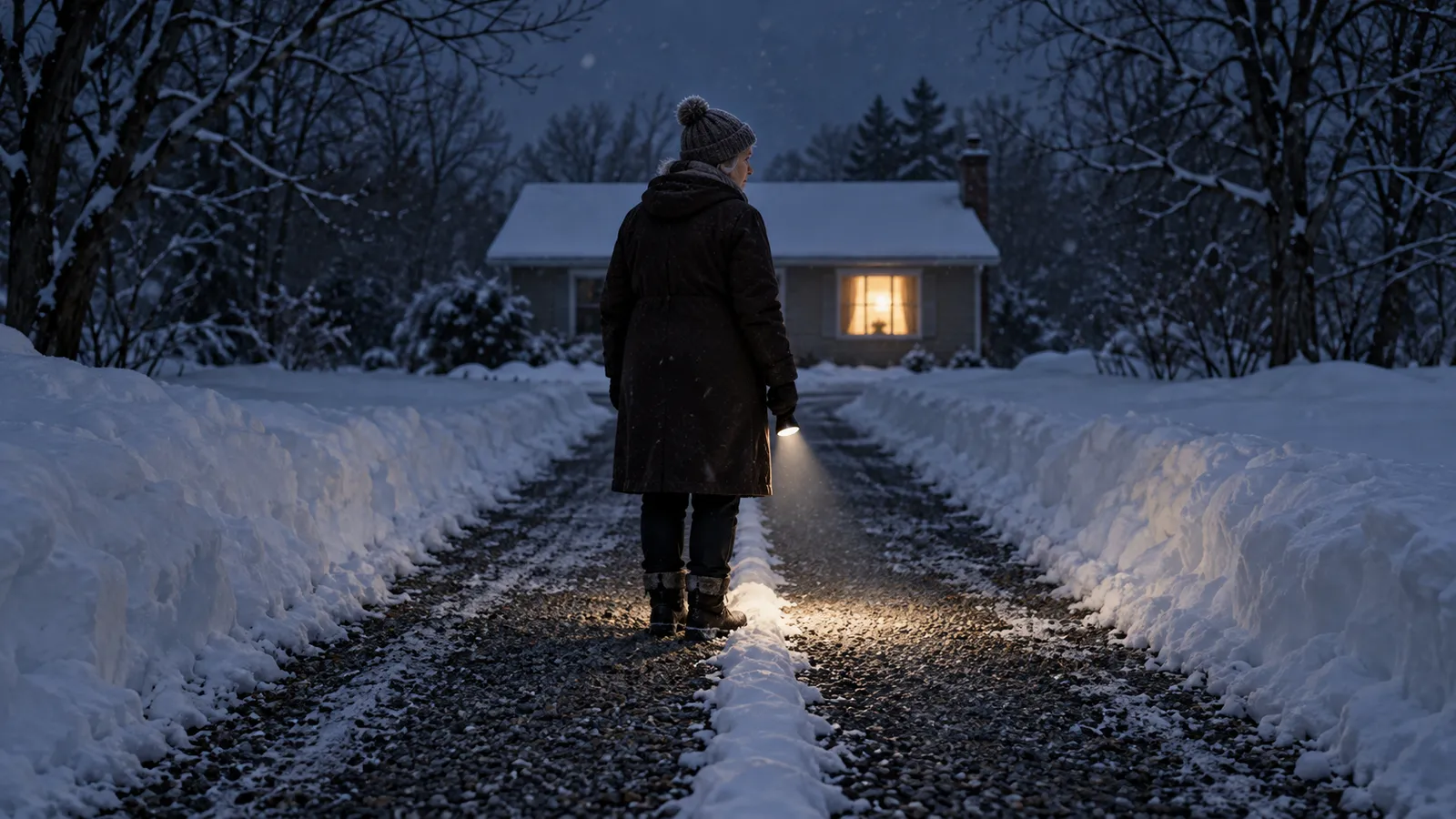
I set the alarm for three thirty on Friday and I did not need it. I was awake at two forty-five, dressed, with my coat on over my nightgown and my good boots on the kitchen mat, waiting like a woman waiting for a bus that is going to be late.
At three forty I went out and stood at the end of my own driveway with a flashlight.
It was about fifteen degrees and dead still, the kind of cold that makes the snow squeak under you like dry hinges. New snow had come in all evening, six or seven inches of it, soft. I could hear the generator at the Kesler place a half mile off. That was all I could hear.
I stood out there for twenty-four minutes.
At four oh four the light came up Quarry Road — one amber beacon throwing orange across the trees, then the headlights, then the shape of the truck behind the headlights with the plow riding low in front of it like something held out.
He saw me from maybe forty feet.
He had every chance to back out. He could have dropped it in reverse and gone and I could not have stopped him or proved anything. He sat there instead with his high beams on me and the blade up, and I watched him decide, and then he put the truck in park and set the brake and the beacon kept going around and around and painting the snowbanks orange and then not orange.
He got out but he did not come toward me. He stood in the open door of the truck with one hand on the top of it.
"Mrs. Atwood."
"You know my name."
"Yes, ma'am."
"Say the rest of it."
He didn't pretend not to understand. "Walter Redmond."
The heater was roaring out of the cab behind him and the engine was going and we had to talk over the top of it, which I was glad about. I don't know what either of us would have done with silence.
"How long?" I said.
"December tenth."
"You know the days."
"The sheet's on the glass at the clinic. By the door." He said it straight out, no shading on it. "I salt that walk at twenty of five. I read it the first week of December. Your name was on it."
"So you took it."
"I didn't take it anywhere. I read it and I knew where Quarry Road was."
"That's a thing people do to other people, Mr. Redmond. Knowing their mornings."
He looked at the ground for a second and then back up. "Yes. I'd have been angry too."
That knocked a leg out from under me, and I had come out there at three forty in fifteen degrees with the full intention of being angry in an organized way, so I went at the thing underneath it instead.
"What do you want?"
"Nothing."
"Don't."
"I'm not going to say a thing to you that isn't true," he said. "I want nothing."
"Men don't get up at three thirty for nothing. You want a letter. The parole board takes letters from victims and witnesses and I am a witness, and you have been clearing my driveway for two months, and in a year and a half you are going to come up that road in the daylight and ask me."
And here is what he did.
He laughed. Not a nice laugh and not a mean one. One short sound, out his nose, like a man hearing a thing he had already thought of and settled a long time ago.
"No," he said.
"No."
"If I came up here and asked you for that, after plowing your drive, what would it be worth? Nothing. Less than nothing. You'd know and I'd know." He shifted his hand on the door. "And I'm not going to ask it anyway. They send me a form every year. I don't fill it out."
"Why not?"
"Because he did it."
The beacon went around.
"My son got in a truck," he said, "with a quarter of a bottle in him, before six in the morning, on a road he'd driven a thousand times. Nobody made him. Nobody handed him the keys. He was twenty-three years old and he'd been warned by me and by his mother before she passed and by a judge in 2021 over a different night." He stopped and started again. "If that board calls me I'll tell them the seven years fit. I have told him that. He doesn't like hearing it. I've got nothing else to tell him that's honest."
I stood there in the cold with my flashlight pointed at the snow between us.
"I'm never going to write anything for him," I said. "Not a letter, not a sentence. I testified and I'd testify again tomorrow the same way, and I will not be made to feel one ounce of bad about it, not by you and not by a plowed driveway."
"I know it."
"Do you understand what I'm telling you? I don't believe a word of this. Not the nothing. People don't do nothing."
"I tried to give money to Dana," he said.
I had not expected her name in his mouth. He said it carefully, the way you hold something that is not yours.
"Twice. Sold the dump trailer and the second truck. Her lawyer sent it back both times with a letter, and the letter was right, and I'd have done the same." He looked off up the road. "So I sat in the kitchen for a year and a half with that money and no place on earth to put it that wasn't an insult."
The wind came up a little and the loose snow went sideways across the top of the bank.
"Then I read a sheet taped to a window," he said, "and it said a woman out on Quarry Road gets picked up at twenty of six, three mornings a week, to go get her blood cleaned. And I know what that road drifts like. I've plowed this county since 1986. And I thought: that is one thing. That is one thing in the whole world that I can do that nobody has to accept from me and nobody has to thank me for and nobody has to even know about." He tapped the top of the door once with the flat of his hand. "That's all it is, ma'am. It isn't about him. I'd have done it if you'd been anybody."
"But I'm not anybody."
"No," he said. "You're not."
Four fourteen by then, I expect, though I did not look.
"I'm not going to forgive you," I said. "There's nothing of yours to forgive and I wouldn't have it to give if there were. It isn't mine to give. It's Dana's."
"I've never once asked you for that." His voice stayed flat but something went through it on the word asked, and I heard it, and I have thought about it a great many times since. "He calls on Sundays. Eleven o'clock. I take it in the kitchen." He stopped there and did not finish, and I understood that he had come to the end of what he was able to say out loud in a driveway.
"Stop plowing my driveway," I said.
He did not argue. He did not explain himself again, or tell me I would regret it, or make me say it twice. That is the part that stayed with me.
"All right," he said.
He got up in the truck and shut the door and the beacon turned the snowbanks orange and then he backed down a hundred and eighty feet of my unplowed gravel in the dark, all the way to the road, without once putting a tire into either bank.
I shoveled the mouth of it myself that morning and I was fifteen minutes late to the chair, and Marisol asked me what on earth happened and I said the snow.
I shoveled it myself again on the Monday and again on the Wednesday after that, and then on the Thursday the county put out a warning for the weather coming over the lake: eighteen to twenty-four inches, Thursday night into Friday.
End of chapter 3