Family6 min read
Surprised to See Me
My mother set her wedding ring on the table beside my father's memorial photograph and said she was finally free. My brother asked about the money. Then the door behind us opened.
Chapter 1: The Door Behind Us
My mother slid her wedding ring off her finger and set it on the table beside my father's memorial photograph. The ring made a small sound against the wood, just a tap, and she looked at it for a moment the way you look at something you've been holding too long.
"Finally," she said. "I'm free."
No one answered. Barnaby was standing by the fireplace with his arms crossed, looking at Giles, the family attorney. I was standing at the back of the room near the hall archway, where I had positioned myself an hour earlier so that I could leave quickly if I needed to. I had needed to, twice, and I had gone to the guest bathroom down the hall and sat on the closed lid of the toilet until the urge to cry passed. Now I was dry. I was watching my mother put her ring on a table and tell the room she was free, and I was completely dry.
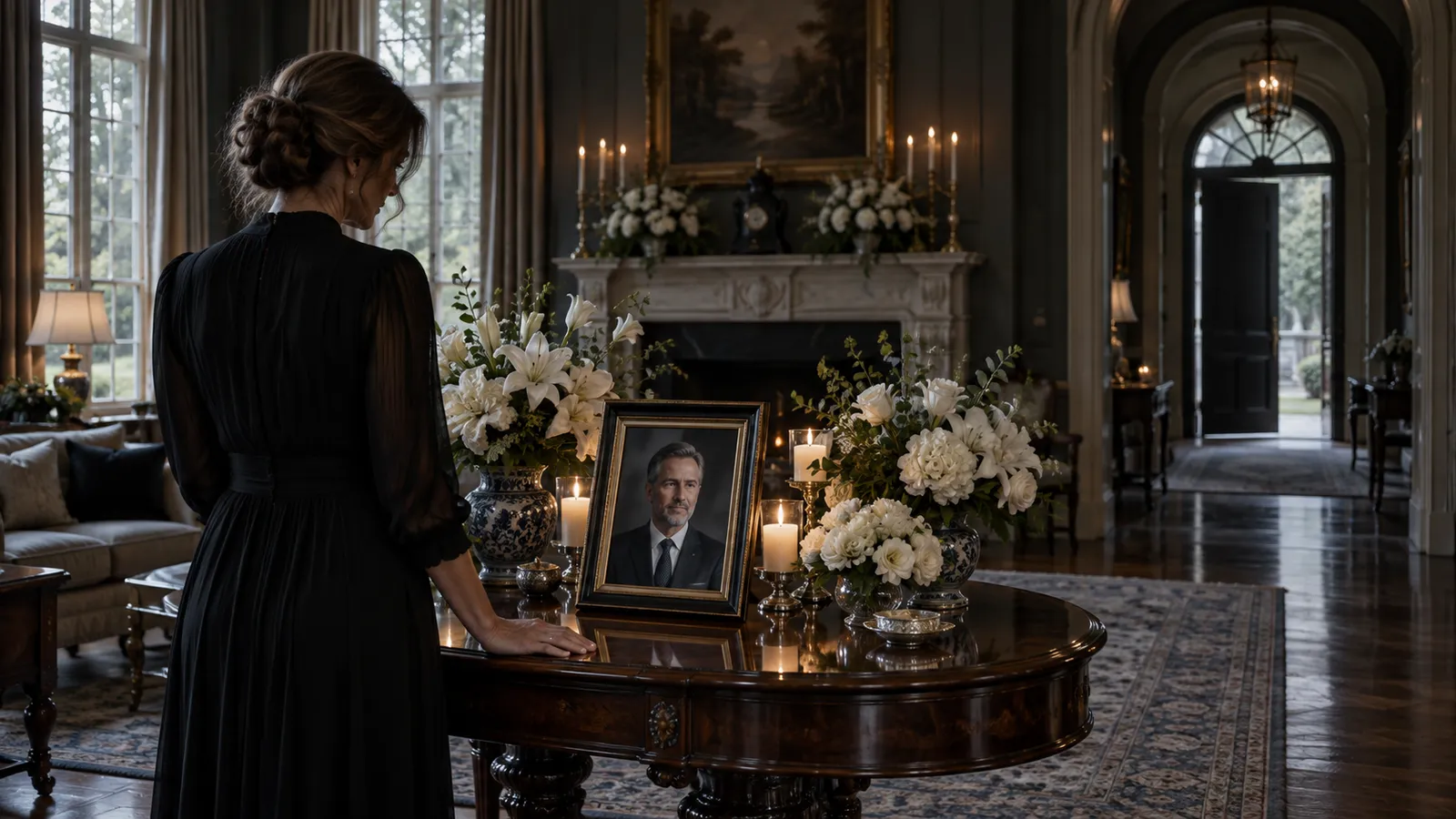
The parlor was decorated the way Giles had arranged it: a white cloth over the sideboard, two vases of white lilies, the framed photograph of my father in the center. I had chosen that photograph. There had been twelve to select from, and I chose the one from the Berkshires trip four years ago, before everything — before the audit, before I understood what the audit meant, before any of what came after. In the photograph my father is standing at the edge of a trail looking at something off to the left of the frame, not quite smiling, but not not-smiling either. His expression is the kind that reads differently depending on what you think of him. I chose it because it looked most like the way I remembered thinking of him when I was twelve.
My mother did not help me choose the photograph.
Barnaby pushed off from the fireplace and looked at Giles. "When do we get the money?"
He said it easily, the way he said most things, with a slight forward lean that was meant to convey casualness but always read as impatience to anyone paying attention. Giles had his briefcase on his knee and was adjusting the latch. He did not look up right away. That was the first thing I noticed later, going back over the afternoon, the fact that Giles was looking at the latch when Barnaby asked that question. As though he were waiting for it. As though the sequence were unfolding the way he had been told it would.
"There's one final condition," Giles said.
He said it quietly, the way lawyers say things that are designed to slow a room down. My mother had already turned toward him; she had been half-turned since she set the ring down, her body angled toward the chair where Giles was sitting rather than toward the table where the photograph was. I noticed that too, though I didn't know yet what any of it meant.
"Just tell us what he left," she said.
She did not raise her voice. She was wearing a black dress and her hair was pinned back. I had read her hair my whole life: loose meant ease, pinned meant she was preparing for something that required composure. Her hair had been pinned for three weeks.
Giles closed the briefcase latch with a soft click.
I heard the door behind me.
It was the front entrance — we were in the parlor at the back of the hall, and the front door was twenty feet behind me, around the corner of the archway. I heard it open, and I heard footsteps on the marble entry, slow and deliberate in the way of someone who is not trying to be quiet and is not in a hurry. And I turned because you turn when you hear a door open in a house that is supposed to be closed to everyone except the people already inside it.
My father was standing in the doorway.
He was wearing a dark coat and his hair was shorter than it had been in the Berkshires photograph, and he looked like a man who had slept well in a hotel for three weeks, which is exactly what he had been doing. He looked at my mother first. Then at Barnaby. Then at me.
"I left you nothing," he said.
He was looking at my mother when he said it, but it landed everywhere. Barnaby's hand went to the mantelpiece. My mother did not move at all. She stood exactly where she had been standing when she set the ring down, one hand still resting on the table near the photograph, her face doing what my mother's face always did when she was reorganizing herself internally: it went very still, the way water goes still after you've disturbed it, until you can't see what's underneath anymore.
My father looked at her for another moment.
"Surprised to see me?"
He asked it the way he asked questions in a boardroom: not looking for an answer, stating a fact in the shape of a question. Then he looked at me, and his face did what I had not seen it do in a long time. I could not name it in the moment. Something like the change of light when a cloud moves — not brighter, not darker, just different, and then it was gone.
I did not move. Barnaby was saying something behind me, something loud, a sentence that started with what the and then broke apart. My mother had not moved, either. Giles was standing now, with the briefcase at his side, and I watched him and understood that he was the only person in the room who had not been surprised.
My father walked into the parlor.
The lilies on the sideboard were the real kind, not the artificial ones — I had insisted on that, and the smell of them was very clean and strong in the closed air of the room. Small unfinished things like that had been taking up a large amount of my mental space for three weeks.
My father stopped in the middle of the room and looked at the photograph.
No one had said anything since Barnaby's broken sentence. The room had the quality of air just before a storm, not wind, just pressure.
My father reached out and picked up my mother's ring from the table. He held it for a moment, not turning it or examining it, just holding it in his palm. Then he set it back down, on the other side of the photograph, away from where my mother was standing.
He looked at Giles. "We can do the rest in the study."
He walked back through the archway. Giles followed without a word. I heard their footsteps down the hall, and then I heard the study door open and close.
My mother sat down in the nearest chair. Her hands were folded in her lap and her back was straight and she was looking at the wall above the fireplace, at a painting of a Maine coastline that had been there since before I was born.
Barnaby said, "What the—" and then stopped again.
I looked at the photograph of my father, the Berkshires one, the one I had chosen because of what his face looked like when he was looking at something I couldn't see. The lilies smelled very clean. The ring was still on the table, on the far side of the frame.
I did not know yet what Giles had been watching for. I did not know yet about the audit or the hotel or the three weeks of daily briefings. I knew only that my father was alive, and that Giles had known it when he closed his briefcase latch, and that my mother's wedding ring was on a table next to a photograph and nobody was asking about it anymore.
I stayed in the parlor for another twenty minutes. Then I went to get a glass of water from the kitchen and I stood at the sink looking out at the back garden and I tried to figure out what I was feeling, and the truest thing I could find was that I was relieved. He was alive. The rest of it was still arriving.
End of chapter 1