Family5 min read
He Left Everything to Someone Else
On the afternoon of her husband's funeral, my daughter grabbed the safe key from my hand and told me what belonged to her now. She didn't know her father had already answered that question — eight months before he died.
Chapter 1: The Afternoon of the Funeral
My daughter grabbed the safe key out of my hand before my husband was cold, and stood there in her funeral dress telling me what belonged to her now.
The service had ended at two. We drove back from St. Andrew's in three separate cars — mine with Hugo Vaughn in the passenger seat, Clementine's with Dexter, and a third car carrying Augustine's two sisters, who had flown in from Portland and said very little except about the casserole situation at the reception. The house was quiet when we came through the door. The caterers had cleared everything but the flowers. Augustine's portrait was on the mantel where I had placed it the night before: the one taken at his sixty-fifth birthday dinner, when he was still certain he was going to outlive the business.
I was standing in front of that photograph when Clementine came up behind me. I heard her heels on the wood floor — she has always worn heels to things she considers important — and I turned, and before I had fully turned she had taken the brass key from my hand. She did not snatch exactly; there was a tug and then the key was in her palm and I had let it go. That is the part I have thought about since. I let it go. My fingers simply opened.
She held it the way she holds a pen when she is about to sign something she does not intend to reconsider.
"Dad's money belongs to us now," she said.
Dexter was standing at the doorway to the hall. He had one hand in his jacket pocket and the other at his side, and his expression was the same expression he uses when he is presenting numbers to a client — settled, prepared, waiting for questions. He was forty-four years old. He had been in his father's business for sixteen years. He had not cried at the service. I do not say that as a verdict; people grieve in private. I am noting what I observed.
Augustine's sisters had taken the sofa. They were holding cups of coffee the caterers had left in a thermos. They did not look at Clementine. They had been married into different families long enough to know when to watch the window instead.
I looked at my daughter. She was thirty-nine years old. Her black dress had cost more than the suit I was buried in my first husband's grief wearing, the brief months I imagined I would not survive him. Her hair was exactly right. Her mascara had not run, which I had noticed in the car from the church and filed away as information, the way I had filed away the expression on her face when the pastor said Augustine's name for the first time.
"Is that all he meant to you?" I asked.
I said it quietly. I did not raise my voice. My voice has not raised itself at either of my children in thirty years, because there was never a point at which I believed volume would change anything.
Clementine looked at me the way she has looked at me since she was seventeen, which is with the slight elevation of the chin that says she has heard me and disagrees with the premise.
Dexter stepped forward. He said, "We want what's rightfully ours."
Clementine nodded. She had already turned toward the hall. She was going to the study. She had the key.
I heard the door open. I heard her stop.
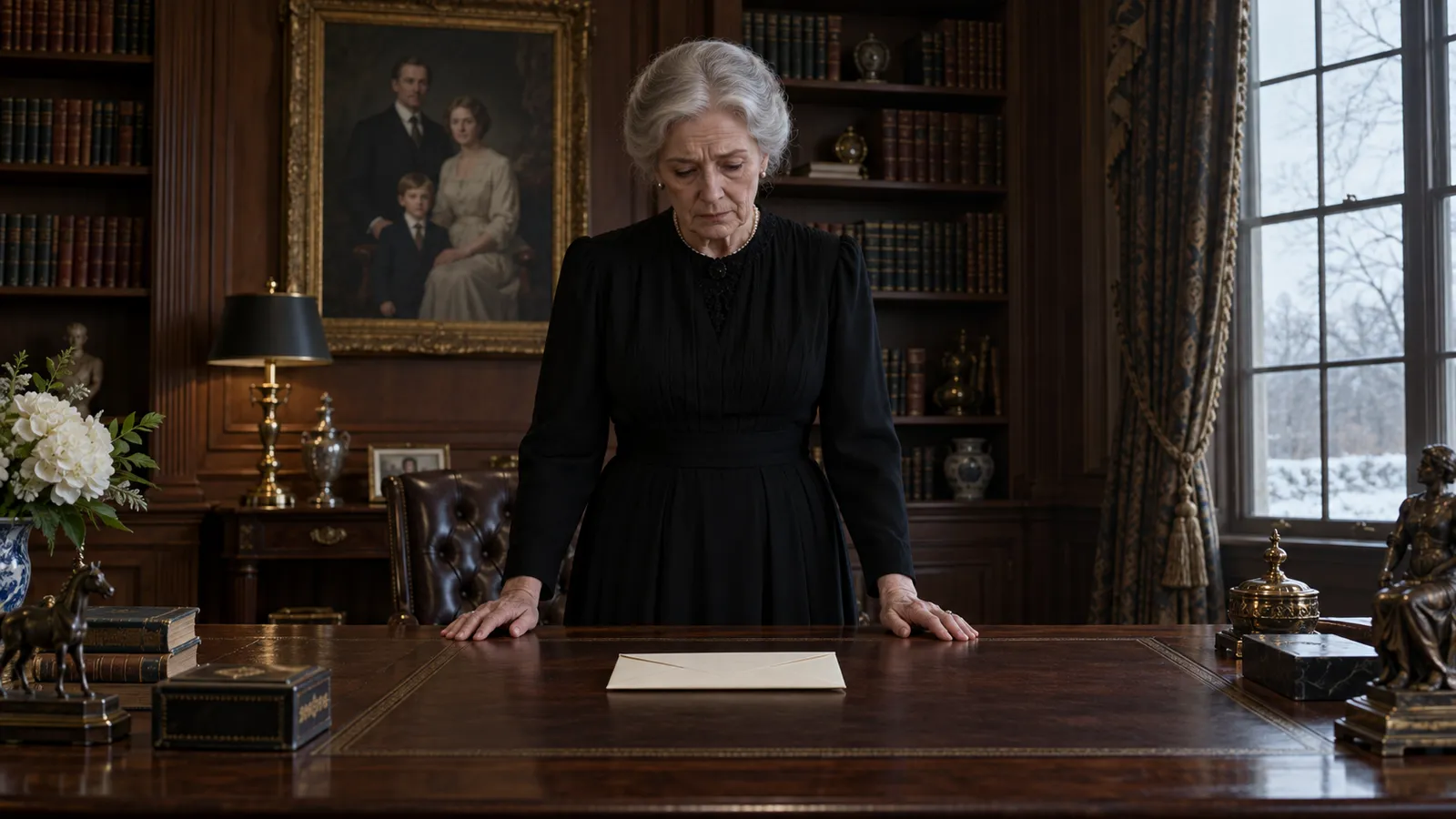
Hugo Vaughn came out of the study with a sealed legal envelope in his hand and his black leather briefcase in the other. He walked with the particular care of a man who has done a difficult thing many times and has learned not to let the difficulty show. He was wearing his charcoal suit. He had driven down from Meridian Street at my request, and he had been waiting in the study for forty minutes before we arrived home from the church, and Clementine and Dexter had not known he was in the house. I had arranged it that way.
He placed the envelope on Augustine's desk. He did not open the briefcase. He put both hands on the back of the chair and looked at Clementine, then at Dexter, then briefly at me.
"Your father changed his will," he said.
The room was quiet. Clementine had one hand on the study door. Her knuckles were visible from where I stood.
"When?" Dexter said.
Hugo did not answer. He opened the envelope, which he had sealed only after Augustine signed the final document, and removed the will. It was twelve pages. He placed it on the desk in front of the chair, turned to the relevant section, and stepped back.
Clementine moved past me. She leaned over the document. I watched her read.
The room stayed quiet for a long time. Augustine's sisters had put down their coffee cups. One of them — the older, Rosamund's age — had folded her hands in her lap and was looking at the ceiling, which is what she does, I have noticed, when she is waiting for a situation to conclude.
"He left everything to someone else," I said.
My voice was still level. It was still quiet. I was reporting what the document said, which was what I had already known it said for seven months.
Clementine straightened up. She was looking at me with an expression I had not seen on her face before — not anger, not exactly, but something that sits under anger, in the layer where the certainties are. The key dropped from her hand onto the desk. It made a small sound on the wood. Dexter stepped around her and reached for the document.
I turned back to the window. The garden was still there — the Japanese maple Augustine had planted the year our first grandchild was born, bare now in January, the branches making the same pattern against the white sky they had always made. The fountain in the center of the parterre was drained for winter. The garden looked exactly the way it looked from this window every January, and it occurred to me that it would continue to look that way long after this afternoon had been absorbed into the house the way all the other afternoons had been absorbed.
Hugo Vaughn picked up his briefcase. He looked at me once, briefly, and I nodded to him, which was all there was to say. He walked past Dexter, who was still reading, and past Clementine, who had moved to the window on the other side of the room, and through the front hall, and I heard the door close behind him.
The fire in the grate was nearly out. I put the screen in front of it and sat down in Augustine's chair, which no one had sat in since he died, and waited for one of my children to say something that required an answer.
Neither of them did, for a long time. When Clementine finally turned from the window, what she said was, "You did this."
I said, "No."
That was the only lie I told that afternoon.
End of chapter 1