Family6 min read
He Left Everything to Someone Else
On the afternoon of her husband's funeral, my daughter grabbed the safe key from my hand and told me what belonged to her now. She didn't know her father had already answered that question — eight months before he died.
Chapter 2: The Will Contest
The will contest was filed on February 3rd, sixteen days after the funeral.
I knew it was coming. Dexter had a spreadsheet by Sunday evening. I know this because Clementine called me Sunday night and told me so, which she did to hurt me, because she believed I had been keeping secrets and she wanted me to understand that her brother was not the kind of man you kept secrets from. I agreed with her on that last point, which seemed to confuse her.
The grounds were undue influence. Specifically: that I had exerted improper pressure on Augustine during the final months of his life, during which his cardiac condition had been managed with a combination of medications that, their attorney would argue, impaired his capacity to make considered decisions. I read the filing when Hugo sent it over. It was thirty-eight pages. It named me eleven times.
I put it in the drawer where I keep the Foundation's quarterly audits and did not read it again.
The Foundation — the Collier Family Foundation — was established in 1998. Augustine had come home that March with a cashier's check for $180,000, the remainder of his share of a commercial contract he had negotiated with the county for a road-widening project on the east side. He said he wanted to do something with it that would last. He meant something outside the business, something that would not have his name on the payroll. We sat at the kitchen table for an evening and I wrote down what he said, in the ledger I keep for that kind of thing — a bound book, not a spreadsheet — and by the time we went to bed we had the outline of a charitable trust. I became its unpaid treasurer that same year. Twenty-eight years of quarterlies, annual audits, the same gray binder with the Foundation's letterhead on the spine. Clementine had attended one Foundation gala in twenty-eight years. Dexter had never attended one.
Hugo called me the week after the filing to go over the discovery process. The other side had requested Augustine's personal financial records and business records from the last five years. The request was broad enough to include billing ledgers, client contracts, account transfers, and internal correspondence. Hugo said the request would likely be granted by the court.
I sat with that for a moment after he said it.
"All five years," I said.
"The standard window," Hugo said. "We can narrow it in response, but I would not expect a significant reduction."
"And the business records. Collier Construction."
"Yes."
I thanked him and said I would call back. I put the phone down and looked at the ledger on my desk — the Foundation's, not the business's. The two are kept separately. I am precise about separation. Augustine built the business; I keep the Foundation's accounts. That is the division we agreed to in 1998 and maintained without discussion for twenty-eight years, because it was a clean line and clean lines are what we were good at.
The clean line had become relevant in a way I had not anticipated when Hugo first called me about the revised will.
Clementine called three days after Hugo did. She called from a number I did not recognize, which meant she had borrowed someone else's phone, which meant she knew I might not answer hers. I answered anyway.
She said that she and Dexter had spoken to a forensic accountant. She said that word — forensic — with a precision that suggested she had been practicing it. She said the accountant had reviewed what was publicly available about the Foundation's financials and had flagged several inconsistencies.
"Flagged," I said.
"In the disbursement records," she said. "From 2022 and 2023."
I said that the Foundation's disbursement records from those years had passed their annual audit without exception and that the auditor's report was on file at the county charitable registry. I said this the way I say most things I have verified — without heat, because heat is what people read instead of the content.
Clementine was quiet for a moment.
"You sound like you're reading from a document," she said.
"I am not," I said, which was true. I had committed those figures to memory in 2022, the year the figures mattered, the year Augustine and I sat in the kitchen for three evenings with the Foundation ledger and the quarterly report and made sure the lines held. Because that was what the Foundation was: a clean line we had agreed to maintain.
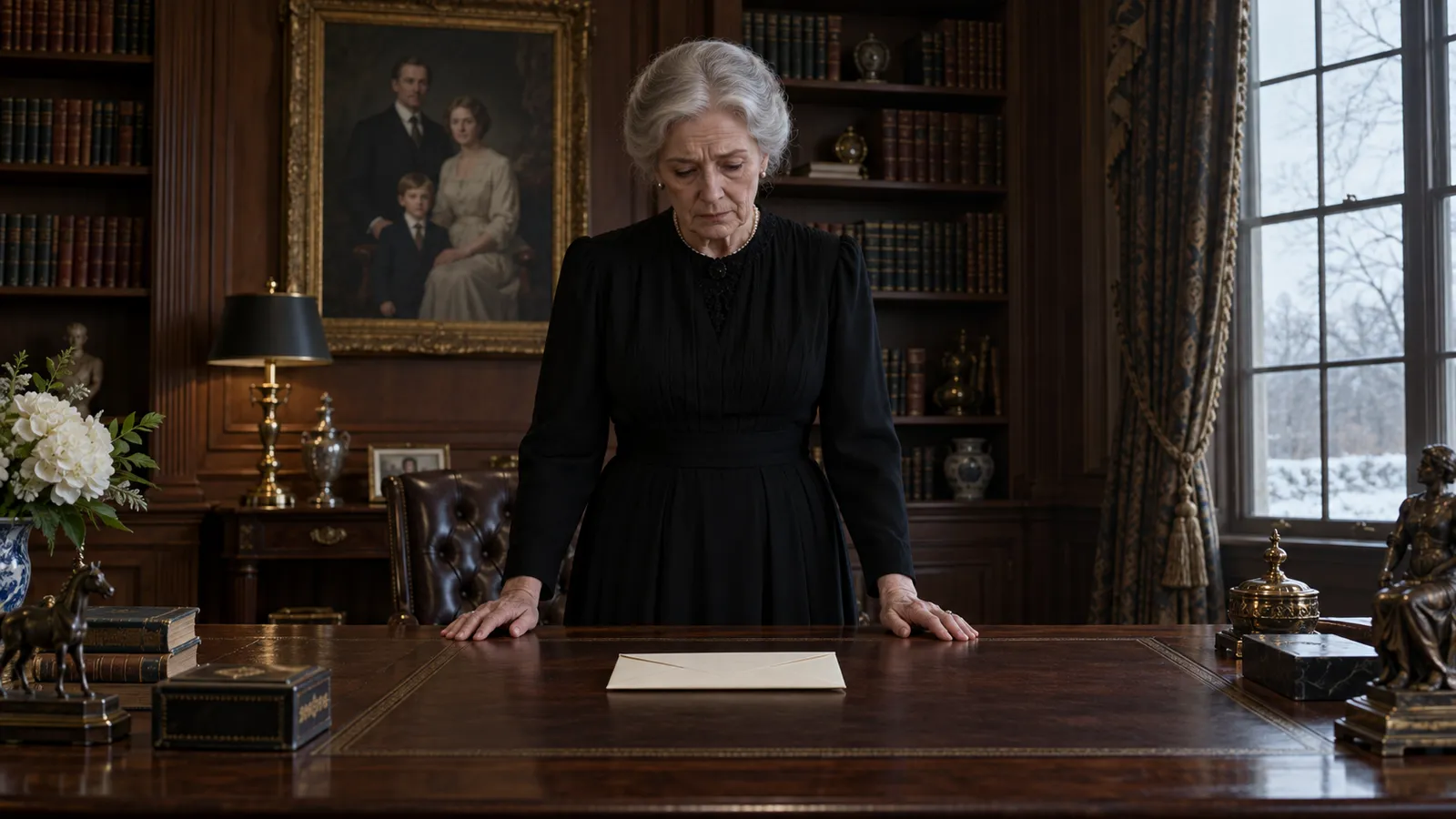
After she hung up I sat for a long time in Augustine's chair. It was the first time I had sat in it since the afternoon of the funeral. The fire was not lit. The room was cold in the way that rooms are cold when they have not been used by someone who knew how to use them, and I had not yet learned how to be the person who lit that fire for herself.
My neighbor Rosamund came by that afternoon with a casserole. She set it on the kitchen counter, looked at me for a moment, and said nothing except that she would be around and I should call. She did not ask about the children. She did not ask about the will. She had been married to the same difficult man for forty-one years and had not needed anyone to explain to her what it looked like when a woman was doing something hard on her own.
I thanked her and watched her go back across the yard.
The subpoena was granted on February 14th. Augustine's business records — all five years — would be produced to the court within sixty days. The records from Collier Construction included billing ledgers, account transfers, client correspondence, and, I had no doubt, the internal financial documentation that Augustine's forensic accountant had used to compile the report that was currently locked inside the study safe.
Hugo called to tell me. He was careful and professional, as he always is, and he did not say anything that was not in his role to say.
"Are you prepared for what the records may show?" he asked.
"I am," I said.
"Is there anything you want me to do differently in response?"
I thought about that.
"No," I said. "Proceed as required."
After I hung up I went to the desk and opened the Foundation ledger. It was the current year's — 2026, started in January, only a few entries. Augustine's name appeared twice in the notes column, where I had written his name as I always had, out of habit, because for eighteen years I had been noting things he had said that I wanted to remember and putting them in the ledger where I would find them again. I looked at his name in my handwriting for a long time.
Then I closed the ledger and set it on the corner of the desk where I always set it, and went to the kitchen to heat the casserole Rosamund had brought.
The business records would go to the court. The court would produce them to the other side's attorney. Their forensic accountant would review them. Somewhere in that review, they were going to find what Augustine had found. And when they found it, they would understand why they had lost the money. And when they understood that, they would also understand that their father had known, and had chosen not to destroy them in the way they had perhaps deserved.
I did not know yet whether that understanding would be better or worse than what they believed now.
I heated the casserole. I ate it at the kitchen table with the ledger closed on the corner of the desk. The maple in the back garden had not changed. The fountain was still drained.
I decided I would go into the study the next day.
End of chapter 2