Family6 min read
He Left Everything to Someone Else
On the afternoon of her husband's funeral, my daughter grabbed the safe key from my hand and told me what belonged to her now. She didn't know her father had already answered that question — eight months before he died.
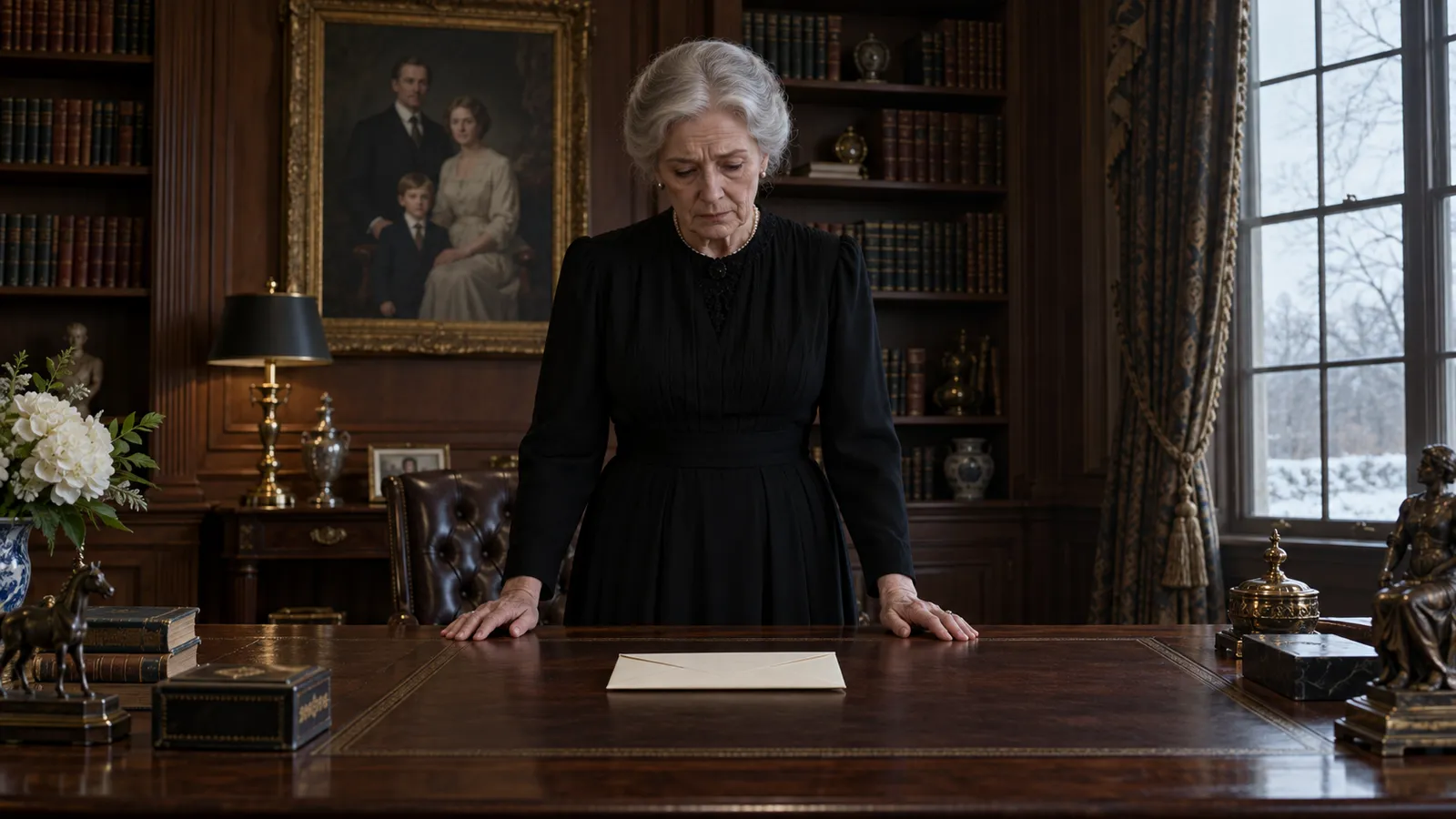
Chapter 3: The Report
I went into the study the next afternoon.
Not in the morning. I had set the intention to go in the morning and then made coffee and sat at the kitchen table with the Foundation ledger and entered the one transaction from January that I had been putting off — a disbursement to the Harmon County literacy program, the second installment of a three-year commitment Augustine and I had approved together in the fall. I entered it precisely. I reviewed the balance. I closed the ledger. And then I sat with my coffee for another hour, which is to say I was afraid of the study in the way I am rarely afraid of things.
I had been in the study on the afternoon of the funeral, briefly, to make sure the room was arranged for Hugo. I had not been back since.
The study smelled like Augustine — paper and the faint cedar of the pencil holder on the desk, the one his father had made on a lathe in the 1950s and given him when he graduated. I stood in the doorway for a moment. There was no reason to wait in the doorway. I went in.
The safe was in the cabinet beside the window — the old Mosler, black steel, a combination lock and then a key lock, the key being the brass key Clementine had dropped on the desk three weeks earlier and that I had picked up on my way out of the room. The combination Augustine had chosen in 1989 and kept until he died was the telephone number of the first office Collier Construction had ever leased, a four-room suite on Baxter Street that he'd outgrown in three years. He told me the combination in 1989 because he said he might forget it and needed someone who wouldn't.
I opened the safe.
The forensic accountant's report was in a manila folder with the words COLLIER CONSTRUCTION — FINANCIAL REVIEW — CONFIDENTIAL typed on the tab. It was eighty-one pages, spiral-bound, printed on the kind of dense paper that accountants use for reports they expect to be read by lawyers. I set it on the desk and sat down.
Augustine had told me the substance of what it contained. He had told me in May, on an afternoon when he came in from the garden and sat down at the kitchen table and said that he had the report back from the accountant and he needed me to know what it said. He had been calm. He had always been calm about difficult things; it was his peculiarity and the thing that had made him, in his working years, a man others brought their worst problems to. He told me about the billing accounts, the client overpayments routed through personal accounts, the duration, and the total. He did not use the words fraud or embezzlement. He said that money had been moved in ways it should not have been moved, and that he had confirmed it was intentional.
I had asked him what he was going to do.
He said he had been thinking about that for three weeks.
He said he was not going to prosecute.
I had sat with that for a moment, and then I said that was his decision to make.
He said it was. He said that the business had enough equity to survive it, and that he was not willing to put either of his children in a courtroom as defendants, and that he had decided to handle it differently. He said he would be calling Hugo about the will.
I had not read the report that afternoon, or any afternoon after that. I had known it existed and I had known what it contained, in the way you know the weight of a thing without having picked it up yourself. Now I read it.
The summary was six pages. The main body was seventy-five, organized by fiscal year. The accountant — a firm out of the city, not anyone we knew — had reconstructed the transfer pattern from billing statements, client deposit records, and bank account documentation. The scheme had started in 2019, when Dexter had taken over the day-to-day operations of the business and Clementine had moved into the client services role. The pattern had been consistent. The amounts had been small enough, per transaction, to stay within the threshold that would normally trigger a review.
Over five years: approximately $2.3 million.
In the margins, in pencil, in Augustine's handwriting, there were notes. Not many — he was not a man who wrote his feelings in margins. But in the summary section, beside the accountant's conclusion, he had written one thing: They thought I wasn't watching. I was watching from the beginning.
I read that note three times.
The question I had been sitting with since May — since the afternoon Augustine told me — was what it would mean to give Clementine and Dexter the report now. They were going to find the business records through discovery. Their accountant would eventually find the same trail the report documented, or enough of it. They would understand, in some version of understanding, that their father had known what they had done. Whether they would understand why he had chosen not to prosecute — that was the question I could not calculate.
Augustine's margin note was not anger. It was not satisfaction. It was the note of a man who had been watching, who had continued to watch, and who had made his decision about what watching cost and what it was worth.
I thought about what Clementine had said on the phone: You did this.
I thought about what I had said: No.
That was the lie I had told that afternoon, but it was not the lie about the will. The lie was a different shape. Clementine had meant something specific when she said I had done this, and I had answered a different version of the question, the version in which I had not manipulated a dying man. That version was true. The other version — the one in which I had sat in the kitchen in May while my husband told me our children had stolen $2.3 million from his business, and said that the decision not to prosecute was his to make, and gone to bed that night, and gotten up the next morning, and made coffee, and not told anyone, ever — that version was also true.
I had decided in May that it was Augustine's decision. I had made that decision again every day since. I was making it now.
I put the report back in its folder. I put the folder back in the safe. I closed the combination lock and then the key lock, and put the key in my pocket. I sat for a moment in the chair at Augustine's desk, in the room that smelled like him. The cedar pencil holder. The window that looked out on the same garden as the kitchen window, a different angle.
The thing I would not give to Clementine and Dexter was not the report itself. They were going to find an equivalent, through discovery, eventually. The thing I would not give them was Augustine's margin note. They thought I wasn't watching. I was watching from the beginning. That was between him and me and whoever he had written it for, which I believed was me.
I also would not give them the explanation. They were going to lose the money. They were going to lose the will contest — there was no undue influence, there was no impaired capacity, there was only a man who had made a decision in full possession of himself. Hugo had been clear about this, as clear as Hugo is ever clear about anything. They were going to lose and they were going to spend the rest of their lives in the certainty that their mother had turned their father against them, because I would never tell them otherwise, and they would not look for another explanation when the one they had was so satisfying.
Augustine had not wanted them prosecuted. He had wanted them to lose what they had taken and to keep the reason.
I locked the study door behind me. I went back to the kitchen, where the Foundation ledger was still on the corner of the desk. I put the kettle on. I looked at the garden through the window above the sink — the maple, the drained fountain, the particular way the light fell in February, flat and cold and honest.
The report would surface eventually. When it did, Clementine and Dexter would understand the when and the how. They would not understand the why, which is the part Augustine had left for me.
End of chapter 3