Family6 min read
He Left Everything to Someone Else
On the afternoon of her husband's funeral, my daughter grabbed the safe key from my hand and told me what belonged to her now. She didn't know her father had already answered that question — eight months before he died.
Chapter 4: The Letter
Hugo came on a Tuesday morning in late February, by appointment.
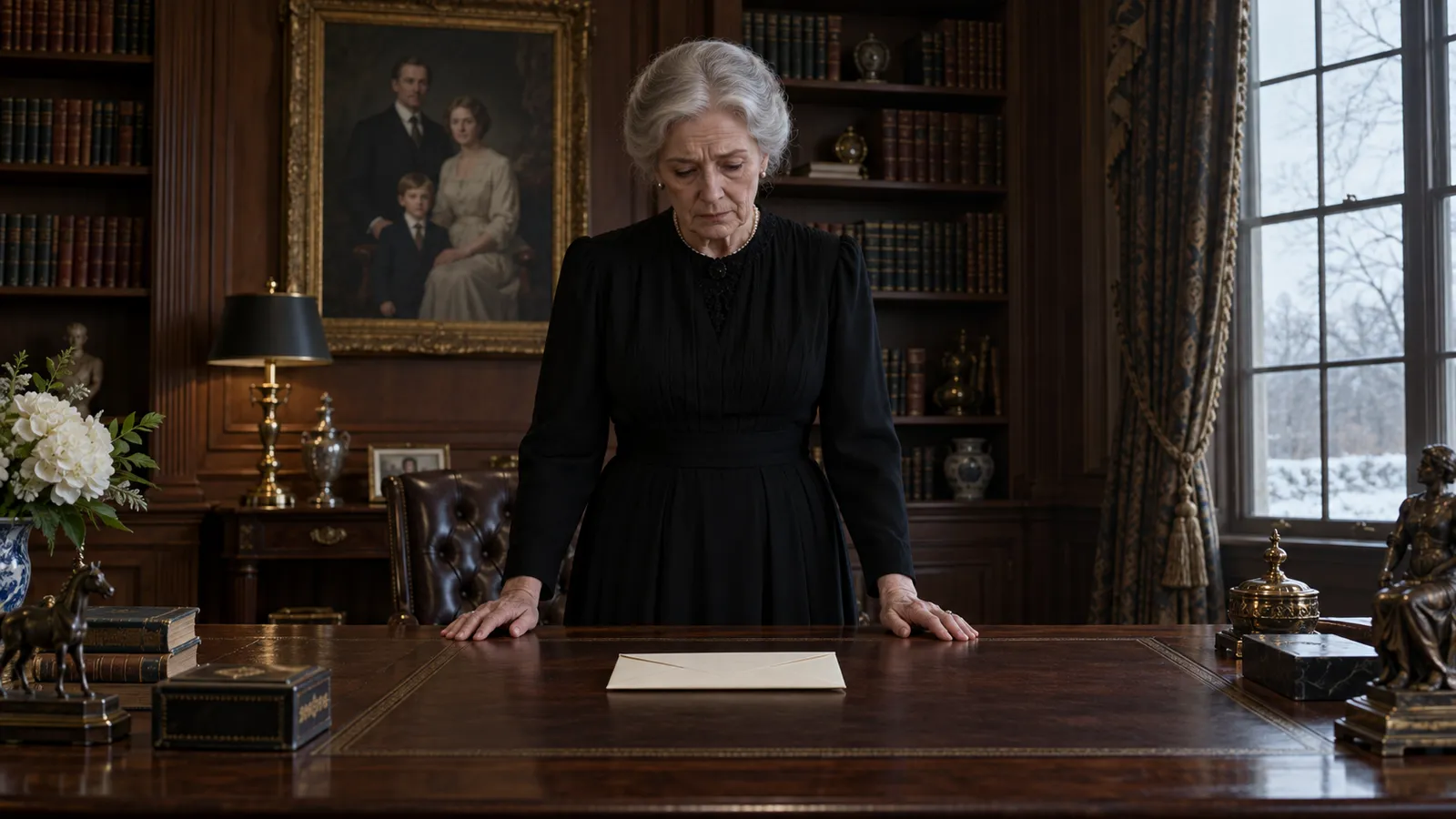
He was wearing the same charcoal suit he had worn to the funeral, which I did not think was deliberate — it was the suit he wore for estate matters. He carried the black leather briefcase. He declined coffee, which he always does, and sat in the chair on the other side of Augustine's desk while I sat in Augustine's chair and we went through the remaining administration. The estate inventory. The Foundation's updated trustee designations. The probate calendar. Hugo had been managing Collier estates for twenty-two years, and he moved through paperwork the way he moves through everything — exactly, without comment on what the paperwork contains.
When we had gone through the last item, he reached into the briefcase and set a sealed envelope on the desk in front of me. It was smaller than the will envelope. It was addressed in Augustine's handwriting: For Philippa, with the date — June 14, 2025. The day he had signed the revised will.
"He asked me to hold this until the estate was substantially closed," Hugo said. "We're not there yet, legally, but I thought you should have it."
I said I understood.
Hugo picked up his briefcase, and we walked to the door, and I thanked him, and he said he would call about the probate calendar, and then the door closed and I was alone in the house with the envelope.
I brought it to the kitchen table.
I have read many documents at that table. Tax returns, Foundation audits, school district reports during the twenty-two years I spent in administration, correspondence that required careful answers. Augustine used to sit across from me on mornings when he had a contract to review, and we would each read our respective documents and occasionally read passages aloud to each other if something was interesting or unexpected. The kitchen was the working room in this house. The study was where Augustine kept his records; the kitchen table was where we read them.
I opened the envelope.
The letter was three pages, on the same heavyweight bond Augustine used for formal correspondence. His handwriting, which had been large and precise his entire life, was slightly smaller now — the result, I thought, of the medications, which had affected his fine motor control in the last months. It was still readable. It was very clear.
He began with the date and a statement of his intentions, which was how he always began formal correspondence. Then:
I want you to know what I found, and what I chose, and why.
He described the forensic accountant's findings in the same terms he had used in the kitchen in May, but in more detail — the bilateral nature of the scheme, the specific accounts, the precision of the amounts chosen to stay below review thresholds. He did not use the word clever. He used the word deliberate, twice. He wrote that he had spent three weeks after receiving the report trying to find a reason to believe it was something other than what it was, and that he had not found one.
He wrote that he had decided not to prosecute because he believed that the consequences of prosecution — for the business, for the family, for the possibility of any functional relationship for whatever time remained — would be worse than the consequences of not prosecuting. He wrote that he knew this was a choice that some people would call weakness, and that he had considered that and decided he was willing to carry it. He had not been willing to carry it quietly, which was why he had called Hugo about the will. He had wanted the financial consequence to be real. He had not wanted the public consequence.
He wrote that he had told me and not them because he trusted me to know the difference between a decision I was party to and a decision I was responsible for. He wrote: You are not responsible for what they did, and you are not responsible for what I decided. You are only responsible for what you do next, and I trust you to know what that is.
The last page was shorter.
He wrote that the Foundation was in good hands because it had always been in good hands, that the literacy program was the right commitment for the next three years, that the endowment meeting in the spring should probably address the maintenance fund.
And then, at the bottom of the last page:
The maple needs a trim on the east side before spring. The branches are crossing.
That was the last line. I read it three times.
I sat at the kitchen table for a long time after that. The light was coming through the window above the sink — the same angle it comes through in late February, flat and pale, the kind of light that does not make anything easier to look at but doesn't distort anything either. The maple in the garden was bare still. I could see the east side from where I sat. The branches were crossing.
I folded the letter and set it on the table. Then I went to the study and opened the safe and took out the forensic report in its manila folder. I brought it back to the kitchen. I ran water in the sink — not much, just enough to manage any stray ash — and I lit the corner of the first page with the lighter I keep in the utility drawer for the candles at the Foundation's annual dinner. The paper caught slowly. I fed it into the sink a few pages at a time.
The smoke was thin and the room was ventilated and the whole thing took eleven minutes by the clock on the microwave. When it was done I ran water over the ash and let it drain. I washed the sink. I stood at the window for a moment and looked at the maple.
The report would surface through discovery. Clementine and Dexter's accountant would reconstruct enough of the transfer pattern to understand what had happened. They would know that their father had found out. They would lose the will contest on top of everything else, because the discovery of the fraud would make the undue influence claim untenable — a man who rewrote his will specifically in response to a documented financial betrayal had not done so under anyone's influence.
They would not have Augustine's letter. They would not have the margin note. They would not have the three weeks he had spent looking for an alternative explanation and not finding one. What they would have was the fact of what they had done, and the consequence of what he had chosen, and a mother who had known the whole time and said nothing.
I did not know if that was mercy or something else entirely. I had decided it was not my question to answer.
I went back to the kitchen table and opened the Foundation ledger. The letter was beside it. I took the letter and folded it once more and placed it in the inside cover of the ledger, which is where I put the things I want to find again. Augustine's name was in the notes column twice from January. It would be in there again, in March, when the endowment meeting convened and I would sit with the trustees and discuss the maintenance fund in the language of governance, which is a language I am fluent in.
The ledger was open on the table. The maple needed a trim on the east side before spring.
I wrote down what I would say to the arborist.
The end