Family6 min read
I Paid for Every Room
My daughter told me I'd only slow them down. I didn't argue. I picked up my phone instead. I had paid for every room.
Chapter 1: The Window
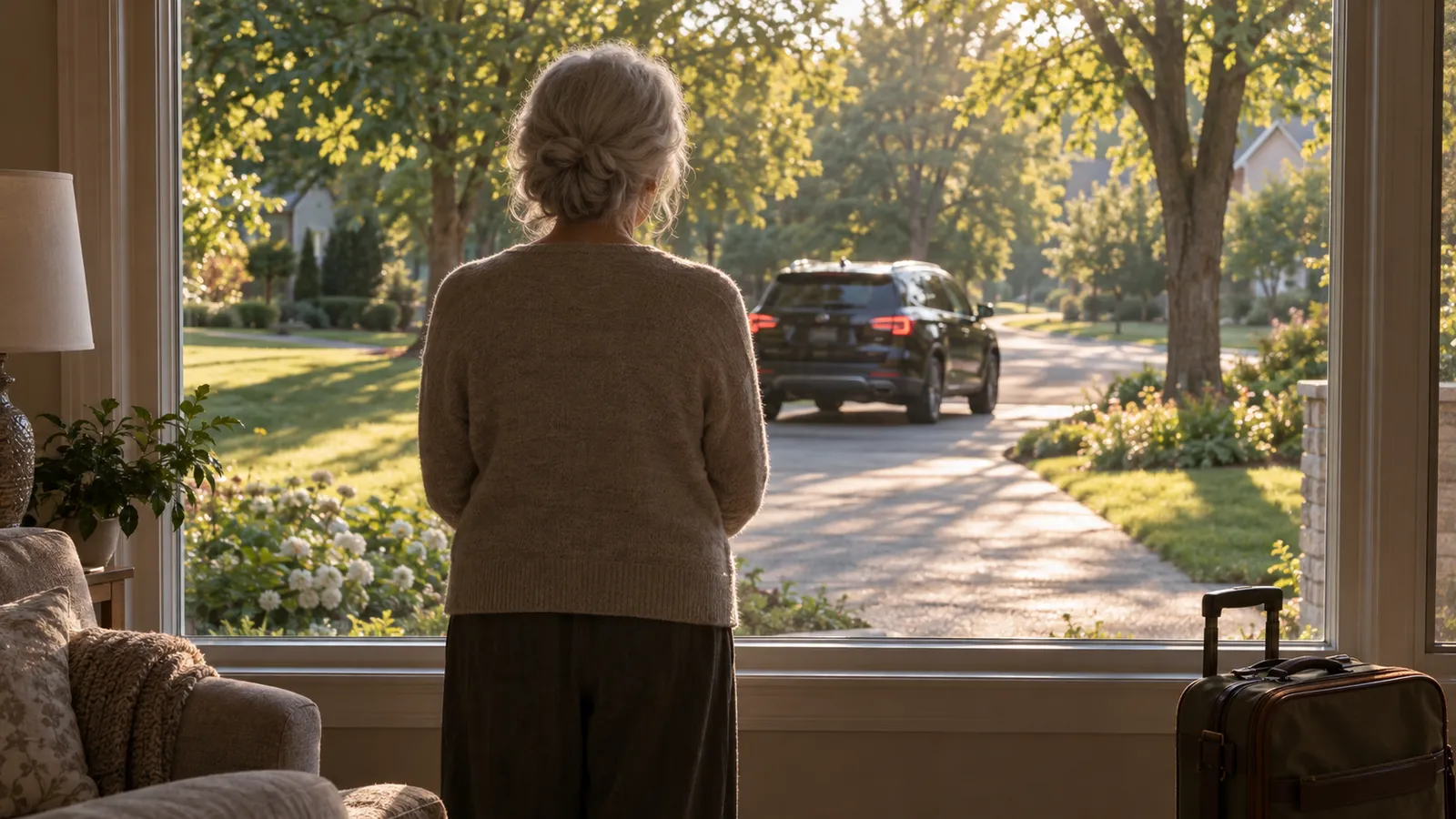
I was standing at the window with my packed suitcase when Delphine told me I would only slow them down.
The suitcase was a small one — the canvas carry-on with the broken wheel that I've been meaning to replace since 2019 — and I had it pressed against my calf because there wasn't room beside the armchair with the lamp table there. The lamp table has been in that corner since Harold died, and I have never moved it. Outside, Corbin was loading the car. Two large rolling suitcases, one duffel, one cardboard box of snacks that Delphine had packed the night before. The SUV's rear hatch was open and he kept having to rearrange things to make them fit. I watched him lift the blue duffel, set it down, lift it again.
Annika was standing near the passenger door in a yellow shirt with her arms crossed, the way she does when she doesn't want to be somewhere. She looked up at the window. I don't know if she saw me. I raised my hand slightly, a small wave, but she'd already looked away.
Delphine came in from the kitchen carrying her purse and her phone and the printed confirmation pages in a manila folder, which was the kind of thing she still did — printed things, put them in folders. She had been doing that since she was eleven and in charge of the family's vacation itinerary while I was working summers. I used to come home to find neat stacks of printed MapQuest directions and motel phone numbers on the kitchen counter. It was a charming habit in a child. In a woman of forty-two, it is just her way of being in charge.
She said, "We're almost ready."
I said, "I know. I'm ready too."
There was a pause. She looked at the suitcase, then at me, then at something past me, the way you look at a wall when you're deciding something.
She said, "Mom, I've been thinking. The drive is five hours. The resort has all those stairs to the beach. You'd really just—" She stopped. Started again. "You'd just slow us down."
I have been 74 years old since February. My left knee is unreliable on wet pavement. I take a blood pressure pill at seven every morning and a second one at seven every evening, and I have not missed a dose in six years. I walk two miles every morning. I went to Patricia Welch's birthday party in February and I danced twice. These are facts about me the same way the weather is a fact about the day. I had not thought of any of them as reasons I should not go to the beach.
I asked, "Aren't I coming with you?"
She said, "Mom, you'd just slow us down."
She had already said it once. Now she said it again, a little softer, the way you repeat something to someone who didn't hear it the first time. I heard it both times.
Corbin appeared in the doorway. He had on a blue polo shirt with a collar, which he wore when he was trying to seem in control of things. He looked at Delphine. Then he looked past me, at the wall, at the calendar that hangs beside the kitchen doorway with my handwriting on it. He looked at it the way you look at something when you are keeping your eyes somewhere safe.
Annika appeared behind him. She was still in the yellow shirt. She looked directly at me, which was more than Corbin was managing, and her expression was the one she wears when she has decided to wait and see — not agreement, not resistance, just watching.
I said, "All right."
Nobody asked what I meant.
I set the suitcase down beside my chair. It made a small sound when the bad wheel touched the floor. Corbin said, "We should get on the road." Delphine said, "I'll call when we get in." Neither of them was speaking to me. It was the voice people use when they're already somewhere else.
I followed them to the door. Delphine gave me a quick hug, the kind where only the shoulder makes contact. Corbin said, "Take care, Marguerite." He was already walking toward the car when he said it, which is a way of saying a thing without having to look at the person you're saying it to. Annika paused at the threshold, almost long enough to say something. She looked at the suitcase beside the chair. She looked at me. Then she didn't say anything and went down the porch steps.
I stood in the open doorway and watched the car back out of the driveway. The hatch was fully closed. There was no indication from outside the car that anything unusual had happened. They turned onto the street and I watched until the SUV reached the intersection and turned right, toward the highway.
I went back inside.
The reservation confirmation was on my phone, in an app called Pelican Crest Guest Portal that I had downloaded in April when I made the booking. Three nights, two adjacent suites. Check-in Saturday, checkout Tuesday. Total charged: $8,400, which included the resort fee, the parking, and the upgrade to suites that Delphine had asked for when I was on the phone with them. My card number, my name, my email address. I had forwarded the confirmation to Delphine in April. She had replied: Perfect, thank you Mama followed by a sun emoji and a beach umbrella emoji.
I stood in the living room for a moment, the phone in my hand.
Then I sat down in my chair.
Delphine had the manila folder with the printed pages. What she did not have was the login for the Pelican Crest Guest Portal. I had set it up myself when I booked the rooms, because I had wanted to see the floor plan of the suites, whether the bathroom in one faced the water or the parking lot. That kind of thing matters to me. Delphine had asked at one point if I needed help with the app, and I had said no.
I opened the app.
My name was at the top: Welcome back, Marguerite MacKenzie. The reservation was there. Three nights. Two suites. Five names on the guest list, one of which was mine.
Five names. Delphine's. Corbin's. Annika's. Corbin's sister, who was apparently joining them on Saturday evening, which was the first I had heard of that.
I tapped Manage Reservation.
It asked me to confirm my identity with the last four digits of the card I had used for the booking. I typed them. I have had that card for nine years and I know the number the way I know my own phone number. The screen went to the reservation details. At the bottom there was a red button.
I thought about Delphine checking her phone five hours from now, pulling into the resort, showing the folder to the front desk attendant.
Corbin's sister. Saturday evening.
I tapped the button.
A message appeared: Are you sure you want to cancel this reservation? This action cannot be undone. All guests will receive cancellation notifications at the email addresses on file.
I tapped Confirm Cancellation.
Delphine came back before I expected her. I heard the car in the driveway — the hatch must have already been closed — and then her key in the lock, and she came in fast, phone in her hand, her face doing something I hadn't seen it do before.
She said, "What are you doing?"
I said, "I paid for every room."
She looked at me. She looked at the phone in my hand.
She said, "What are you doing?"
I looked at her.
I said, "Canceling my reservation."
She froze. I turned the phone screen away from her and set it face-down on the side table. Then I walked to the kitchen and put the kettle on.
I set the phone face-down on the side table, walked to the kitchen, and put the kettle on.
End of chapter 1