Family4 min read
The Key Taped Under the Mailbox
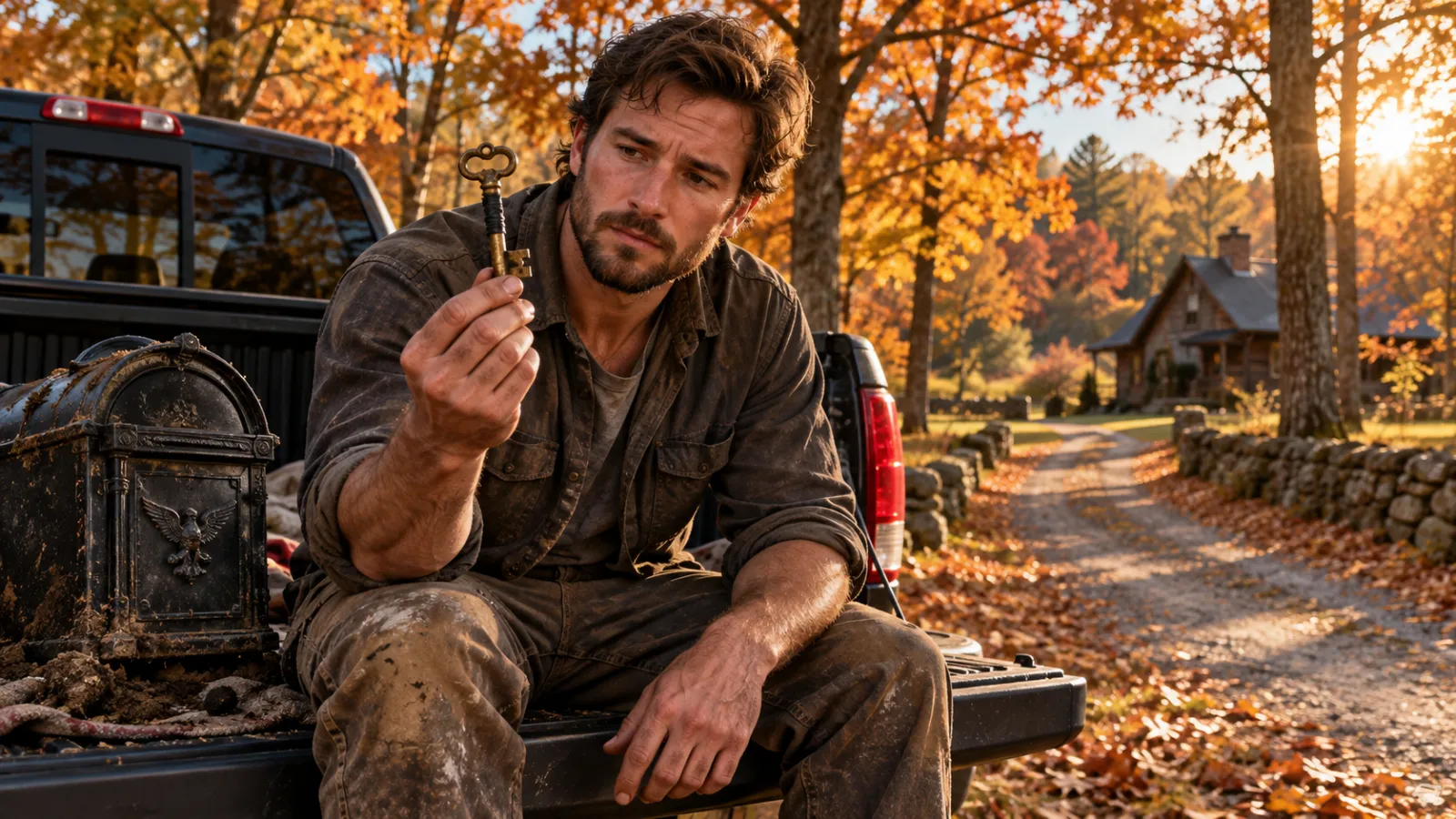
When older brother Raymond auctions Grandpa Arthur's house and leaves Lucas only a heavy cast-iron mailbox as scrap iron, he thinks he won. Restoring the metal in his workshop, Lucas finds an antique brass key and an irrevocable deed to a hidden fifteen-acre lakefront cedar lodge.
Chapter 1: The Auction at the Lake House
When my older brother Raymond sold our grandfather's estate at auction and handed me Arthur's rusted cast-iron mailbox as my entire inheritance, he laughed and told me to sell it for scrap. He had no idea Grandpa Arthur had taped an antique brass key and an irrevocable deed under the false bottom.
The gravel driveway was crowded with pickup trucks, flatbed trailers, and strangers haggling over things that had defined my childhood. It was a brisk Saturday in late October in Ashland County, Ohio. Dry maple leaves scuttled across the limestone foundation of the small cottage where Arthur Vance had lived for fifty-four years.
My brother Raymond stood on the front porch steps, looking like a visiting banker who had gotten lost on a back road. At forty-two, Raymond ran a boutique commercial brokerage in Columbus. He wore a camel-hair overcoat, spotless Italian leather loafers, and a gold watch that caught the pale autumn sunlight whenever he checked the time.
The auctioneer's chant rose and fell like a rhythmic engine over the loudspeaker. One by one, Arthur's treasures vanished into the beds of strange trucks. His 1948 Delta wood lathe, with its heavy green cast-iron bed and smooth pulley drive, went to a cabinetmaker from Wooster for four hundred dollars. His set of Lie-Nielsen hand planes, which Arthur had kept oiled in soft felt rolls inside a cedar chest, sold for three hundred. Boxes of brass fittings, vintage fishing reels, and stacks of quarter-sawn white oak planks were tagged and hauled away.
I stood beside my battered 2011 Silverado, my hands stuffed deep into the pockets of my canvas chore jacket. My knuckles were scarred from fifteen years of custom carpentry, the trade Arthur had taught me before his fingers began to tremble.
For the final four years of Arthur's life, I was the one who lived in the drafty back bedroom of this house. When Parkinson's disease began stealing his balance, I lifted him into his rocking chair each morning. When his hands could no longer grip a spoon, I prepared pureed squash and vegetable broth. I washed his flannel sheets, managed his medications, and listened to his stories about forty-one years working as a mechanical foreman for the Norfolk Western railroad.
Raymond visited twice a year. He would park his leased black Mercedes by the lilac bushes, leave the engine idling while he made business calls, and walk through the kitchen only to ask if Arthur had located his municipal bond certificates. Raymond never touched a dust rag. He never emptied a chamber pot. Whenever Arthur asked him about his family, Raymond smiled politely, checked his phone, and promised to visit longer next time.
Three weeks ago, Arthur passed away peacefully in his sleep at eighty-six. The memorial service had barely concluded before Raymond filed probate petitions, declaring himself personal representative of the estate under an outdated handwritten will from twelve years ago.
By three o'clock that afternoon, the auction crowd thinned out. The gravel drive stood empty, littered with crushed plastic cups and yellow bidder tags. The cottage looked hollow, stripped down to bare floorboards and dusty baseboards.
Raymond walked down the porch steps, carrying a leather folio under his arm. He approached my truck with a smug, hurried expression.
'Well, Lucas, that wraps up the liquidation,' Raymond said, tapping his manicured index finger against the folio. 'After paying the outstanding hospice invoices, the property tax arrears, and my estate management fees, the liquid balance is virtually zero. The cottage itself was already pledged under a private contract to a retail developer from Mansfield. You know how volatile rural real estate can be.'
I stared at him, my jaw clenched. 'Arthur spent half his life building the cabinetry in that house, Raymond. You sold the entire place for quick cash before the grass even took root on his grave.'
Raymond sighed with theatrical patience, adjusting his designer glasses. 'Sentimentality does not pay administrative costs, little brother. I have fiduciary responsibilities to settle debts. Be realistic. You are thirty-three years old and making cabinets in a rented barn. You have no head for real financial assets.'
He turned toward the locust post near the ditch. An hour earlier, Raymond had used an electric impact driver to unbolt the old mailbox Arthur had erected forty years ago. It was a massive, weathered box of black cast iron, shaped like a miniature railroad freight depot, pitted with rust and spattered with dried road dust.
Raymond lifted the heavy iron box with an exaggerated grunt and tossed it carelessly into the bed of my truck. The metal clanged sharply against the ribbed steel liner.
'Take this piece of scrap iron, Lucas,' Raymond chuckled, wiping grease from his fingers with a monogrammed handkerchief. 'Grandpa welded it himself back in the seventies. Consider it your sentimental souvenir. You can use it for nails, or you can haul it down to the scrap yard in Loudonville and get twenty dollars for the cast metal. It suits your line of work.'
Without waiting for my reply, Raymond turned on his heel and walked toward his Mercedes. The car engine purred softly, and he accelerated down the dirt lane, leaving behind a plume of gray dust.
I stood alone in the driveway for a long time. I walked to the tailgate, looking down at the heavy black iron mailbox lying on its side. It looked forgotten, discarded, and worthless. But as I reached out and touched the cold, textured iron, I felt a familiar reverence.
Arthur had made this with his own hands. I climbed into the cab, turned the key, and drove toward my workshop.
End of chapter 1