Family4 min read
The Key Taped Under the Mailbox
When older brother Raymond auctions Grandpa Arthur's house and leaves Lucas only a heavy cast-iron mailbox as scrap iron, he thinks he won. Restoring the metal in his workshop, Lucas finds an antique brass key and an irrevocable deed to a hidden fifteen-acre lakefront cedar lodge.
Chapter 3: Waterproof Tape and an Old Brass Key
The quiet inside the workshop was absolute, broken only by the hum of the transformer powering the overhead fluorescent tubes. I pulled a wooden stool up to the bench, switched on my jeweler's magnifying lamp, and leaned over the exposed cavity.
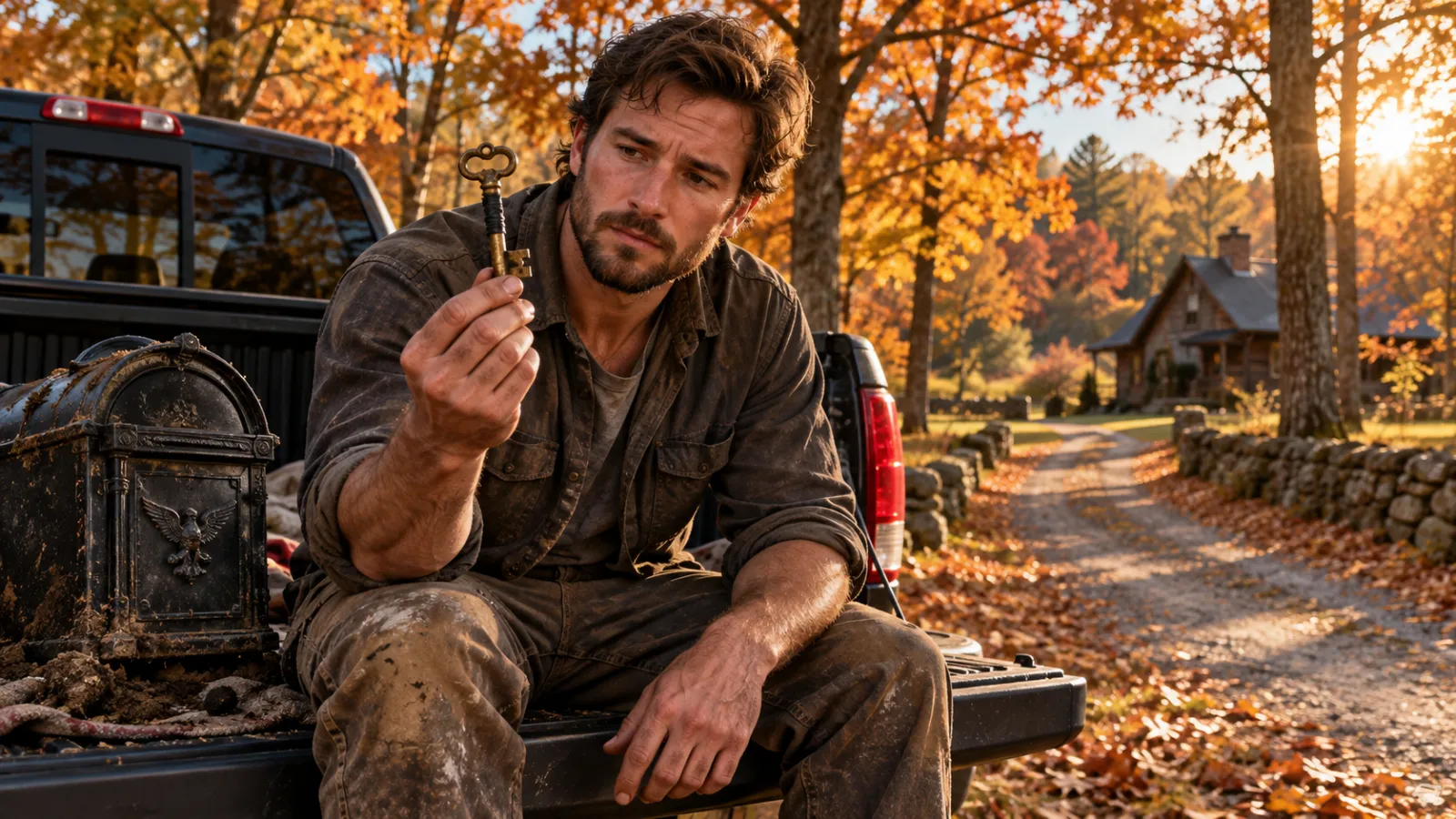
The interior compartment was lined with heavy oiled canvas, tucked into the milled corners and sealed against humidity with a bead of hardened amber rosin. Inside this waterproof lining lay two items: an antique brass key wrapped in heavy black electrical tape, and a thick legal envelope sealed with red drafting wax.
I lifted the key first. It was surprisingly heavy in my palm. Nearly five inches long, it had been cast from solid naval brass, showing the deep honey patina of polished metal kept in darkness for decades. The barrel was fluted, and the bit was notched with intricate, step-cut wards.
Stamped into the brass collar was a crisp railway inventory mark: 42-BF.
Wrapped tightly around the shank of the key was a folded strip of waxed drafting paper, secured by several overlapping layers of vulcanized black rubber tape. I used a sharp scalpel from my inlay kit to slice through the tape. The rubber smelled strongly of pine pitch and sulfur as it peeled away.
The folded paper inside contained a small hand-drawn map in black India ink. In Arthur's precise mechanical lettering, the heading read: Spur Line Access — Clear Fork Drainage.
I set the key and map aside on a clean square of linen and turned my attention to the envelope. The paper was heavy twenty-pound cotton bond, yellowed slightly around the edges but perfectly preserved. Across the front, written in the steady, calligraphic block letters Arthur used for engineering blueprints, were the words:
To Lucas Vance, Master Carpenter and Faithful Steward.
My hands trembled slightly as I slipped a thin bone folder beneath the wax seal. The brittle red disc cracked with a small pop. Inside were two folded legal documents and a three-page handwritten letter.
I unfolded the letter and began to read Arthur's words:
Lucas, my boy,
If you are reading this letter, it means I have reached the end of my line, and your brother Raymond has done exactly what I predicted he would do. Raymond lives in a world of quick transactions, ledgers, and empty prestige. He sees land only as acreage to be subdivided and houses only as structures to be stripped and flipped for a commission.
I knew that when my breathing slowed, Raymond would arrive with an estate appraiser before my sheets were cold. I knew he would sell my lathe, liquidate my checking accounts, and leave you with whatever he considered worthless junk.
What Raymond never understood is that real value is never listed on a public probate filing.
Forty years ago, before the Muskingum Watershed Conservancy District expanded the flood control reserves around Black Fork Lake, I bought a forgotten tract of timberland. It was fifteen point six acres of virgin hemlock and red cedar, sitting on a high sandstone bluff overlooking the deep water of the northern cove. The land was part of the old Norfolk Western right-of-way that was abandoned in 1968.
For twenty-two years, while Raymond was in Columbus chasing corporate partnerships, you and I worked with wood. But on the weekends you were in trade school, I went to the lake.
I cut native cedar logs with my two-man saw. I hauled sandstone foundation blocks from the creek bed using my tractor. I framed a two-story timber lodge using hand-hewn white oak bents, mortise-and-tenon joinery, and two-inch faceted trunnels. I built that place with the same discipline I gave to locomotive engines, designed to withstand two centuries of Ohio winters.
I knew that if I left this land in a standard last will, Raymond would hire probate lawyers, drag you through county court, and force a partition sale so he could build condominiums.
Therefore, in May of 2001, I worked with attorney Evelyn Ward in Loudonville to establish the Arthur Vance Irrevocable Heritage Trust. The deed to the entire fifteen-acre lakefront parcel was deeded irrevocably into the trust twenty-five years ago. It sits entirely outside my probate estate.
Under the terms of the trust agreement, you are named as the sole successor trustee and the sole equitable beneficiary. The legal transfer activates the moment you take physical possession of the original property key and record the certified acceptance document with the Ashland County recorder.
The brass key in your hands unlocks the main security gate at Milepost 42 on the abandoned railroad spur, as well as the heavy oak front door of the lodge.
Everything inside that cabin belongs to you: my master library of architectural timber drafting, the seasoned black walnut slabs I seasoned for thirty years, and the peace of the lake. Take care of the cedar beams, Lucas. You were the only one who stayed by my side when my hands shook too hard to hold a tea mug. You gave me your youth. This is your home.
With pride and love, Arthur Vance.
I sat at the workbench, feeling a lump rise in my throat as I traced the familiar slanted lines of Arthur's signature. Beside the letter lay the certified trust certificate, embossed with the gold seal of the State of Ohio and notarized by Evelyn Ward.
I looked down at the brass key resting on the linen cloth. The stamped code, 42-BF, was not an inventory number. It meant Milepost 42, Black Fork.
I checked the wall clock above the tool rack. It was past two o'clock in the morning. Outside, a light autumn rain had begun to tap against the tin roof of the workshop. I carefully folded the trust papers, slid them into an oiled leather map case, and put the heavy brass key into the inner pocket of my coat.
I would leave at daybreak.
End of chapter 3