Kindness4 min read
The Mechanic’s Twelve-Year-Old Receipt
On a freezing rainy Tuesday in Cleveland, a homeless man in a tattered military field jacket walked into my auto shop and handed me a yellowed, oil-stained receipt from twelve years ago. Across the bottom, written in grease pencil: 'One life saved. Debt paid forever.'
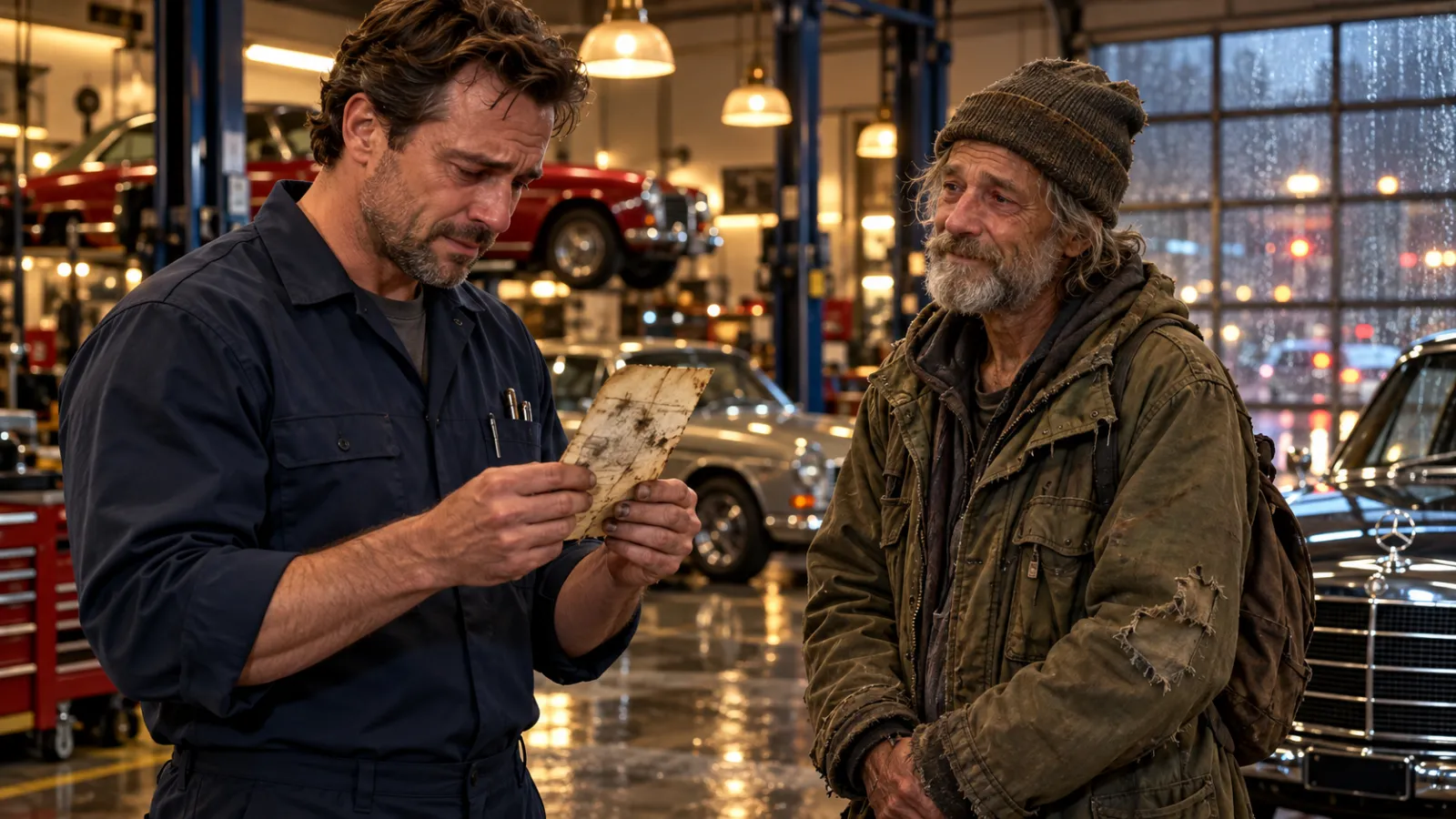
Chapter 1: Rain on the Showroom Glass
On a freezing rainy Tuesday in Cleveland, a homeless man walked into my pristine auto showroom, reached into his soaked military coat, and handed me a yellowed, grease-stained receipt from twelve years ago—written on the exact night my truck burned on Interstate 71.
Outside our plate-glass windows on West 130th Street, Lake Erie hurled a mixture of sleet and road grit that coated every car in gray sludge. Inside, our radiant heating hummed quietly under sixty thousand dollars of polished cream tile. We had two late-model German sedans parked beneath overhead LED pendants, the scent of fresh Colombian roast drifting from our client lounge, and four service lines buzzing with commercial fleet accounts.
Bradley Cole, my twenty-eight-year-old service advisor, was standing behind the quartz reception desk in a pressed Oxford shirt and silk tie. Bradley took immense pride in our front-of-house presentation. He treated a single muddy footprint on the welcome mat as an insult to his career.
When the glass double doors slid open with a wet whoosh of wind, Bradley looked up with his rehearsed corporate smile. That smile vanished the second his eyes registered the visitor.
The man stood just past the threshold, dripping puddle water onto the entrance tile. He was in his mid-fifties, with deep lines carved across his windburned face and stubble the color of rusted wire. His clothes told a story of brutal Midwestern winters: a faded olive-drab M-65 field jacket frayed at the cuffs, patched denim trousers held by utility webbing, and cracked leather boots with worn rubber treads. Yet there was no slump in his shoulders. He did not shuffle or avert his gaze like men accustomed to begging.
Bradley rounded the counter, his dress shoes clicking sharply on the tile. His hands were raised in that polite, dismissive gesture managers use when someone wanders into the wrong building.
"Sir, excuse me," Bradley said, loud enough to draw glances from two executives waiting by the coffee machine. "Our client lounge is reserved strictly for active repair customers. The Lorain Avenue emergency warming center is four blocks south on the bus line. You cannot stay in here."
The older man did not flinch, nor did he back toward the street. He simply wiped a streak of freezing rain from his brow with a calloused hand. His grey eyes were calm, piercing, and completely sober.
"I am not asking for a dollar, son," the man replied. His gravelly voice had an unhurried weight that stopped Bradley mid-stride. "And I am not looking to warm myself on your company dime."
I walked out from my back office with a clipboard of job sheets when the exchange caught my ear. I was forty-four, wearing my standard navy shop shirt with my first name embroidered over the left pocket. I spent half my days turning wrenches and the other half managing payroll. I knew what hard times looked like because I had lived through them myself.
"Is there a problem here, Bradley?" I asked, stepping into the showroom.
Bradley turned, looking relieved. "Marcus, I was just explaining building policy. This gentleman wandered in out of the storm, and we have a full schedule of corporate drop-offs."
I ignored Bradley and looked straight at the older man. Water dripped from the hem of his coat, forming a small pool around his boots. Up close, I noticed the faint scent clinging to him: damp wool, stale woodsmoke, and the metallic tang of cold machine iron. It was a scent every mechanic recognized anywhere on earth.
The stranger looked at my face, then let his eyes drop to the blue oval stitched over my pocket that read Marcus. A quiet breath slipped through his cracked lips.
"You are Marcus Miller?" he asked softly.
"I am," I answered. "This is my shop."
"Did you own a two-tone crimson Ford F-150 back in the fall of fourteen?" he asked, keeping his voice level. "Had a heavy diamond-plate toolbox welded across the bed and a union sticker in the back window?"
My stomach dropped straight through the floor. A cold chill ran down my neck that had nothing to do with the sleet outside. Nobody had mentioned that specific truck to me in over a decade.
"I did," I whispered, taking two slow steps toward him. "I haven't seen that truck since November fourteenth, twenty-fourteen."
The man nodded once, slowly. He unzipped the stiff brass zipper of his jacket and reached deep into an inner pocket. Bradley tensed beside me, thinking the man might be reaching for a weapon, but I held up my palm to keep him silent.
From under several layers of flannel, the man pulled out an old zippered sandwich bag, yellowed and clouded with age. With stiff fingers, he unsealed the plastic and extracted a single slip of folded paper.
The paper was brittle, its edges frayed and darkened by engine grease. He unfolded it with immense care and laid it flat on the cool quartz counter between us.
It was a duplicate carbon receipt from Miller Towing & Garage, the tiny one-bay shop I ran out of an old cinderblock barn in Medina before this modern facility existed. Across the top, in my own youthful handwriting, was the date: 11/14/2014.
And across the bottom, scrawled in thick black grease pencil, were six words that made the room fall silent: One life saved. Debt paid forever.
End of chapter 1