Kindness4 min read
The Mechanic’s Twelve-Year-Old Receipt
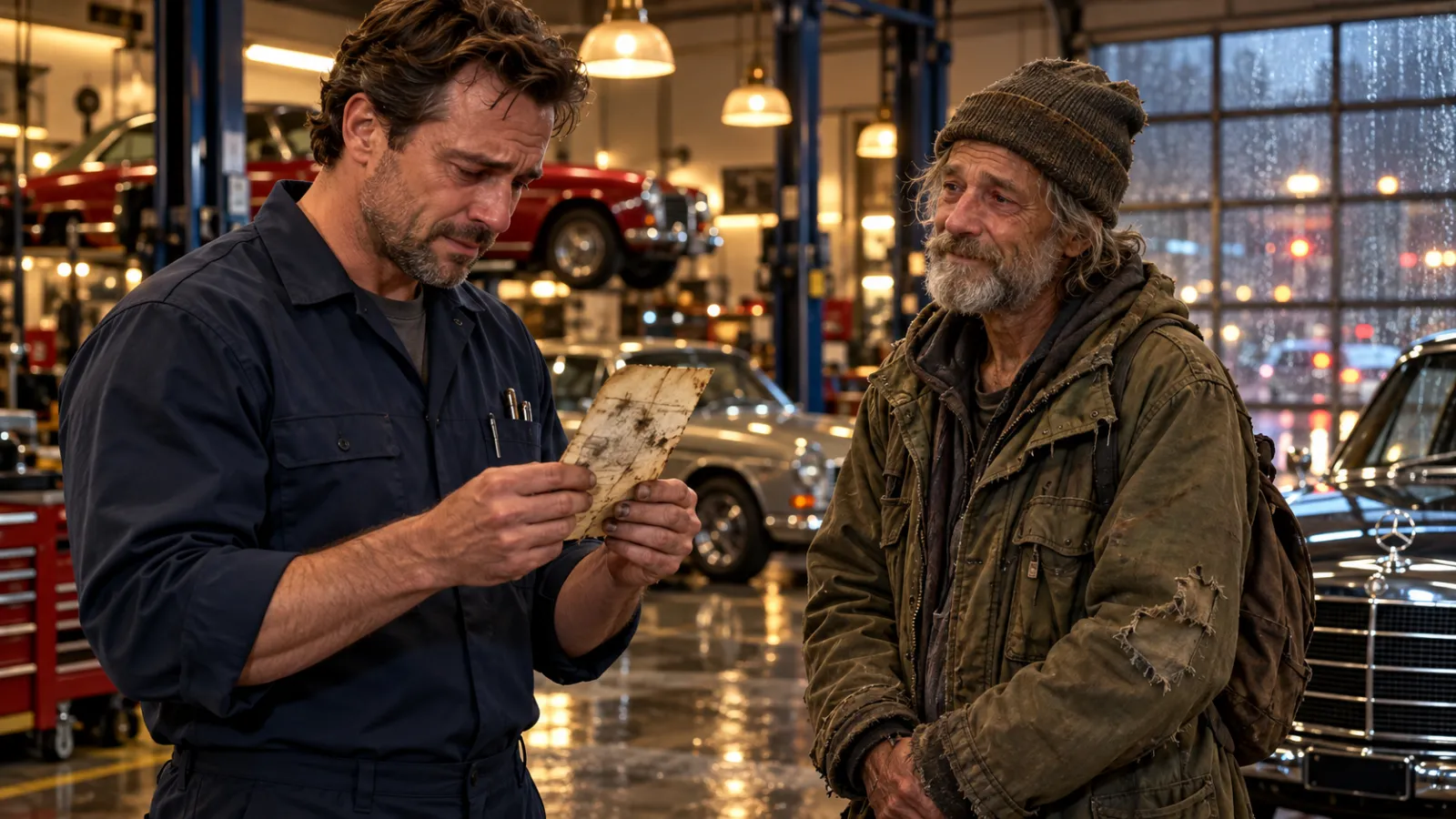
On a freezing rainy Tuesday in Cleveland, a homeless man in a tattered military field jacket walked into my auto shop and handed me a yellowed, oil-stained receipt from twelve years ago. Across the bottom, written in grease pencil: 'One life saved. Debt paid forever.'
Chapter 4: A Heavy Wool Coat
Loretta stood up from the floor, wiping tears from her cheeks with the cuff of her sleeve. Her business mindset returned instantly, replaced by fierce, protective determination.
"First thing we are doing is getting you out of those freezing clothes and seeing a physician," Loretta said, checking her wristwatch. "That cough in your lungs is not going away on coffee alone. I am calling Dr. Patel at the medical clinic on Lorain."
Frank raised his hands, looking uneasy. "Ma'am, I appreciate the thought, but I don't have insurance cards or credit. I cannot take your charity."
"This is not charity, Frank," I said, putting my hand firmly on his left shoulder. "This is a twelve-year-old invoice that has accrued astronomical interest. You are going to let us take care of this."
I led Frank out of the office and down the private hallway toward the technician locker room. The hallway was quiet, insulated from the bustling showroom. I unlocked my personal tall metal locker in the corner and pulled out clean gear from the upper shelf.
I found a heavyweight insulated thermal undershirt, thick wool socks, and a heavy charcoal Carhartt winter coat lined with thick sherpa fleece. I also pulled out a pair of dark oil-tanned Red Wing work boots, size ten and a half, still sitting in their original cardboard box. I had bought them two months ago as spares and never laced them up.
"Try these on," I said, setting the boots and clothes on the wooden bench. "Take your time. The private washroom is right through that door with hot water and clean towels."
Frank looked down at the sturdy boots, his throat working. He ran a scarred finger over the stiff leather stitching, silent for several seconds. When he looked up, his grey eyes were glassy with unshed tears, but he nodded and stepped into the washroom.
I walked back into the hallway, where Bradley was hovering near the breakroom doorway. The young service advisor held a stack of fleet folders, but his eyes were fixed on the floor. His face had gone red with embarrassment.
"Marcus," Bradley stammered, his voice tight. "I didn't know. When he walked in earlier, I thought he was just another vagrant from the bus turnaround. I was only trying to protect the shop image."
"I know what you thought, Bradley," I said, keeping my voice low and calm. "You saw an old green jacket, wet mud on the floor, and you made a calculation based on what someone looked like. But the man in that locker room gave away his livelihood and burned the skin off his arm so I could survive to build this company. Without him, there is no Miller Auto Works. There is no showroom floor for you to manage."
Bradley swallowed hard, staring at the floor. "I am sorry, Marcus. Truly."
"Don't apologize to me," I told him gently. "Apologize to Frank. And remember that the clothes a man wears when he walks through our doors will never tell you the caliber of his soul."
The locker room door opened, and Frank stepped out into the hallway.
The change in his appearance took my breath away. In the heavy wool flannel shirt, dark work trousers, and fresh charcoal coat, Frank stood tall and broad-shouldered. He had washed his face with hot water and combed back his gray hair with his fingers. He looked like what he truly was: a master craftsman who had spent forty years commanding heavy machinery.
Bradley stepped forward, extending his right hand toward Frank with both palms open.
"Mr. Holloway," Bradley said, his voice trembling slightly. "I want to apologize for how I spoke to you at the counter earlier. It was disrespectful and completely ignorant. Thank you for saving Marcus's life."
Frank paused, studying the younger man's flushed face. Then he reached out and took Bradley's hand in his own scarred grip, giving it a single, solid pump.
"Water under the bridge, son," Frank said with quiet grace. "You were watching the front door. A good shop needs someone minding the perimeter."
Loretta met us at the rear staff entrance with her coat and keys in hand. She drove Frank three blocks down to Dr. Patel's clinic while I walked over to the corner deli on West 130th to pick up containers of hot beef stew, crusty sourdough rolls, and a gallon of fresh milk.
Forty-five minutes later, the rear shop door clicked open. Frank walked in beside Loretta, carrying a brown pharmacy bag.
"Early bronchial infection," Loretta announced, hanging her wet umbrella on the coat rack. "Dr. Patel gave him a strong dose of antibiotics, a steroid inhaler, and told him that if he had stayed outside another night in this sleet, he would have been in the emergency room with double pneumonia by sunrise."
We sat around the heavy oak table in the employee breakroom. Frank ate the hot stew in reverent silence, savoring every spoonful of hot broth and torn sourdough bread. Warmth had returned to his cheeks, and the persistent rasp in his breath was already beginning to ease.
Through the reinforced glass window separating the breakroom from the garage bays, the rhythmic thrum of our repair shop echoed through the walls. Pneumatic ratchets whined, an exhaust fan hummed, and the heavy bass rumble of a commercial diesel engine vibrated through the concrete slab.
Frank set his spoon down. His eyes fixed on the yellow hydraulic lifts in the service bays, watching our junior mechanics hover over an open engine compartment. A look of profound, aching nostalgia settled over his weathered face.
End of chapter 4