Kindness4 min read
The Mechanic’s Twelve-Year-Old Receipt
On a freezing rainy Tuesday in Cleveland, a homeless man in a tattered military field jacket walked into my auto shop and handed me a yellowed, oil-stained receipt from twelve years ago. Across the bottom, written in grease pencil: 'One life saved. Debt paid forever.'
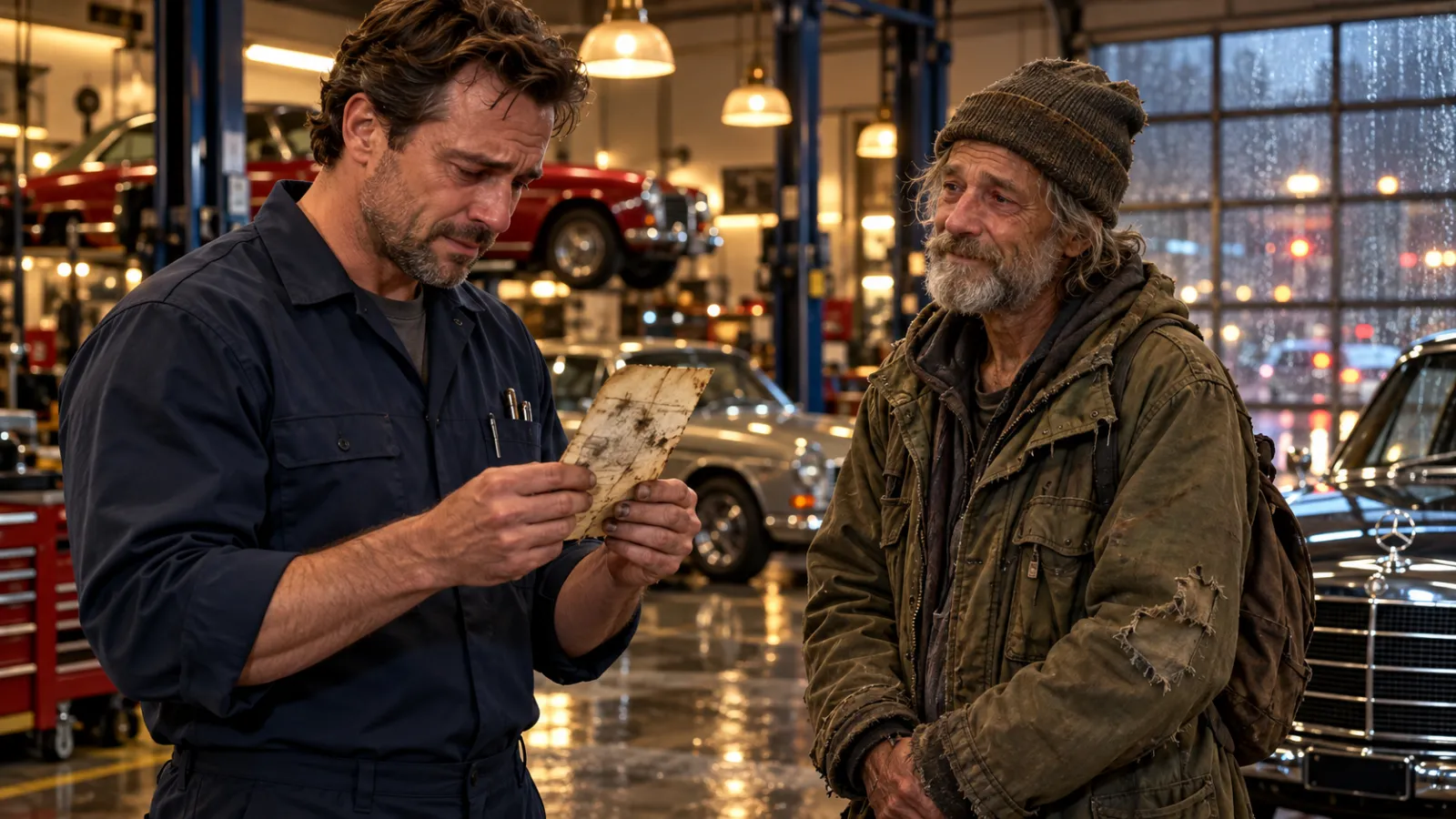
Chapter 2: The Creased Carbon Slip
I stared at the slip of paper on the quartz counter, unable to lift my gaze. The carbon copy was thin as an onion skin, tinted with that faint purplish dye that old receipt pads used before computer printers took over every garage in Ohio. Along the header, stamped in faded black ink, were the words Miller Towing & Garage, Route 3, Medina, OH.
My own signature was at the bottom, scrawled with the hurried slant of a thirty-two-year-old man whose hands were shaking so hard the pen dug through the parchment.
Twelve years ago, I was operating a solitary tow truck out of an unheated cinderblock bay, drowning in bank loans and praying for enough roadside service calls to keep the lights on. That night in November fourteen had permanently remapped my life. I had forgotten the exact invoice number, but I had never forgotten the words written in grease pencil across the grand total box.
"Come with me," I said, my voice barely louder than a whisper.
Bradley blinked, stepping forward with his tablet held against his ribs. "Marcus, your eleven o'clock fleet manager from Great Lakes Delivery is due in fifteen minutes. I can have this gentleman wait outside near the bus shelter—"
"Cancel the meeting, Bradley," I interrupted, without looking at him. "Or take the notes yourself. Nobody disturbs me for the next hour."
I placed a gentle hand on the older man's damp sleeve. The fabric of his M-65 field jacket was stiff with dried road salt, but beneath the rough canvas, his shoulder felt solid. He followed me across the polished showroom, leaving a trail of damp prints across the tile that Bradley stared at with open disbelief.
We stepped into my private office behind the customer counter. The room was warm and smelled of motor oil, paper invoices, and the rich Colombian blend brewing on my credenza. On the wall behind my cherry-wood desk hung framed photographs: my grandfather standing beside a 1952 Buick, our grand opening ribbon-cutting four years ago, and a picture of my wife Loretta and our two teenage daughters at Lake Erie.
I pulled out the leather armchair opposite my desk and guided the man into it. He sat down stiffly, holding his cracked work boots tucked together so they would not smudge the oriental rug Loretta had bought for the office.
"Let me get you a cup of coffee," I said.
He nodded once, his throat bobbing as he swallowed. "Black, if you have it. Thank you."
I poured a heavy ceramic mug full of steaming dark roast and set it in front of him. His hands wrapped around the ceramic mug, their knobby knuckles turning white as he pulled the heat into his skin. His fingernails were worn down to the quick, with traces of ancient grease ground deep into the ridges of his knuckles. They were hands that had turned wrenches for decades.
Before I could sit down, the frosted glass door swung open. Loretta walked in carrying a stack of vendor invoices, her reading glasses perched on her dark hair.
"Marcus, the parts delivery from Akron was short two brake calipers—" She stopped abruptly, her brown eyes darting from the wet, disheveled visitor in the leather chair to the pale expression on my face. "Marcus? What is going on?"
Loretta was forty-two, sharp as a tack, and ran our bookkeeping with an iron fist and an enormous heart. She had met me when I still worked out of a rusty tool trailer, and she knew every inflection in my voice.
Without speaking, I picked up the yellowed carbon receipt from the desk and handed it across to her.
Loretta took the fragile paper by its corners. Her brow furrowed as she read the company header, then dropped to the date: 11/14/2014. When her eyes reached the bottom line, the grease-pencil note written across the zeroed-out balance, all the color drained from her cheeks. Her mouth opened, but no sound came out.
"November fourteenth," she whispered, her hands beginning to tremble against the paper. "Medina General. The highway fire."
"Yes," I said quietly.
Her eyes lifted from the paper and fixed on the older man sitting in our guest chair. Twelve years earlier, Loretta had spent seventy-two continuous hours sitting on a plastic chair in the MetroHealth burn unit, holding my bandaged hands while nurses changed sterile dressings on my shoulders and smoke poured from my lungs. The highway patrol had told her that whoever pulled me from that burning cab had saved my life by less than thirty seconds, but the stranger had vanished into the blizzard before the state troopers could take a statement.
"You," Loretta said, her voice catching on a sob. "It was you."
The man looked down into his coffee mug, steam rising past his windburned cheeks. He did not smile, nor did he puff out his chest with pride.
"My name is Frank Holloway, ma'am," he said in his low, measured drawl. "I was on my way home to Brunswick that night when the pileup started. I didn't plan on being a hero. I just saw a red pickup crushed beneath a trailer and a man screaming inside the fire."
End of chapter 2