Kindness4 min read
The Mechanic’s Twelve-Year-Old Receipt
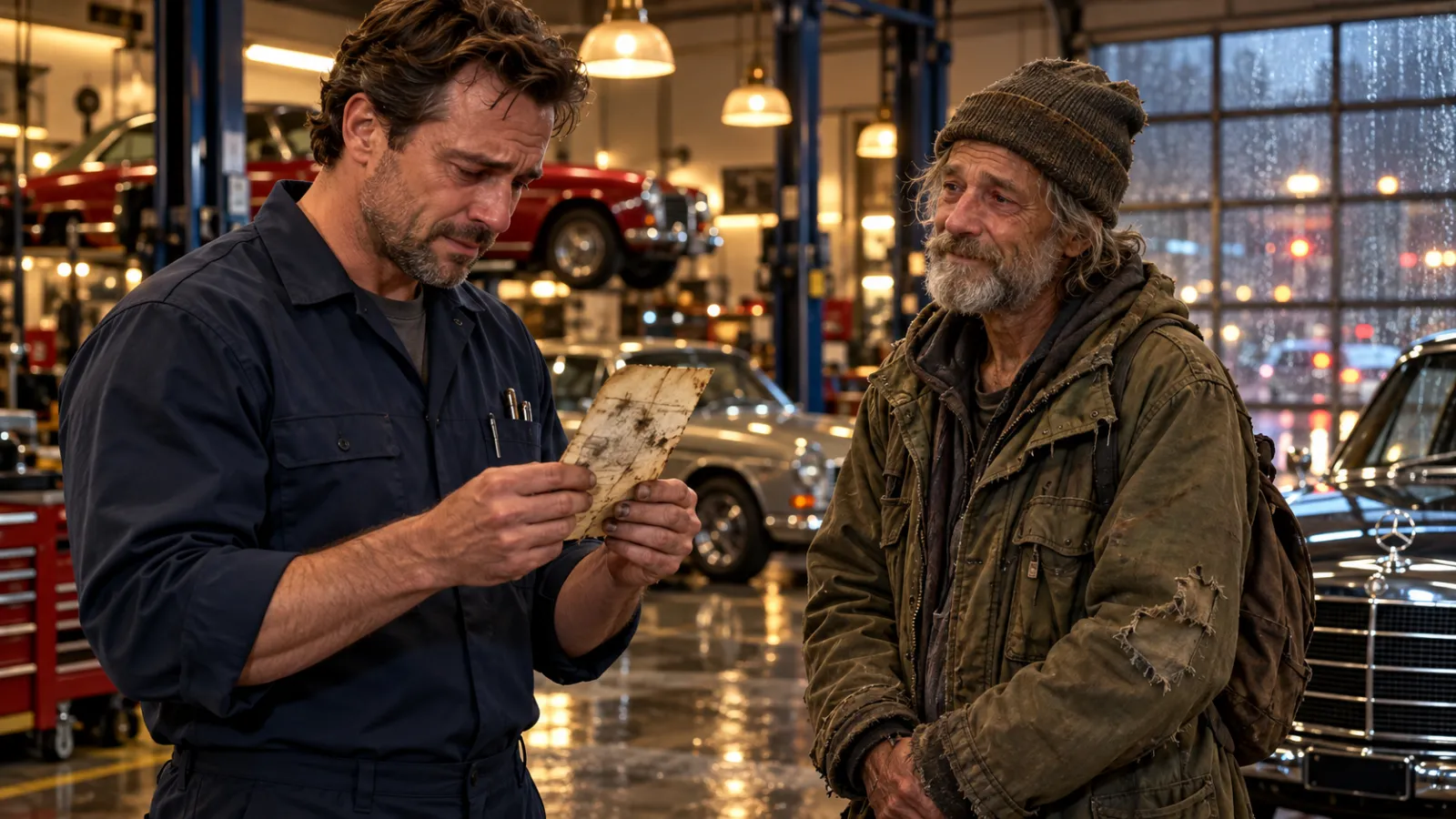
On a freezing rainy Tuesday in Cleveland, a homeless man in a tattered military field jacket walked into my auto shop and handed me a yellowed, oil-stained receipt from twelve years ago. Across the bottom, written in grease pencil: 'One life saved. Debt paid forever.'
Chapter 3: The Fire on Interstate 71
The rain rattled against the office windowpanes like handfuls of buckshot. Loretta remained standing by the bookshelf, clutching the fragile carbon receipt against her sweater, her eyes glistening.
"I still see that stretch of highway whenever the temperature drops below freezing," I said, leaning forward across the desk. "Black ice had turned Interstate 71 near the Medina exit into an ice rink. A tractor-trailer carrying sheet steel jackknifed across all three lanes. I hit the brakes, but my truck slid sideways right under the rear undercarriage."
Frank stared into the dark surface of his coffee, nodding slowly. "Your cab was crushed down to the steering column. When I pulled over on the shoulder, the engine bay was already roaring with fire."
"My legs were pinned beneath the collapsed dashboard," I murmured. "The seatbelt mechanism had fused tight in the heat. I could feel the floorboards scorching the soles of my work boots. I remember the smoke filling my mouth, thick and sweet with burning synthetic carpet. I thought about Loretta at home with our two girls, and I thought that was the end of me."
"Other folks were standing by the guardrail," Frank said quietly, without anger or judgment. "They were filming on their cell phones and shouting that the fuel tank was about to blow. Nobody wanted to get close, and I couldn't blame them. Fire makes men think of their own skin first."
"Except you didn't stand by the guardrail," Loretta whispered.
Frank took a sip of his coffee. His shoulders rose and fell with a steady, quiet breath.
"I was twenty years in heavy equipment maintenance," Frank said. "When you spend your youth working around diesel pumps and hydraulic rigs, you learn that panic never fixed a single bolt. I grabbed my three-foot steel tire iron and a utility folding knife from my work truck. I ran across the slush before the heat could seal the doors."
I closed my eyes, and the memories rushed back with terrifying clarity. I remembered the deafening crack as the driver's side window shattered under iron. I remembered two calloused hands grabbing the collar of my work jacket, hauling me toward the broken frame. The nylon seatbelt had locked like steel cable, and Frank had sawed through the webbing with his pocket blade while flames licked through the dashboard vents.
"You pulled me out onto the snowbank," I said, looking at him. "Less than ten seconds later, the gas tank went up. The fireball threw us both five feet into the ditch."
"You were coughing blood from the smoke," Frank recalled, a faint hint of a smile touching the corner of his mouth. "The paramedics arrived two minutes later. While they were loading you onto the gurney, you were half-delirious, mumbling that you owed me for a tow and a rescue. You grabbed a blank receipt pad from your jacket, scribbled out that note with a grease pencil, and pressed it into my palm."
"And then you vanished," Loretta said, stepping closer to his chair. "The state highway troopers searched every emergency room between Cleveland and Akron trying to find the man who pulled Marcus out. Why didn't you stay?"
Frank hesitated. For the first time, a shadow of pain crossed his weathered features. With deliberate care, he set his empty coffee mug on the desk. He reached down to his right sleeve, unbuttoned the frayed military cuff, and peeled back two layers of worn flannel.
Loretta covered her mouth with both hands.
From his wrist all the way up beneath his shoulder, Frank's forearm was a landscape of thick, puckered keloid scar tissue. The skin was mottled white and deep purple, grafted and tightened across tendon lines like scorched leather. It was the undeniable signature of third-degree burns.
"When that fireball blew through the cab window, I had my right arm thrown over your neck to keep the glass from cutting your throat," Frank explained, his voice steady. "My jacket melted right into the skin. I didn't want to get tangled up with troopers or ambulance bills. I had an old truck of my own and drove straight down to a county clinic in Wayne."
"Frank," I breathed, feeling a lump rise in my throat. "What happened to you after that?"
"The burns damaged the nerve endings in my fingers," Frank answered softly. "I couldn't hold a high-torque impact wrench for six months without dropping it. My shop in Brunswick let me go because I couldn't clear the billable hours. Then the medical collection agencies started calling, and my savings vanished in about ninety days."
He smoothed the flannel sleeve back down over his scarred wrist and buttoned the cuff.
"I spent a couple of years living out of my old van," Frank continued, looking at the carpet. "When the transmission gave out four winters ago, I ended up at the men's mission on Superior Avenue. I never showed this receipt to anyone, Marcus."
"I didn't save you so I could cash in a favor," he added quietly. "Two days ago, the shelter had a pipe burst in the basement, and they turned sixty of us out into the freezing rain. My chest has been rattling with a wet cough, and my boots don't keep the slush out anymore. I remembered the name on this paper, and I figured I had nowhere left to walk."
Loretta dropped to her knees beside Frank's chair. Without a word of hesitation, she took his scarred, trembling right hand into both of her warm palms and held it tight against her chest. Tears ran freely down her face.
"You gave my daughters their father," Loretta wept softly, pressing his hand between hers. "You gave me my husband. You never have to walk in the cold again, Frank. Not for as long as we live."
End of chapter 3