Revenge5 min read
The Lockbox in the Floorboards
When my former mother-in-law evicted me from my grandfather's historic timber mill with forty-eight hours' notice, she didn't know I spent my childhood helping him bolt a four-ton lathe over a fireproof Mosler safe embedded in the bedrock floor.
Chapter 2: The Heart-Pine Joists
Felix Kowalski backed his heavy one-ton flatbed truck into the loading bay of Riverbank Mill at twenty past three.
Felix was sixty-eight years old, with broad, rounded shoulders shaped by forty years of swinging iron hammers in the boiler shops. He wore faded canvas work overalls tucked into scuffed Red Wing boots, a yellow pencil perpetually tucked behind his left ear, and thick silver hair cut into a flat military brush. For eighteen years, before he retired to run a custom timber saw out of his barn, Felix had served as the county's chief structural inspector.
He stepped out of the truck cab holding a five-foot forged pry bar and a wooden box of hydraulic toe jacks.
"Forty-eight hours," Felix said, his deep baritone rumbling across the cavernous room as he dropped the iron tools onto the sawdust. "Beatrice Lombardi wouldn't give a dying dog forty-eight seconds if there was a dollar bill caught under its paw."
"She claims the lease option was terminated for demolition," I said, handing him an oil rag to wipe his grease gun. "Trevor said they closed the municipal development bond on Tuesday. The excavators are coming Monday morning."
Felix walked into the center of the shop and spat a tobacco flake into the woodstove bucket. He tapped the cast-iron frame of the four-ton lathe with the heel of his pry bar, producing a deep, bell-like gong that resonated through the joists.
"Trevor Lombardi couldn't read a structural blueprint if his life depended on it," Felix snorted. "His grandfather, Arthur Lombardi, was a real builder. Hard as granite, but he knew how to lay brick. These second-generation paper pushers think you build a city out of spreadsheets and bank drafts."
He set two ten-ton hydraulic jacks beneath the lathe's cast-iron footings.
"First things first," Felix said, handing me a thirty-millimeter impact socket and an electric breaker bar. "We get this Cincinnati iron off the floor. Your grandfather paid twenty-two hundred dollars in silver certificates for this machine in nineteen fifty-eight. It's faced every white pine timber that holds up the municipal library roof. Beatrice Lombardi isn't scraping this iron into a demolition dumpster."
For the next two hours, we worked in rhythmic, coordinated silence.
We backed out the eight rusted anchor bolts, wedging heavy oak rollers beneath the machine's leveling feet. With Felix guiding the hydraulic levers and me tensioning the hand winch attached to the building's central kingpost, we walked the four-ton lathe eighteen feet across the shop toward the rear loading door.
By five o'clock, the iron bed was resting safely on the flatbed trailer, covered in heavy tarpaulins and chained down with load binders.
I walked back to the center of the cleared floor, holding a steel wrecking bar and a flashlight.
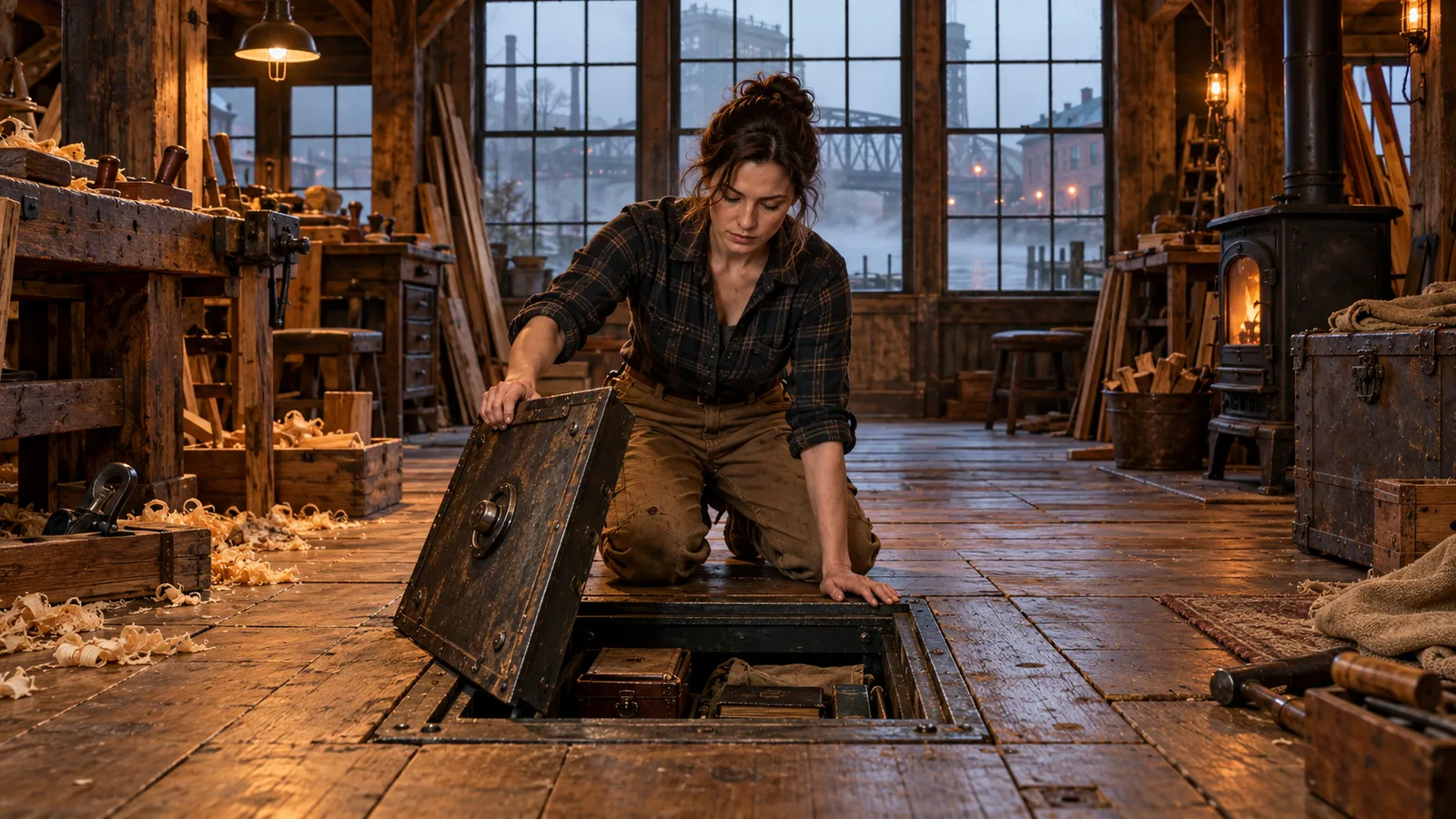
Where the lathe had stood for seventy years, the heart-pine floorboards were dark with decades of dried whale oil and turbine grease. The planks were three inches thick, ten inches wide, and fastened to the floor joists with square-headed cut iron spikes driven flush into the grain.
"Look at the perimeter seams, Corinne," Felix said, kneeling beside me on his denim knees.
He swept away a mound of dark walnut sawdust with his leather glove.
Instead of running continuous lengths like the rest of the mill flooring, an eight-foot by eight-foot section directly beneath the lathe had been framed out as an independent structural hatch. The tongue-and-groove joints along the boundary had been trimmed with a fine cabinet saw, leaving a hairline gap barely wider than the blade of a utility knife.
"The summer of nineteen ninety-six," I whispered, the memory rushing back with sudden clarity. "I was ten years old. My grandfather told my mother that the river damp had rotted the subfloor joists beneath the headstock. He made me sit on the steps and keep watch on the driveway while he worked with an air hammer."
"Donald didn't replace any rotted wood that summer, Corinne," Felix said softly, running his rough thumb along the cut seam. "I was the building inspector that year. The foundation beneath this mill is solid Niagara limestone bedrock. It hasn't shifted a quarter of an inch since the Civil War."
Felix wedged the chisel end of his forged pry bar into the corner seam and bore down with all his weight.
The cut iron spikes groaned as eighty years of friction gave way. With a sharp wooden crack that smelled of ancient pitch, the first ten-inch heart-pine plank lifted from the subfloor.
I hooked my fingers beneath the raised board and helped him ease it back.
Beneath the top planks lay not standard diagonal pine subflooring, but a solid grid of twelve-by-twelve rough-hewn white oak timbers, interlocked with mortise-and-tenon joints and pinned with three-quarter-inch locust wood trunnels.
"Heavy framing," Felix muttered, his eyes narrowing as he adjusted the pencil behind his ear. "This isn't flooring support. This is bomb shelter framing."
We worked together for another forty minutes, systematically numbering each pine board with blue chalk and stacking them neatly against the northern brick wall.
As the final planks of the eight-foot hatch came free, the beam of my flashlight shone into the cavity beneath the floor joists.
Set flush between four massive oak stringers, resting directly on the flat surface of the limestone bedrock three feet below the floor level, was a dark steel plate measuring four feet square. The plate was made of half-inch cold-rolled boiler iron, fastened to the foundation rock with twelve heavy expansion anchors sealed in molten lead.
In the center of the steel plate, welded with heavy, overlapping beads of arc-welding rod, sat a commercial vault door.
Cast in raised Gothic lettering across the center of the steel door was a manufacturer's name that every bank manager in the Midwest recognized:
THE MOSLER SAFE COMPANY — HAMILTON, OHIO — PAT. 1924
Beneath the brass combination dial, a heavy brass index plate was stamped with a single hand-chiseled inscription:
RIVERBANK PARCEL #1 — SURVEY TRUTH — D.M. 1978
Felix sat back on his boot heels, letting out a low, breathless whistle that echoed through the empty workshop.
"Sweet mother of mercy," Felix whispered, looking up from the steel plate into my face. "Your grandfather didn't just build a workshop here, Corinne. He built a fortress."
My hands rested against the cold, smooth steel of the Mosler vault door.
"He never gave me the combination, Felix," I said, staring at the brass numbers on the dial.
Felix reached into his pocket and pulled out an old silver Zippo lighter, snapping the flint to illuminate the brass plate.
"He didn't need to give you a combination, kid," Felix said, pointing the tip of his knife at the brass dial housing. "Look at the dial hub. Donald didn't use a rotating tumbler. He replaced the combination mechanism with a heavy three-pin cylinder lock from an industrial machine tool."
He looked at me with a grin that showed thirty years of stubborn defiance.
"Check the brass ring on your grandfather's key chain," Felix said. "The one with the square brass key you use to start the mill generator."
End of chapter 2