Revenge6 min read
The Lockbox in the Floorboards
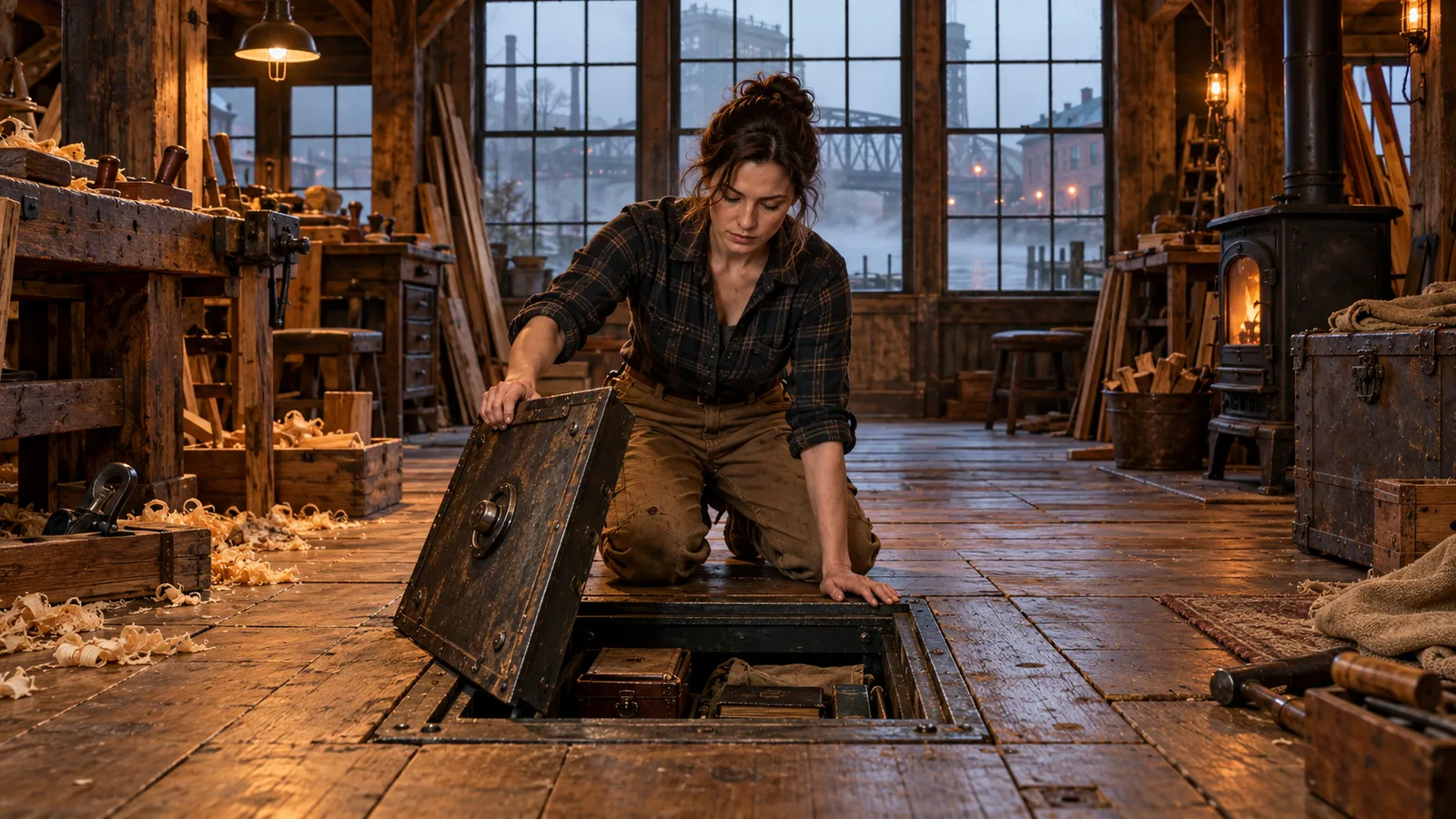
When my former mother-in-law evicted me from my grandfather's historic timber mill with forty-eight hours' notice, she didn't know I spent my childhood helping him bolt a four-ton lathe over a fireproof Mosler safe embedded in the bedrock floor.
Chapter 7: The Foreclosure Call
On Tuesday afternoon at two o'clock, the executive boardroom on the top floor of the Lombardi Tower was suffocating with tension.
The room featured panoramic floor-to-ceiling glass walls overlooking the Blackwood River valley, an expansive twenty-foot Brazilian rosewood conference table, and twelve ergonomic leather chairs. Outside, a cold autumn rain streamed down the glass, blurring the distant gray rooftops of the historic downtown district.
Seated at the far end of the table was Beatrice Lombardi.
She was dressed in a tailored black wool suit with sharp silk lapels, her hands clasped tightly over an embossed leather portfolio. Her face was as pale as chalk, lines of exhaustion etched deep into her mouth. Beside her sat Trevor, his tie loosened, staring down at an untouched porcelain cup of black coffee as if it held poison. Flanking them were three corporate defense attorneys in dark pinstriped suits from a prominent Chicago law firm.
Across the table sat four representatives from the First Commercial Bank of Chicago, led by Senior Vice President Bradley Donovan.
Donovan was a man of fifty-five with silver hair, cold blue eyes, and the grim, procedural efficiency of an institutional lender executing a foreclosure workout. Beside Donovan sat two forensic accountants and an assistant county prosecutor who had arrived with a court-ordered preservation subpoena.
Nathan Sutherland pulled out the chair directly opposite Beatrice and sat down, gesturing for Felix and me to take the seats on either side of him.
"Good afternoon, Mrs. Lombardi," Sutherland said, resting his elbows on the rosewood table and folding his hands. "I see you received our formal notice of extraordinary shareholder assembly."
Beatrice’s lead attorney, a senior partner named Henderson, cleared his throat and leaned toward his microphone.
"Mr. Sutherland," Henderson said, his voice flat and defensive. "My clients have agreed to this meeting purely as an informational courtesy. We dispute the validity of the purported nineteen seventy-eight indenture, and we intend to file an expedited appeal before the state appellate bench on Thursday morning."
Bradley Donovan cut him off with a single, sharp gesture of his pen.
"Save the legal posturing for the court reporter, counselor," Donovan said, his voice cold and cutting. "The First Commercial Bank of Chicago does not finance lawsuits. Our title insurance underwriter has formally denied coverage for the Riverbank Lofts bond issuance. The nineteen seventy-eight cross-easement is an active, recorded encumbrance. Your clients signed an affidavit of unencumbered title on Tuesday to draw forty million dollars in syndication credit."
Donovan slid a three-page document across the rosewood table to Beatrice.
"This is an official notice of loan acceleration," Donovan said. "Pursuant to Section Fourteen of the master credit facility, your firm's default has accelerated the entire twenty-four-million-dollar development draw, along with sixteen million dollars in secondary construction guarantees. You have seventy-two hours to cure the title defect or wire forty million dollars in certified funds to our depository in Chicago."
Beatrice closed her eyes for two seconds, her hands trembling against the leather portfolio.
"Forty million dollars," Trevor whispered, his voice cracking as he looked at his mother. "We don't have forty million in cash, Mom. The firm's entire liquidity is tied up in the suburban retail plazas."
"Be quiet, Trevor," Beatrice hissed, her knuckles turning white.
She leaned across the table, her dark eyes fixing on me with pure, venomous hatred.
"You think you've won, don't you, Corinne?" Beatrice said, her voice dropping into a harsh, trembling rasp. "You think you can destroy sixty years of Lombardi family enterprise over some rotten boards in an old mill. If this firm goes into Chapter 11, you get nothing. The bank liquidates every asset, the subcontractors go unpaid, and your little workshop gets sold off at a sheriff's auction anyway."
"Lombardi Development is not going into liquidation, Beatrice," I said quietly.
I opened the manila folder in front of me and drew out the 1982 certified share certificates and my grandfather's blue accounting ledgers.
"These certificates represent forty percent of the voting common stock of this corporation," I said, placing them in the center of the table under the recessed halogen lights. "According to the corporate charter on file with the secretary of state, all major capital disbursements, asset pledges, and refinancing agreements require a sixty-seven percent super-majority vote."
I looked at Henderson, who was hurriedly flipping through a copy of the corporate bylaws.
"You and Trevor only hold fifty-two percent of the voting shares," I continued. "When you executed that twenty-four-million-dollar bond pledge without calling a shareholder assembly, you violated your fiduciary duties under state corporate law. You acted ultra vires."
"She's right, Henderson," Sutherland added, tapping the table with his fountain pen. "Under the state business corporations act, Corinne has the statutory authority to petition the court for an immediate judicial receivership to protect the corporation from the officers' ultra-vires malfeasance."
Henderson leaned over and whispered into Beatrice's ear for thirty seconds.
As the attorney spoke, I watched every trace of resistance drain from Beatrice Lombardi’s face. The rigid posture that had intimidated township councils and contractors for three decades collapsed in on itself, leaving only a frightened, aging woman sitting at the head of a table she no longer controlled.
"What do you want, Corinne?" Beatrice asked, her voice barely louder than the hum of the air conditioning.
Nathan Sutherland pulled a four-page legal agreement from his briefcase and slid it across the rosewood table.
"Here are our terms, Mrs. Lombardi," Sutherland said, laying out the conditions with surgical precision.
"First," Sutherland said, "Trevor Lombardi immediately resigns as managing general partner and surrenders all executive authority in Lombardi Development Corporation. Second, Lombardi Holdings executes a quitclaim deed transferring the adjacent historic warehouse parcels, along with the three-acre riverbank basin, to the McAllister Historic Craft Cooperative in fee simple absolute."
Trevor looked at his attorney, his face slack with disbelief. "That's thirty percent of our riverfront assets!"
"Be thankful she isn't taking your house, Trevor," Sutherland countered without missing a beat.
"And third," Sutherland concluded, turning back to Bradley Donovan and the Chicago bankers, "in exchange for Corinne McAllister voting her forty-percent shareholder bloc to ratify a restructured, low-density municipal bond that preserves the historic riverfront, the bank will withdraw its acceleration notice and grant a sixty-day standstill on the secondary guarantees."
Bradley Donovan studied the agreement, glanced at his forensic accountants, and nodded once.
"The bank accepts the restructuring proposal," Donovan said firmly. "It's either this, or we foreclose on the entire company on Friday."
Beatrice stared down at the agreement for a full minute, the pen trembling in her withered hand.
The only sound in the boardroom was the rain lashing against the glass.
With a ragged, shuddering breath, Beatrice Lombardi unscrewed her gold fountain pen, lowered the nib to the signature line, and signed her name across the bottom of the page.
She stood up slowly, leaning heavily against the rosewood table. She did not look at Trevor, she did not look at her attorneys, and she did not look at me. She gathered her leather portfolio to her chest, turned on her heel, and walked out of the boardroom into the gray elevator foyer.
Trevor lingered for three seconds, his eyes darting between the signed document and my face.
"Corinne," Trevor began, his voice breaking. "We were married for five years."
"And for five years, you looked right through me," I said, meeting his gaze with calm finality. "Pack your personal things from the office, Trevor. Your building passes have already been revoked."
End of chapter 7