Revenge5 min read
The Lockbox in the Floorboards
When my former mother-in-law evicted me from my grandfather's historic timber mill with forty-eight hours' notice, she didn't know I spent my childhood helping him bolt a four-ton lathe over a fireproof Mosler safe embedded in the bedrock floor.
Chapter 8: The Oak Threshold
By the final week of January, winter had settled deep into the Blackwood River valley, draping three feet of clean white snow over the timber drying sheds.
The river was half-frozen along the granite retaining wall, its black waters rushing swift and cold between jagged shelves of blue ice. But inside the main workshop of Riverbank Mill, the air was warm, vibrant, and alive.
The two barrel woodstoves glowed a steady cherry red in the corners, crackling with dry hickory cut-offs and ash trimmings. A dozen brass pendant lamps hung from the thirty-foot ceiling trusses, illuminating five heavy maple workbenches where half a dozen young craftsmen and apprentices were planing curly maple, cutting dovetails, and fitting mortise-and-tenon joints.
In the center of the shop, the four-ton Cincinnati patternmaker's lathe was back in its rightful place.
Its eight massive anchor bolts were seated deep into the limestone bedrock, their iron nuts torqued down flush against fresh, oiled steel washers. Standing beside the machine's headstock, Felix Kowalski was showing an eighteen-year-old apprentice from the county vocational school how to gauge the runout on a twelve-foot white oak architectural column using an antique dial indicator.
Felix wore his usual canvas overalls, but he had a brand-new yellow pencil tucked behind his ear and a broad, satisfied grin across his weathered face.
At two o'clock, the heavy pine front door swung open, accompanied by the cheerful brass chime of the entrance bell.
Nathan Sutherland walked in, stamping his snow-dusted boots against the hemp doormat. He wore a heavy wool duffel coat and carried a burgundy leather portfolio bearing the gold seal of the county clerk of courts.
"Afternoon, Felix," Sutherland called out, waving a gloved hand. "You're still burning hickory, I see. I could smell the woodsmoke three blocks before the river bridge."
"Hickory burns hot and clean, Nathan," Felix shouted back above the hum of the overhead dust collector. "Keeps the moisture off the tool racks."
Sutherland walked over to my assembly bench at the southern end of the shop.
I was working at the trestle vise, shaping a four-inch-thick plank of quarter-sawn white oak with a traditional wooden hand plane. The curled shavings spiraled up through the throat of the beechwood plane, smelling sweet, pungent, and rich with tannin.
Sutherland laid the burgundy portfolio flat on the bench, unfastened the brass clasp, and opened the folder. The crisp parchment sheets rustled with the unmistakable legal finality of judicial decree.
Inside lay the final, recorded decrees issued by the State Supreme Court of Equity, accompanied by the certified copies of the perpetual land trust deed.
"Signed by Judge Callahan at ten o'clock this morning," Sutherland said, turning the documents toward me with quiet professional pride. "The quitclaim deeds for the adjacent warehouse parcels have been recorded in the county deed books. The entire seven-acre Riverbank industrial parcel is now officially vested in the McAllister Historic Craft Cooperative, held in a perpetual charitable trust that cannot be severed or partitioned by future commercial entities."
I traced my fingers over the embossed county seal and the registration stamp: RECORDED DEED BOOK 418, PAGE 902.
"What about the municipal bond?" I asked, looking up from the legal parchment.
"The restructured low-density development plan was approved unanimously by the city council on Thursday evening," Sutherland replied. "The remaining Lombardi commercial entities will build thirty modest residential townhomes on the upland bluff behind the state highway, completely separated from the working riverfront. Lombardi Development had to pay two million dollars in civil penalties to the state banking division, and Beatrice Lombardi has formally retired from all corporate boards."
"And Trevor?" I asked, remembering the arrogant man who had stood on this floor three months ago.
Sutherland let out a short, dry chuckle that carried little sympathy. "Trevor is working as an associate leasing agent for a commercial brokerage in Minneapolis. My colleagues in Chicago tell me he shares a rented two-bedroom apartment near the airport and takes the commuter train to work every morning. He spends his days leasing suburban strip-mall storefronts on straight commission."
I looked down at the smooth oak plank beneath my hands. There was no anger left in me, no bitterness, and no desire to gloat over their ruin. The Lombardis had chased paper wealth until they forgot that buildings require foundations, that agreements require honor, and that land remembers the hands that shaped it.
"Thank you, Nathan," I said softly, looking up into his eyes. "For everything."
Sutherland closed his portfolio and tapped the oak bench twice with his knuckles. "Your grandfather built the foundation of this valley, Corinne. I just made sure the law remembered who owned the stone."
He turned, exchanged a nod with Felix, and pushed back out into the bright winter afternoon.
When the five-o'clock whistle sounded from the town water tower, the apprentices packed their chisels into their tool rolls, swept the walnut shavings into the recycling bins, and bade me good night.
Felix stayed behind for another fifteen minutes to bank the coals in the woodstoves and check the padlocks on the drying sheds.
"You heading home soon, kid?" Felix asked, pulling on his sheepskin coat by the door.
"In a little while, Felix," I said. "I want to finish setting this threshold before the morning frost."
Felix smiled warmly, touched the brim of his cap, and pulled the pine door shut behind him.
The workshop fell into a peaceful, resonant stillness.
The only sound was the muffled rush of the river outside the glass and the occasional crackle of a dying ember in the iron stove.
I picked up the four-inch white oak plank, carried it over to the front entrance, and set it into the wide doorway opening. It was the new entrance threshold for Riverbank Mill, cut from a storm-felled oak tree that had grown along the riverbank since the late eighteenth century. The wood was dense and heavy, its pale rays shimmering like silk under the shop lamps.
The wood fit between the massive pine jambs with hairline precision, seating flush against the limestone foundation step. Every bevel had been planed by hand to shed the spring rainwater away from the workshop floor.
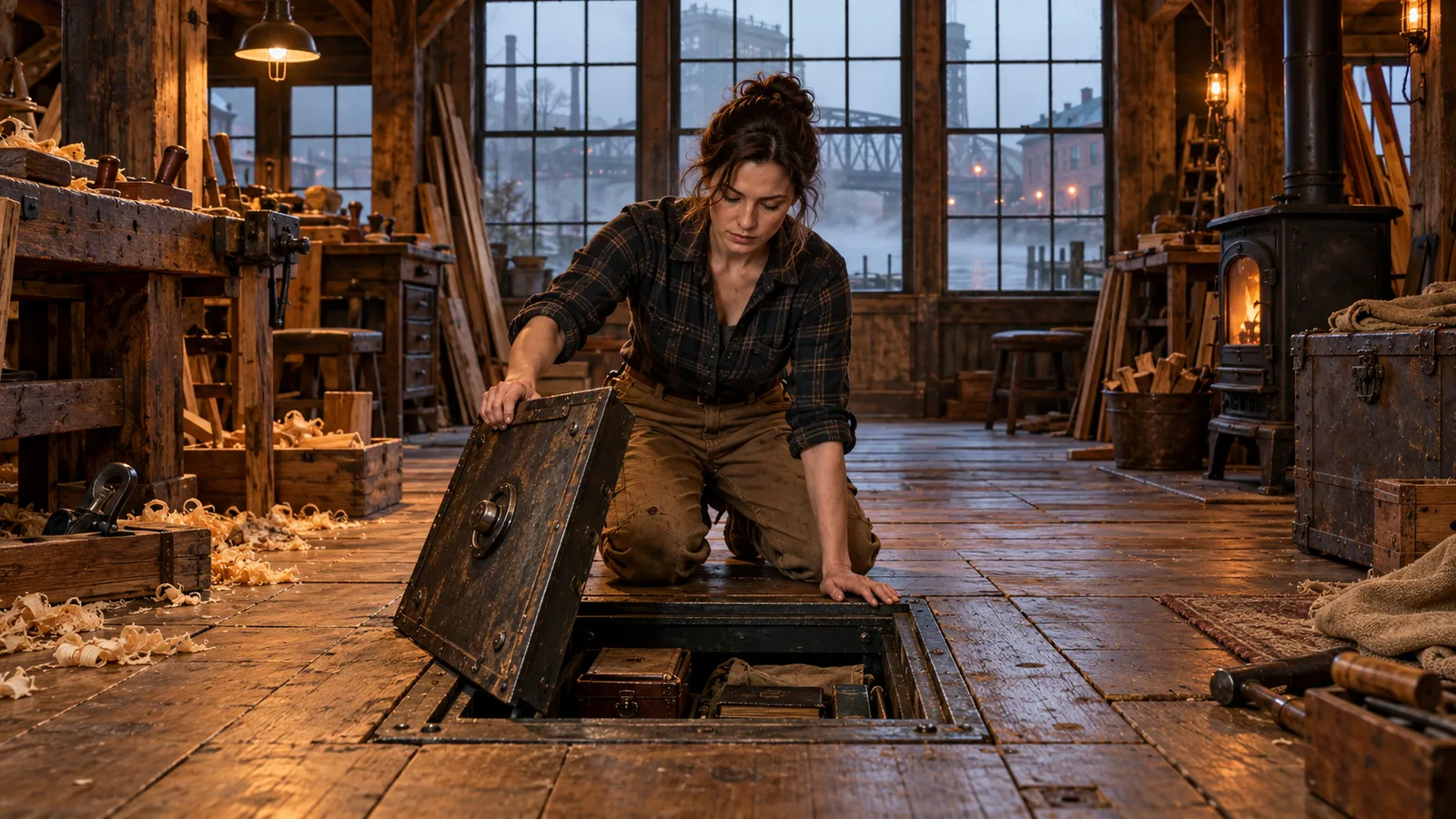
I knelt on the floorboards with my carving gouge and a hickory mallet. The cold air from the river seeped beneath the open door, carrying the scent of hemlock needles and frozen spray.
In the exact center of the new oak threshold, directly where every visitor, customer, and apprentice would step when entering the workshop, I carefully carved my grandfather's traditional builder's mark: a balanced compass rose interlocking with a carpenter's square, flanked by two simple numbers:
1954 — 2026
I brushed the pale oak chips from the carved incisions, smoothed the grain with a coat of warm boiled linseed oil, and stood up in the quiet shop. The oil deepened the amber color of the oak, making the carved lines glow with rich, permanent warmth.
Through the tall sash windows facing the river, the winter dusk was turning from lavender to deep sapphire. Across the valley, the streetlights of Blackwood Falls were flicking on along the avenue, their golden reflections shimmering across the cold, dark water.
Beneath my boots, the three-inch heart-pine floorboards held firm and solid, rooted in forty feet of ancient bedrock, ready for another century of honest work.
The end