Revenge5 min read
The Lockbox in the Floorboards
When my former mother-in-law evicted me from my grandfather's historic timber mill with forty-eight hours' notice, she didn't know I spent my childhood helping him bolt a four-ton lathe over a fireproof Mosler safe embedded in the bedrock floor.
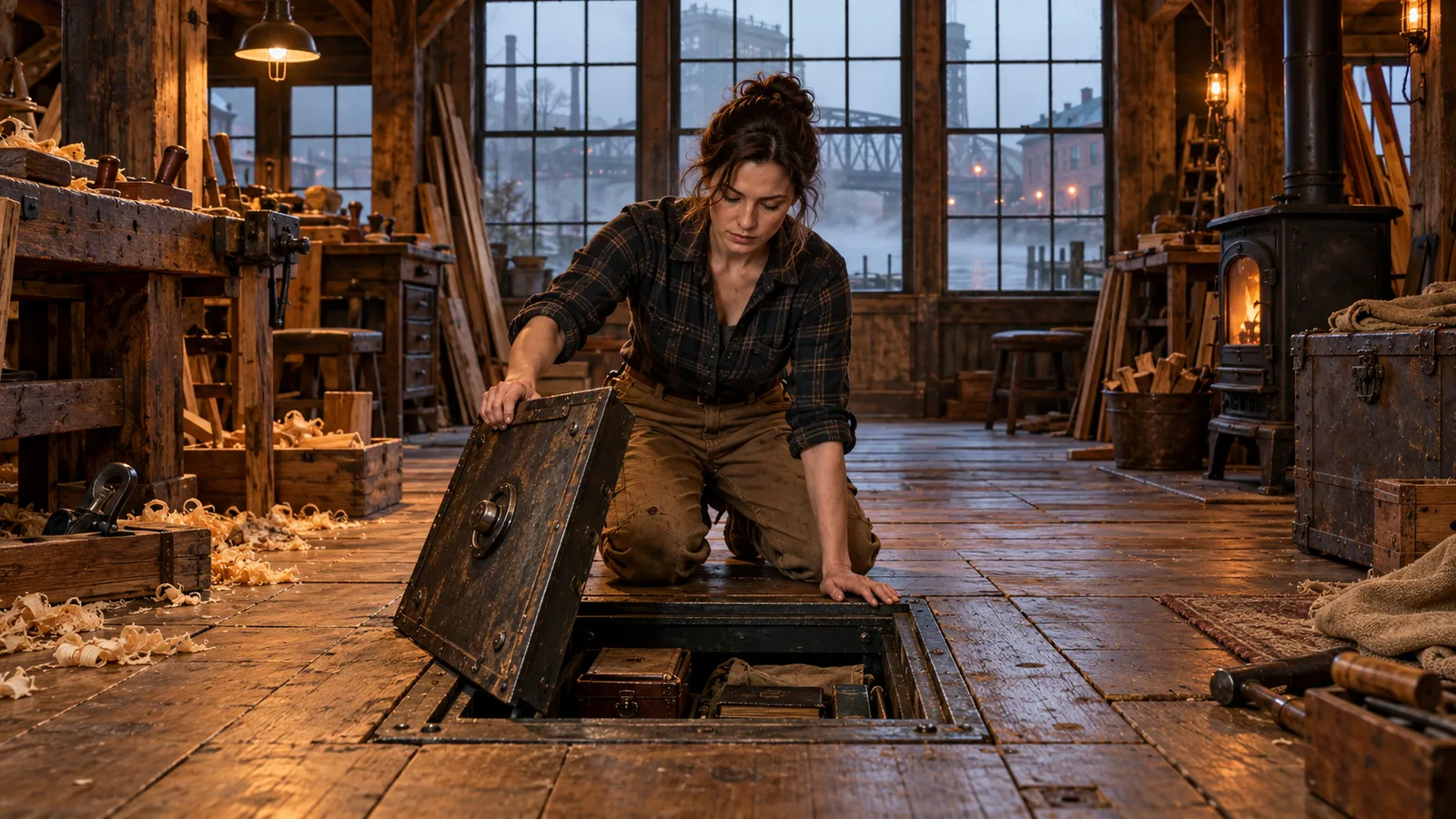
Chapter 3: The Mosler Box
The brass key chain had hung from an iron nail beside the shop door since the afternoon of my grandfather's funeral in August of 2022.
I walked over to the pine doorframe, lifted the heavy ring from the nail, and carried it back to the excavated floor hatch. The ring held five keys: two flat iron keys for the padlocks on the lumber sheds, a modern Yale brass key for the front office, an ignition key for the 1974 Ford tractor, and a heavy, four-sided square brass key with cross-hatched grip knurling.
Felix held the LED work light steady over the vault door as I knelt on the cold oak framing.
I aligned the square brass shank with the center of the keyway. The key slid into the cylinder with a satisfying, airtight precision, seating flush against the brass faceplate with an audible mechanical click.
"Turn it clockwise," Felix whispered, his breath clouding in the chill air rising from the foundation rock. "Donald always turned his chuck keys to the right."
I set both thumbs against the knurled brass head and applied pressure.
The cylinder resisted for half a second against thirty years of dried grease, and then turned smoothly through ninety degrees. Deep inside the four-inch steel door, three heavy case-hardened locking bolts retracted from their limestone strike plates with a dull, ringing clunk.
Felix hooked his fingers into the recessed drop handle and pulled upward.
The counterweighted Mosler vault door swung open on hardened steel pivot hinges, rising smoothly toward the ceiling joists.
A wave of preserved air rushed up from the subterranean chamber. It smelled of dry parchment, sealing wax, mothballs, and the faint, sweet metallic scent of high-grade copper plate engravings.
The vault was three feet deep, lined with two-inch sheets of fireproof asbestos board faced in bright, uncorroded sheet copper. Resting on the raised cedar floor rack at the bottom of the safe sat three heavy steel lockboxes painted in dark olive enamel, and a stack of six canvas-bound accounting ledgers tied with surveyor's pink nylon twine.
Felix reached down with both gloved hands and lifted the top olive lockbox. Stenciled in white block letters across the lid was a single label:
ORIGINAL PATENTS & DEEDS — RIVERBANK TRACT 1954–1978
"Bring the work light," I said, carrying the heavy box over to the edge of the assembly bench.
The lockbox was fastened with a simple brass hasp and a spring-loaded toggle. I flipped the latch and lifted the lid. The interior hinges groaned slightly from long stillness, releasing the fragrance of vintage legal documents preserved against moisture and decay.
Inside lay three thick manila envelopes tied with red cotton tape, and a sealed parchment folio bearing the blue wax seal of the State Supreme Court of Equity.
I untied the red tape on the parchment folio and unfolded the first document. The heavy parchment was crisp and pale ivory, its edges deckled by hand and preserved without a single trace of yellowing or silverfish damage.
It was an original indenture deed, drawn on heavy legal vellum, dated November 14, 1978.
The title across the header was printed in ornate engraving: CROSS-EASEMENT AND GROUND COVENANT AGREEMENT.
The two signatories were listed in bold ink: Donald McAllister, Master Millwright and Arthur Lombardi, Founder of Lombardi Construction & Engineering. Each signature was accompanied by an embossed red wax seal and the official stamp of the county registrar of deeds.
Felix adjusted his glasses, leaning his heavy forearms against the bench as his finger traced the typed clauses. His eyes moved methodically through the recitals, verifying the legal descriptions of the metes and bounds running along the riverbank.
"Look at clause four, Corinne," Felix said, his voice rising in astonishment. "Read that paragraph out loud."
I read the text, my eyes racing across the sharp typewriter print:
'In consideration of the completion of the municipal river retaining wall and the preservation of continuous timber manufacturing on the Blackwood River, Arthur Lombardi hereby conveys to Donald McAllister and his lineal heirs a permanent, non-severable ninety-nine-year ground leasehold over the entire seven-acre industrial basin, with sole and exclusive authority over all demolition, construction, and structural alterations.'
I looked up at Felix. "Ninety-nine years from nineteen seventy-eight."
"That lease doesn't expire until two thousand and seventy-seven," Felix said, slapping the wooden bench with an open palm that sounded like a gunshot. "Fifty-one years from now!"
"And look at the deed restriction," I whispered, pointing to the second page.
Clause six was underlined in red drafting pencil:
'Any commercial transfer, mortgage encumbrance, or rezoning petition attempted without the explicit, notarized written consent of Donald McAllister or his named successor shall instantly trigger an automatic reversion of full fee-simple title to the McAllister estate, extinguishing all underlying commercial mortgages.'
"Do you know what this means?" Felix asked, his face illuminated by a fierce, vindictive grin.
"Tell me," I said, my heart pounding against my ribs.
"Beatrice and Trevor didn't just try to evict you," Felix said, pointing a calloused finger at the red seal. "They pledged this seven-acre waterfront parcel as the primary equity collateral for their twenty-four-million-dollar municipal development bond. They signed an affidavit to the First Commercial Bank of Chicago claiming Lombardi Development held unencumbered fee-simple title to the entire river frontage."
"They lied on their mortgage applications," I said.
"They committed federal bank fraud," Felix corrected, his voice dropping into a harsh, triumphant whisper. "The moment Beatrice filed that demolition permit on Tuesday, she triggered the automatic reversion clause. She doesn't own this land, Corinne. She just gave away her family's entire real estate company to Donald McAllister's granddaughter."
I looked back down into the open safe beneath the floorboards.
Beside the deeds lay five smaller leather-bound journals. I pulled the top journal out and flipped through the pages.
Every page was filled with my grandfather's meticulous pencil script: dates, check numbers, bank transfer records, and secret escrow accounts dating back to the late 1980s. Tucked into the back flap was a certified copy of a partnership agreement showing that Arthur Lombardi had transferred forty percent of the voting shares of Lombardi Holdings directly to Donald McAllister in 1982 to prevent a hostile corporate takeover by an out-of-state developer.
My grandfather had never mentioned the shares. He had continued working his timber lathe, wearing his denim apron, and sweeping walnut shavings off the floorboards every evening until he was ninety-four years old.
He had kept the documents hidden beneath four tons of Cincinnati cast iron, waiting for the day when the Lombardi family's greed finally outpaced their caution.
"We need Nathan Sutherland," I said, folding the vellum deed carefully back into its parchment sleeve.
Felix pulled his flip phone from his overalls and looked at his watch.
"It's six-thirty," Felix said. "Nathan is still at his desk on High Street. He's been trying to stop Beatrice Lombardi from paving over the riverfront for ten years."
"Pack the lockboxes into the truck," I said, locking the olive steel lid with a sharp snap. "We're going to pay my ex-husband's lawyer a visit."
End of chapter 3