Kindness4 min read
The Ticket in My Mother's Coat
After my mother died, I found a hotel coat-check ticket sewn into her winter coat—and learned where our missing furnace savings had gone. Her final unfinished kindness left me one choice she refused to make for me.
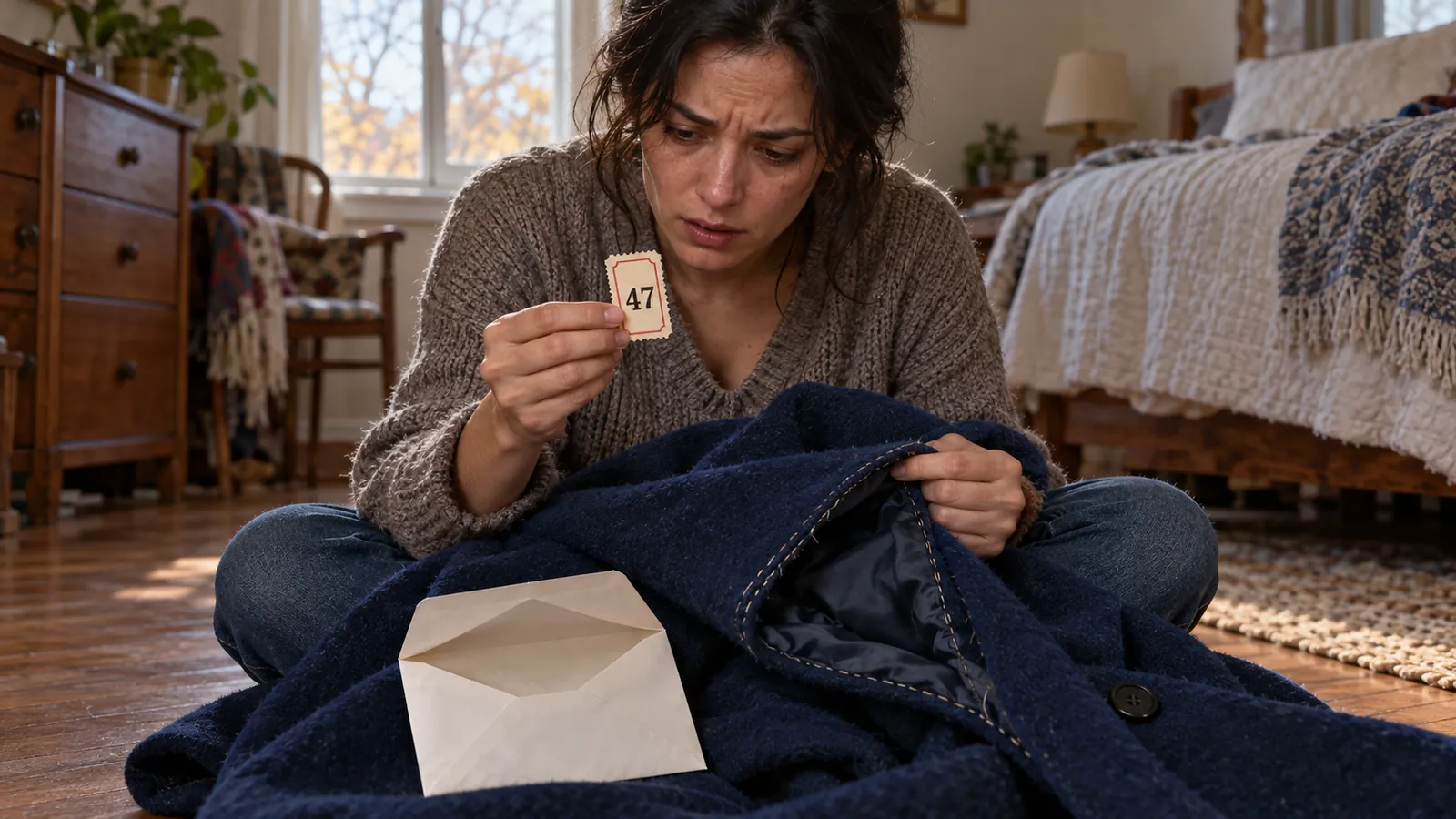
Chapter 1: The Number in the Hem
The coat-check ticket was stitched inside the hem of my mother's winter coat, where no one would find it by accident. I found it six weeks after we buried her, while searching the pockets for money she could no longer explain.
The ticket was thick cream paper with a red border and the number 614 pressed into it. On the back, in my mother's narrow handwriting, were three words: Ask for Celia.
I sat on the bedroom floor with Ruth Navarro's blue wool coat across my knees and the empty boiler envelope beside me.
The envelope should have held nineteen hundred and twenty dollars.
My mother and I had fed it for two years, ten or twenty dollars at a time, because the furnace made a knocking sound whenever it woke. I had put in most of the money during the final months, working lunch shifts at a diner after my bookkeeping clients went home. Ruth had written every deposit on the front.
The last line said August 3 — balance $1,920.
The envelope held eleven dollars and a grocery coupon.
I had searched the kitchen tins, her desk, the freezer, and the shoebox where she kept tax receipts. The bank statements showed three cash withdrawals in September, all made before her stroke. Six hundred. Seven hundred. Six hundred twenty.
Exactly nineteen hundred and twenty dollars.
Grief had left me tired. The missing money made me angry enough to move.
I turned the ticket over again. The front carried the faded crest of the Alder House Hotel, a downtown place with brass doors and a lobby that smelled, in my memory, of lemon polish and lilies. My mother had worked there as a banquet seamstress until arthritis bent two fingers on her right hand. She retired eight years ago and still called the lobby carpet “the new one,” though it had probably been replaced twice.
I called the hotel.
A woman at the front desk transferred me to management. I expected a voicemail. Instead, a low voice said, “Celia Brennan.”
“My name is Mara Navarro. Ruth Navarro was my mother.”
The silence on the line changed. It was not confusion. It was recognition.
“I heard about Ruth,” she said. “I am very sorry.”
I pinched the ticket between my fingers. “I found something in her coat. A claim ticket. Number six-fourteen.”
Another pause.
“Where did you find it?”
“Sewn into the hem.”
Celia exhaled near the receiver. “Then she meant you to have it.”
The answer sharpened every suspicion I had carried through the house. “What does it claim?”
“I would rather show you.”
“I would rather you tell me.”
“It is not hotel property, and it is not only your mother's property. There are privacy concerns.”
My eyes went to the boiler envelope. “Did my mother give you money?”
“No.”
“Did she owe the hotel money?”
“No.”
“Then why are you talking like a lawyer?”
“Because Ruth trusted me to keep other people's difficult weeks from becoming lobby conversation.” Celia's voice stayed level. “Come tomorrow at four. Bring the ticket and identification. Use the service entrance on Bell Street.”
She ended the call before I could ask anything else.
I almost called back. Instead, I cut three careful stitches from the coat hem. The lining opened like a small mouth. Behind the ticket was a folded receipt from a dry cleaner. It listed four suits, two dresses, one wool skirt, and a men's charcoal overcoat. Paid in cash: $286.40.
The date was September 9, two days after the first withdrawal.
At the bottom, beneath the total, my mother had written initials and amounts.
T.W. — 94.40.
The other initials meant nothing to me.
I knew what I wanted the story to be. I wanted Ruth to have hidden the savings somewhere sensible because she had stopped trusting her memory. I wanted Celia to open a locker and hand me an envelope with my mother's apology tucked around the cash.
But my mother had not been confused in September. She had still beaten me at gin rummy and corrected the diner when they charged us for two coffees instead of one. She knew the furnace was failing. She knew my rent had gone up. She knew I had moved into her spare room because I could no longer pay for my apartment and her home-care aide at the same time.
And she had taken every dollar.
That night, the furnace struck the pipes three times and went quiet.
I lay awake under two blankets, remembering the last argument Ruth and I had managed before the stroke stole her words. I had found a bus receipt on the counter and asked why she had crossed town in the rain.
“An errand,” she had said.
“You could ask me.”
“You already carry too much.”
It had sounded tender then. Now it sounded like a locked door.
In the morning, I hung the blue coat by the front door. One cuff was shiny with age, and a button near the collar had been replaced with a darker one. Ruth could have bought a new coat. She could have fixed the furnace. She had chosen neither.
At three thirty, I put the claim ticket in my wallet beside the eleven dollars from the boiler envelope.
I told myself I was going to recover what belonged to us.
I did not yet understand that my mother had left me a decision, not an inheritance.
End of chapter 1