Kindness5 min read
The Ticket in My Mother's Coat
After my mother died, I found a hotel coat-check ticket sewn into her winter coat—and learned where our missing furnace savings had gone. Her final unfinished kindness left me one choice she refused to make for me.
Chapter 3: The Last Fitting
Theo Winslow answered on the fourth ring. Machinery rattled behind him, then stopped.
“This is Mara Navarro,” I said. “Ruth's daughter.”
He went quiet.
“I am sorry about your mother,” he said. His voice was rough and careful. “She was kind to me when I had not earned any kindness from her.”
“That sounds like something people say before asking for money.”
“I am not asking you for anything.”
I had called to cancel, but his answer threw me off balance. “Do you know about the interview tomorrow?”
“I know it was postponed. Ms. Brennan left a message that there might be another date.”
“There is one. Ten in the morning.”
The machinery started again in the background, a dry spinning sound.
“Where are you?” I asked.
“Twenty-Four Hour Wash on Fulton. Their worktable is wide enough to cut cloth after midnight. The owner lets me use it if I fix torn laundry bags.”
I looked at the charcoal suit spread across my mother's dining table. One shoulder had been opened. White basting thread marked a clean arc around the sleeve head.
“My mother said you would know why she didn't shorten the sleeve at the cuff.”
Theo answered at once. “Working buttonholes. If she cut the cuff, the spacing would be wrong. The arm has to come off and sit higher.”
“So you really are a tailor.”
“I really was one yesterday too.”
There was no self-pity in it. Just fatigue.
I told him to meet me at the laundromat in twenty minutes.
Theo stood at the back beneath fluorescent tubes, pressing a navy skirt on a folded towel. He was about forty, lean, with a measuring tape looped around his neck and a pale line on his ring finger. I did not ask about it. His gray work shirt had been mended at both elbows with cloth cut so precisely the patches looked intentional.
He saw the garment bag and put down the iron.
“I thought that suit was gone,” he said.
“You sold it?”
“No. Mine was brown and twenty pounds too large. Ruth said it made me look like I was borrowing my uncle's life.”
That sounded exactly like her.
I laid her note beside the suit. I kept the rest of the ledger in my bag.
“Why did she pick you?”
Theo ran two fingers over the basting stitches. “I came to Alder House after hearing their tailor was retiring. I asked to leave my résumé. The sleeve of the front desk clerk's jacket was coming loose, so I fixed it while I waited. Your mother was having lunch with Ms. Brennan. She watched me resew the lining without taking the whole sleeve apart.”
“And that qualified you for nineteen hundred dollars of trust?”
His hands stopped.
I regretted the sentence, but I did not take it back.
“I did not know about nineteen hundred dollars,” he said. “Ruth offered the screening fee and train fare. I told her no. She called it an advance against a first paycheck. I agreed because she wrote the amount down and made me sign it.”
He pulled a folded card from his wallet. On it, in Ruth's handwriting, was the same $94.40 total. Beneath it Theo had signed his name.
“I missed the first appointment because my father fell getting out of the bath,” he said. “I spent the train money going back home. Ruth said we would try once more. Then Ms. Brennan called about her stroke.”
His father remained unnamed between us, a private fact rather than a tool for sympathy.
“Why sell your suit?” I asked.
“Rent.”
He lifted one shoulder.
I wanted him to be careless. I wanted proof that Ruth had mistaken need for character. Instead, he had kept a debt card in his wallet after the woman who recorded it had died.
“The interview requires a fingerprint fee,” I said. “And the train.”
“I have twelve dollars.”
“I have eleven from the envelope she emptied.”
For the first time, he looked directly at me. “Then keep it.”
He began removing the basting thread from the shoulder.
“What are you doing?”
“Finishing Ruth's work. You can return the suit to the closet afterward.”
“You would do that for nothing?”
“It isn't nothing.” He held up the sleeve. “She set the pitch. If I leave it open, the cloth will remember the wrong shape.”
He worked for forty minutes. His stitches were small and even. He rolled the shoulder between his palms, settled the sleeve into the armhole, and made the jacket hang straight. Watching him, I understood what my mother had meant about his hands. He did not force fabric. He listened to what it had already become.
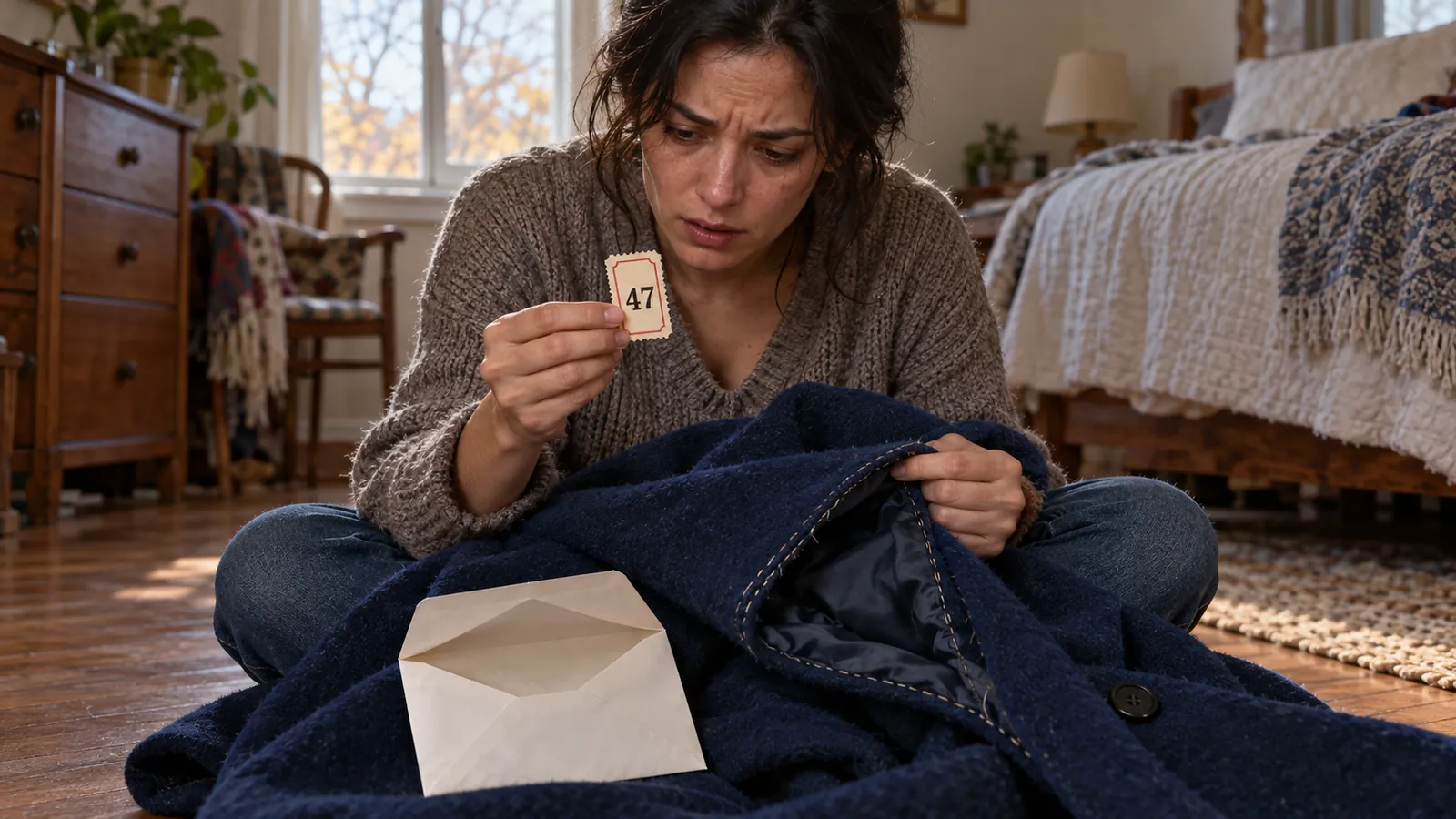
The blue coat lay over the back of a plastic chair. Theo noticed the loose hem where I had cut out the ticket.
“May I?” he asked.
I handed it to him.
He turned the lining back and studied my broken stitches. “Your mother used red thread under here.”
“I saw that.”
“Red means deliberate in some workrooms. A place to return to.”
He did not offer to fix it. He folded the coat and gave it back.
At nine fifteen, Celia called. “I need your decision. Security closes the screening desk at nine thirty.”
I looked through the laundromat window at my car, which had half a tank of gas and a warning light shaped like an engine. I thought about the boiler. I thought about Ruth writing protect your own roof.
Continuing her work exactly as she had done it would not honor her apology. It would repeat the part that hurt me.
“Can the hotel advance the fee and deduct it if he gets the job?” I asked Celia.
“Human resources does not do that.”
“Can the manager?”
A pause. “The manager can authorize an applicant expense if there is a documented skills shortage.”
“Do you have one?”
“We have one qualified candidate and forty-seven jackets waiting for alterations.”
“Then authorize it. My mother already paid for the cleaning. I will buy the rail ticket, but I am not paying the screening fee.”
Theo shook his head. “Mara—”
I covered the phone. “This is not a gift. Sign the card again. Repay the rail ticket after your first paycheck if you get one.”
“And if I don't?”
“Then you alter two interview outfits for the closet. We close the line.”
Celia heard me. “That is better than Ruth's arrangement,” she said.
It felt disloyal to agree. It also felt true.
The rail fare had risen to forty-six dollars. After I bought it online, my checking account held seventy-one dollars until Friday. I did not feel noble. I felt nauseated.
Theo signed the card.
Before I left, he took a spool of red thread from his kit and placed it on top of the blue coat.
“For tomorrow,” he said.
The ticket was still in my wallet. For the first time since I found it, I stopped thinking of it as evidence.
End of chapter 3