Kindness5 min read
The Ticket in My Mother's Coat
After my mother died, I found a hotel coat-check ticket sewn into her winter coat—and learned where our missing furnace savings had gone. Her final unfinished kindness left me one choice she refused to make for me.
Chapter 4: A Place to Return To
At nine forty the next morning, Theo stepped off the train wearing the charcoal suit. The shoulders sat clean, the sleeves showed the right amount of white cuff, and the shoes from Ruth's closet had taken a polish.
He still looked terrified.
“Good,” I said. “You look like a person who understands the stakes.”
“You sound like your mother.”
“I am trying not to.”
“That also sounds like her.”
Celia met us at the service entrance. She handed Theo a temporary badge and led him upstairs without ceremony. I expected to wait in the lobby, but she took me back to the basement.
The borrowing closet stood open. On the desk were the green ledger, a calculator, and three hotel accounting reports.
“What is this?” I asked.
“A problem,” she said. “The hotel cannot keep storing private donations under an informal agreement with a retired employee. Ruth and I ignored that because the arrangement worked. It cannot continue that way.”
My chest tightened. “I didn't say I wanted it to continue.”
“I know. I am asking whether you want two paid days to inventory it and build a proper record. No promises beyond that.”
She named an hourly rate higher than the diner paid me.
“You knew I did bookkeeping?”
“Ruth told me. Repeatedly. I also saw what you did last night. You made the hotel carry a cost connected to its own hiring.”
“That was not charity.”
“No. It was accounting.”
I laughed before I could stop myself.
For the next three hours, while Theo completed his interview upstairs, I counted jackets, dresses, shoes, and open ledger balances. I separated hotel property from donated clothes. I created consent forms for future borrowers and a plain repayment policy: no cash handed to applicants, no debt due before employment, service accepted in place of repayment, and no household savings used without agreement.
The last rule was for a dead woman and for me.
At noon, Theo came downstairs in shirtsleeves carrying a bell captain's jacket. One sleeve hung correctly. The other twisted toward the wearer's thumb.
Celia followed him.
“He found the manufacturer's sleeve mark was wrong,” she said. “Then he corrected it without cutting the lining.”
Theo set the jacket on the desk. “They said they would call.”
His face gave nothing away. A good suit could get a person through a door. It could not make the answer on the other side.
We returned the charcoal suit to the rail. Theo changed into his patched work shirt and folded Ruth's note into the inside pocket of his wallet, beside the debt card.
“Keep the shoes until they decide,” I said.
He shook his head. “Someone else may need them.”
He left in his own scuffed pair.
That choice, more than anything he had told me, made me hope.
The hotel called him six days later.
Celia made the offer contingent on a thirty-day trial: uniform alterations, emergency banquet repairs, and two afternoons a week cataloging formalwear for the new applicant closet. Theo would be paid for all of it. Nothing in the offer was a favor. The hotel had work, and he could do it.
He called me afterward from the station.
“I start Monday,” he said.
I sat on Ruth's kitchen floor with the furnace panel open and a repair estimate beside me. “Then on Monday, you can explain why the left sleeve on my diner uniform keeps turning backward.”
“I can explain it now.”
“Save something for your first day.”
The furnace needed a new control board. The technician agreed to installments. I used the eleven dollars from the envelope as the first payment and kept the receipt under a magnet on the refrigerator.
I did not forgive Ruth all at once. Some mornings I looked at the empty envelope and felt the old anger return. Love did not make her choice fair. Her apology did not make the winter cheaper.
But the ledger changed what I did with the anger. Instead of polishing it into a judgment, I gave it rules.
Celia hired me for eight hours a week after the inventory was done. The hotel called the program the First Day Closet. I refused a photograph for the employee newsletter and so did Theo. We put a small sign inside the basement door, where only applicants would see it: Clothes for the room you are trying to enter. Return them when you can. No explanation required.
The first repayment arrived three weeks after Theo started.
He came to my mother's house on a Saturday carrying a white envelope and a paper bag of pastries. Inside the envelope were forty-six dollars for the rail ticket and twenty-eight dollars and forty cents for cleaning. He had added the fingerprint fee, though I told him Celia had charged that to the hotel.
“Then put it toward the next person,” he said.
“The agreement was seventy-four forty.”
“The agreement was also two outfits if I failed.”
“You didn't fail.”
“I still have hands.”
We settled it like a business. I put seventy-four dollars and forty cents into the closet account. He kept the extra fee and agreed to alter one donated jacket each month on paid hotel time. The system would not survive by asking struggling people to become saints.
Then he placed my mother's blue coat on the table.
He had cleaned it and repaired the lining. The darker collar button remained. So did the shine on the cuff. Under the hem, hidden from view, he had resewn the red stitches.
“You left an opening,” I said.
“For the ticket.”
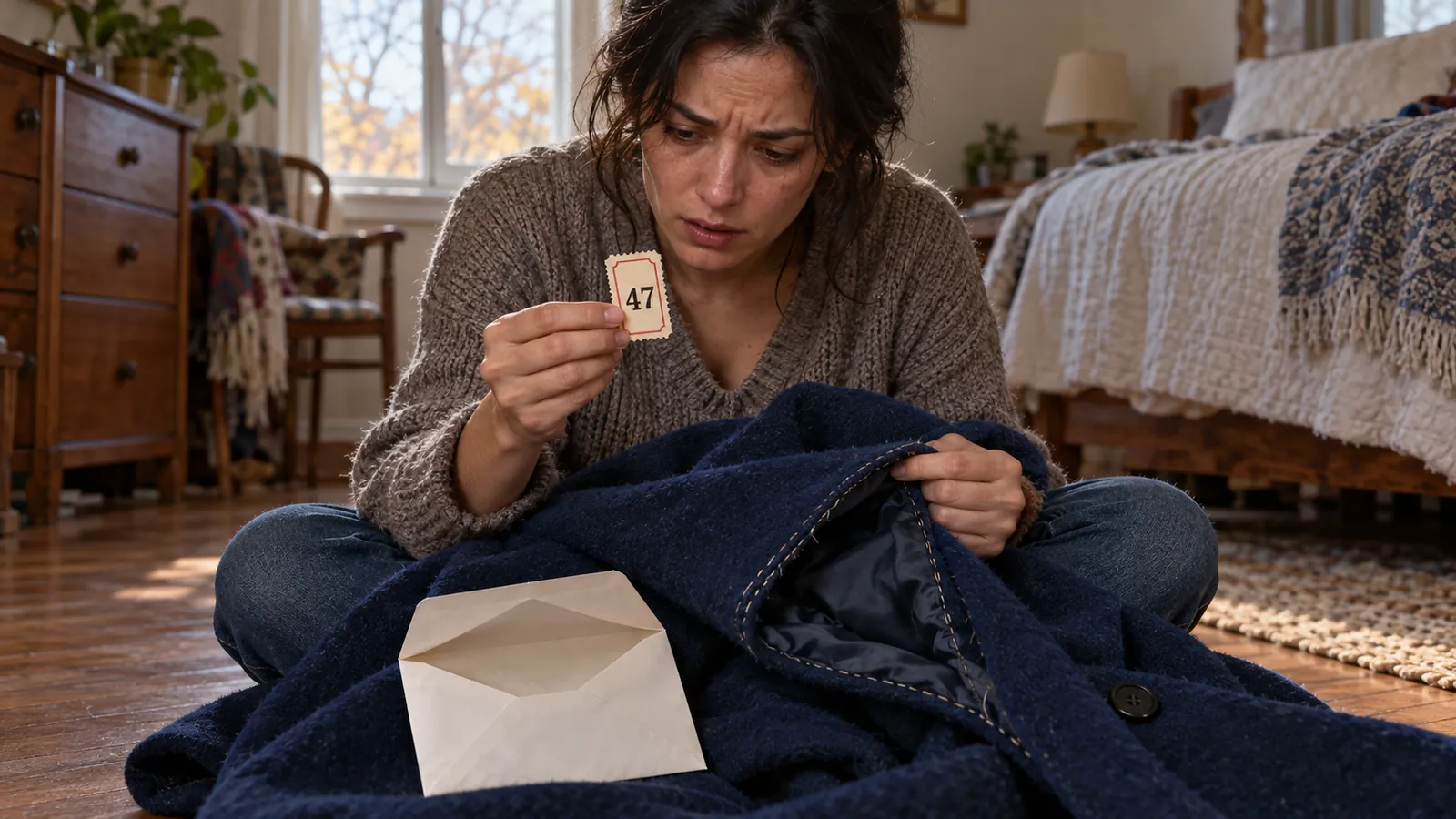
I took number 614 from my wallet. The paper had softened at the corners from weeks of handling.
“I thought you might frame it,” Theo said.
“My mother would hate that. She never trusted objects that needed dusting.”
I slid the ticket into the hem. Theo closed the last inch with red thread and handed me the needle for the final stitch.
My fingers were clumsy. Ruth had tried to teach me when I was ten, but I preferred columns that stayed where I put them. Theo showed me how to catch the lining without piercing the wool.
I pulled the thread through and tied it off.
That afternoon, I wore the coat to Alder House. The furnace payment schedule was in my bag. The green ledger was under my arm. Neither problem had disappeared, but both had a place now.
At the service entrance, a young woman waited in restaurant shoes split along one side. I did not ask for her story. I unlocked the basement door and showed her the shelf where we kept black shoes.
As I bent to find her size, the ticket rested against the inside of my coat, not a secret and not a debt.
A place to return to.
The end