Kindness5 min read
The Ticket in My Mother's Coat
After my mother died, I found a hotel coat-check ticket sewn into her winter coat—and learned where our missing furnace savings had gone. Her final unfinished kindness left me one choice she refused to make for me.
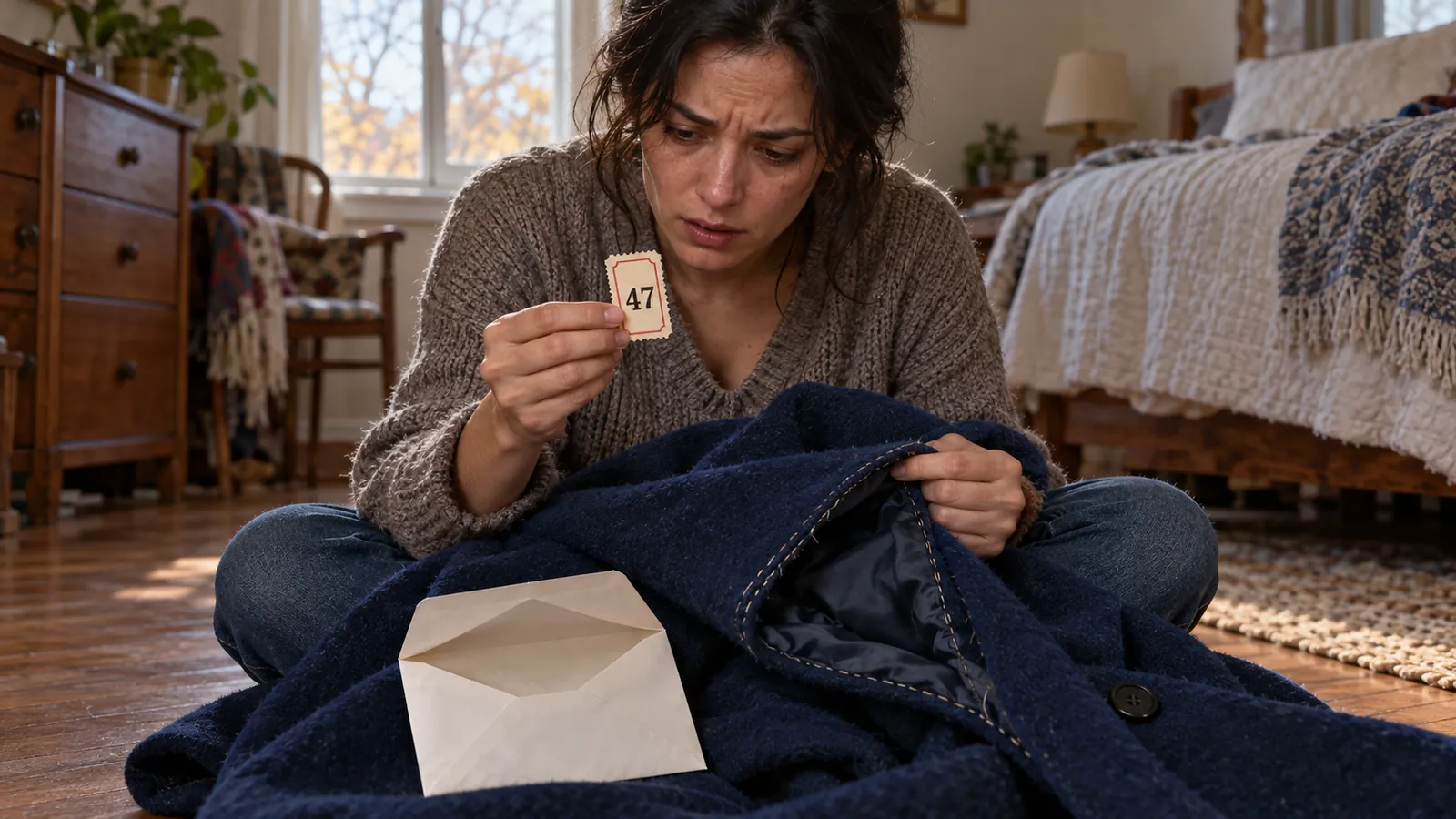
Chapter 2: The Room Behind Coat Check
The service entrance of the Alder House opened beside a row of dented delivery carts. Celia Brennan was waiting inside in a black suit and flat shoes, holding a ring of keys large enough for a jailer.
She was in her late fifties, with silver threaded through her dark hair and half-moon reading glasses hanging from a cord. She looked at my face first, then at the blue coat folded over my arm.
“Ruth wore that through fifteen winters,” she said.
“Sixteen. She refused to count the year the lining tore.”
Celia's mouth softened, but she did not try to hug me. I was grateful for that.
I showed my driver's license and the ticket. She checked both as if we were completing a bank transaction, then led me past the laundry room and down concrete stairs. The air grew cooler. We passed banquet chairs stacked to the ceiling, boxes of chipped saucers, and a row of brass coat racks wrapped in plastic.
At the end of the basement corridor stood an old coat-check room with a Dutch door. The numbered hooks inside were bare.
Celia unlocked a narrow door at the back.
The room beyond was no bigger than a pantry. Garment bags hung from two rails. Men's shoes filled labeled boxes on the floor. A shelf held handbags, belts, unopened hosiery, lint rollers, and travel-size deodorant. Everything was clean and carefully arranged.
A strip of masking tape above the rails read FIRST DAYS in my mother's handwriting.
I stared at it until the letters blurred.
“What is this?” I asked.
“Ruth called it a borrowing closet.”
“A borrowing closet paid for with whose money?”
Celia closed the door behind us. “Mostly donated clothes. The cleaning, repairs, transit, and application costs came from Ruth.”
There it was. No lost envelope. No hidden cash.
I set the blue coat on a chair because my hands had begun to shake. “She took our furnace savings.”
Celia looked genuinely startled. “I didn't know that.”
“Nineteen hundred and twenty dollars. She withdrew it in three pieces.”
Celia removed her glasses. “Ruth told me she had a small fund.”
“She had a daughter working two jobs and sleeping in the room where she stored Christmas decorations.”
“I understand why you're angry.”
“No, you understand why that sounds bad.”
She accepted the correction.
On a small desk beneath the lowest rail sat a green ledger. I opened it before she could object. Each page carried a date, a person's initials, a list of costs, and one of three words: working, repaid, or quietly closed.
The entries went back seven years.
Bus pass, $25. Haircut, $18. State identification replacement, $32. Laundry, $11.50. One week of morning child care, $85. A kitchen worker's nonslip shoes, $46.
Beside many of the older entries, repayments appeared in amounts as small as five dollars. Ruth had drawn a neat line through each balance when it reached zero. Then she had used the money again.
“She never charged interest,” Celia said. “She never asked anyone to repay before a first paycheck. If someone could not, she closed the line and never mentioned it again.”
“Why here?”
“People came to the hotel asking about work. Some were qualified and arrived in the only clothes they owned. Ruth noticed. She always noticed hems and shoes.”
Celia showed me how the system worked. The hotel donated unclaimed formalwear after the required holding period. Banquet staff brought clean clothes their families no longer used. Ruth altered pieces at her kitchen table. Celia stored them off the hotel's inventory and scheduled private fittings before interviews.
“You helped her hide it,” I said.
“I helped her protect people from being displayed as a good deed.”
The distinction irritated me because it mattered.
I turned to the final written page. Four September entries matched the initials on the dry-cleaning receipt. Three were marked working. The fourth was unfinished.
T.W. — charcoal suit, white shirt, black shoes. Cleaning 28.40. Rail ticket 42. Fingerprint fee 24. Interview: Thursday, 10:00. Alteration trial, Alder House.
Total: $94.40.
Thursday was tomorrow.
A charcoal garment bag hung alone at the end of the rail. Pinned to it was a note.
Theo Winslow — sleeves need 3/4 inch. Do not shorten from cuff. Reset at shoulder. He will know why.
The note was dated the morning of my mother's stroke.
“Who is he?” I asked.
“A tailor,” Celia said. “Or he was. The alterations shop where he worked closed in August. Ruth met him when he came here to ask about uniform work.”
“And you offered him a job?”
“I offered him an interview and a practical test. Our contract tailor retired. Theo missed the first appointment because he did not have the fingerprint fee for the hotel's employee screening. Ruth rescheduled him.”
“Why does a tailor need my mother's money for a suit?”
“He sold his good one when his shop closed. Ruth said the reason was his business.”
I flipped through the ledger again, searching for Theo's repayments. There were none. Only that unfinished line and a telephone number.
“Did she pay him directly?”
“No. She paid the listed costs. Ruth was careful about that.”
Careful enough to document strangers. Not careful enough to leave me a note about the money we shared.
Celia reached for the garment bag. “I can call him and cancel.”
The speed of her offer surprised me.
“This was Ruth's arrangement,” she said. “Not an obligation she could pass to you.”
I looked at the suit. One sleeve was basted higher than the other. A tomato-red pincushion, the kind my mother wore on her wrist, rested in the bottom of the bag.
“What happens to the interview?”
“Without the screening, it cannot proceed. The rail ticket was for him to get here from Westbridge. He moved in with a cousin after the shop closed.”
I hated that I was calculating while she spoke. Ninety-four dollars and forty cents was four diner shifts after taxes. It was a furnace service call. It was groceries. It was also the exact amount my mother had set beside his initials.
“Cancel it,” I said.
Celia nodded once. She did not make me defend the choice.
Then she handed me an envelope that had been tucked under the ledger.
My name was written on it.
Inside was not money. It was a single sheet torn from my old bookkeeping pad.
Mara,
If you are reading this, I ran out of time or courage. The boiler money was mine too, but I should have asked you before I used your part. I am sorry. The ledger will show where it went. Do not continue this because I did. Make your own decision, and protect your own roof.
T.W. is the last fitting. His hands are worth the chance.
Love, Mom
I read it twice.
An apology did not refill an envelope. It did not excuse her. It did something harder: it left my anger intact while taking away the villain I had built for it.
Celia waited by the door.
“Have you called him yet?” I asked.
“No.”
I folded the note along its existing crease. “Give me until nine tonight.”
I took the charcoal suit home with me, though I still intended to say no.
End of chapter 2