Revenge4 min read
The CEO’s Stolen Idea
When narcissistic CEO Vance fires chief architect Julian and steals his breakthrough logistics engine for a $100M Series C pitch, he forgets one detail. The core algorithm requires Julian's cryptographic key, which triggers an immutable copyright proof on the live auditorium screen.
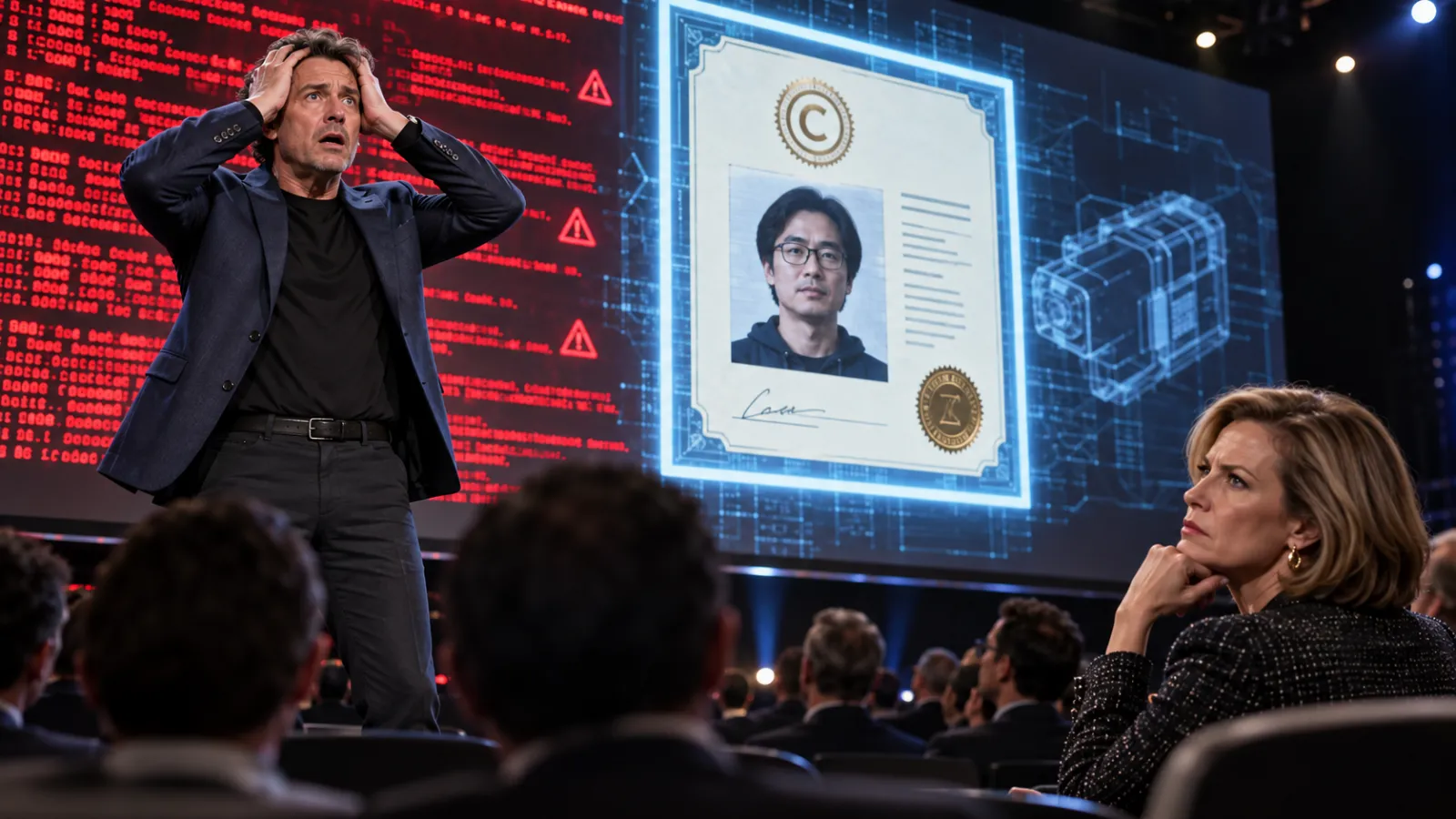
Chapter 1: The Architecture of Prism
When our flamboyant CEO took credit for my two-year logistics algorithm and fired me forty-eight hours before our hundred-million-dollar funding demo, he thought my clean desk was a surrender. He had no idea the engine required a cryptographic key only I possessed.
For two years, I lived on the twenty-fourth floor of our Montgomery Street headquarters in San Francisco. My official title was chief systems architect at NexaLogistics, but in practice, I was the sole author of Prism. Prism was a real-time routing engine designed to solve the multi-agent freight bottleneck. It synchronized container ships, interstate freight rail, and forty thousand regional delivery trucks into a unified mathematical lattice. Traditional logistics software buckled under five hundred simultaneous routing changes, while Prism resolved twenty thousand routing conflicts in under forty milliseconds.
I wrote the core mathematical algorithms in modern systems code, refining the memory management across two hundred sleepless weekends. My colleague Marcus Torres, our senior database engineer, built the distributed data ingestion pipelines that fed raw coordinates into my mathematical models. Together, we had turned a struggling freight brokerage into the most coveted enterprise technology target on the West Coast.
On Tuesday morning at ten o'clock, our chief executive officer, Vance Sterling, summoned me to his corner penthouse office.
Vance was forty-five years old, with silver-streaked hair styled with salon pomade and tailored navy blazers with velvet lapels. He wore custom gold cuff links shaped like miniature nautical anchors, a personal symbol of his self-proclaimed maritime conquest. Before taking the helm at NexaLogistics through aggressive board maneuvers, he had run boutique advertising firms in New York. He understood press conferences, camera angles, and private investor lunches, but he could not read a single line of compiled computer code.
"Julian, close the door and take a seat," Vance said, gesturing with an expensive fountain pen toward a white leather armchair. "We are forty-eight hours away from history. Apex Global Capital is bringing their full investment committee to the Fairmont Grand on Friday. Evelyn Cross herself is leading the syndicate."
Evelyn Cross was legendary in Silicon Valley venture circles. She had spent a decade as an aerospace engineer before founding Apex Global Capital, earning a reputation for cutting through corporate theatrics with forensic precision. Securing her signature on a hundred-million-dollar Series C term sheet would value NexaLogistics at seven hundred million dollars.
"The staging clusters are ready for the demonstration, Vance," I said, setting my notebook on the glass table. "Marcus and I verified the pipeline latency this morning. We are stable up to twelve thousand simulated freight hubs."
Vance smiled, a wide, practiced grin that never quite reached his sharp gray eyes. He spun a heavy, leather-bound portfolio across the glass surface toward me. The cover was stamped with silver foil lettering: Prism: Autonomous Freight Coordination at Global Scale.
I opened the binder. On the first page, beneath the executive summary, sat the author attribution line.
Conceived, Designed, and Authored by Vance Sterling, Founder and Chief Executive Officer.
I scanned the entire document. My name did not appear anywhere. Neither did Marcus's name, nor the names of the six systems engineers who had worked eighty-hour workweeks to stabilize the distributed memory buffers.
"Vance," I said quietly, keeping my tone measured. "My name has been removed from the technical documentation. So has the engineering team's credit."
Vance waved his hand dismissively, leaning back into his leather executive chair. "Julian, you need to understand the realities of high finance. Institutional venture capital does not write nine-figure checks to quiet technicians in flannel shirts. They invest in charismatic founders. They invest in visionaries who command the stage."
"I spent twenty-four months building this mathematical engine from scratch," I said. "This is not marketing copy. This is thirty pages of proprietary algorithmic architecture and patent disclosures."
"And NexaLogistics paid your salary while you wrote it," Vance replied, his smile vanishing into a cold, condescending smirk. "You built the plumbing, Julian. I imagined the cathedral. Without my capital and my stage presence, your equations are just useless academic scratches on a whiteboard. Be grateful you will receive a standard bonus when the deal closes."
I looked at the portfolio on the glass desk. For two years, I had watched Vance take credit for product updates, client acquisitions, and platform metrics. I had tolerated his narcissism because I believed the integrity of our software mattered more than corporate vanity. But looking at his polished face across the mahogany desk, I realized that Vance did not view engineers as colleagues. To him, we were disposable tools to be discarded the moment his personal fortune was secured.
"The live keynote demonstration at the Fairmont requires real-time routing under live enterprise load," I said softly. "Are you confident you understand the execution dependencies?"
"Of course I do," Vance scoffed, checking his gold watch with theatrical impatience. "It is software, Julian. It runs when someone presses enter. I have studied your slides for three weeks. I will deliver the keynote, Evelyn Cross will sign the syndicate term sheet, and Nexa will dominate global freight."
He stood up, signaling that our meeting was concluded. "Make sure the cloud servers are running at maximum capacity on Friday morning. That is all."
I closed the portfolio, stood up, and left his office without uttering another word. As I walked down the glass corridor toward the engineering bullpen, I felt no anger, only absolute clarity. Vance believed that owning the cloud servers gave him ownership of my mind. He had forgotten that complex systems do not bend to executive arrogance.
End of chapter 1