Revenge4 min read
The CEO’s Stolen Idea
When narcissistic CEO Vance fires chief architect Julian and steals his breakthrough logistics engine for a $100M Series C pitch, he forgets one detail. The core algorithm requires Julian's cryptographic key, which triggers an immutable copyright proof on the live auditorium screen.
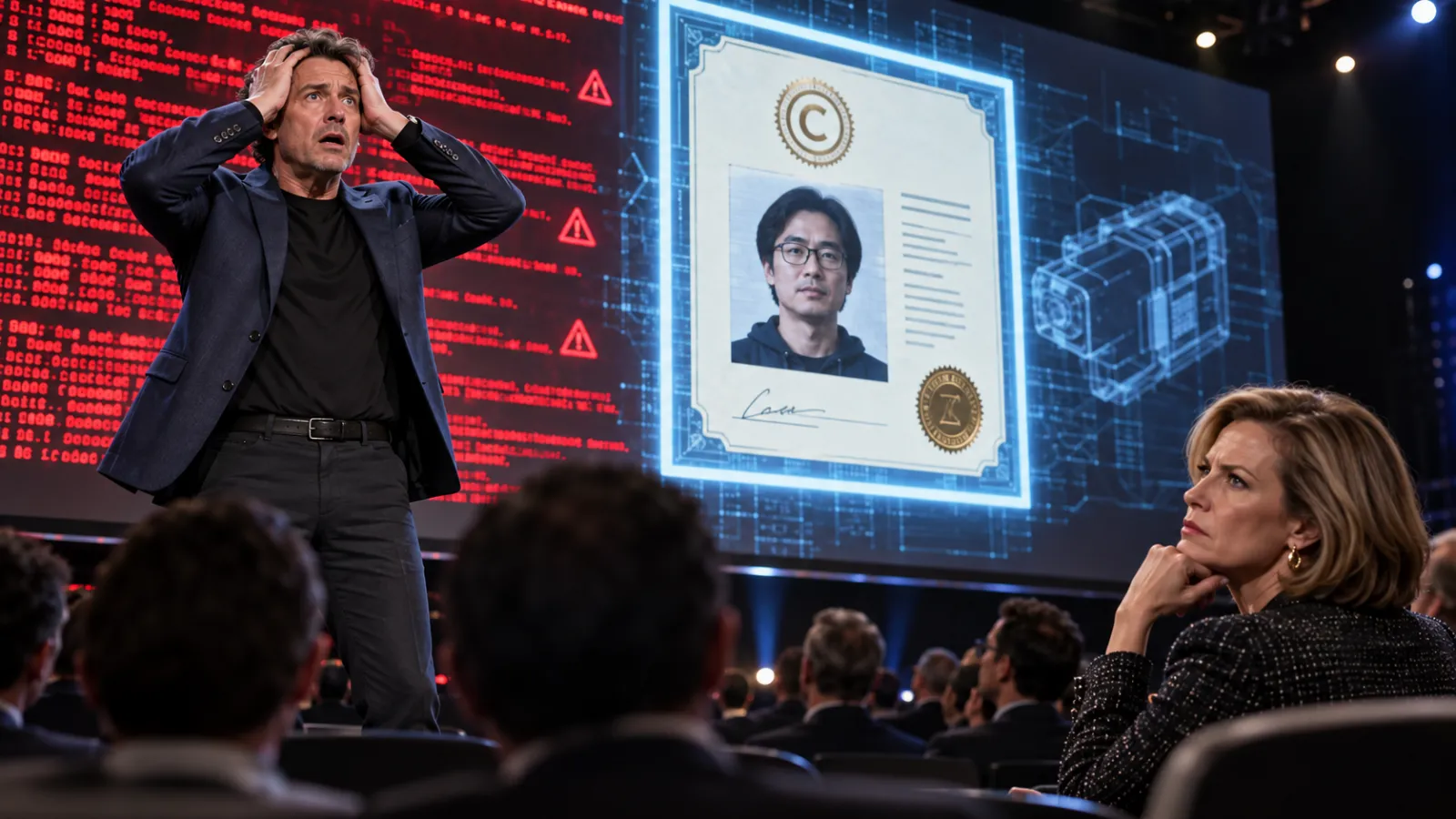
Chapter 3: The Salt in the Cryptographic Key
At eight o'clock on Wednesday evening, the brass buzzer rang in my third-floor flat on Telegraph Hill. Outside the bay window, the fog was rolling in thick over Alcatraz, wrapping the orange towers of the Golden Gate Bridge in cold white cotton.
I walked to the intercom and pressed the button. "Marcus?"
"It is me, Julian. Open up."
A minute later, Marcus Torres walked into my kitchen carrying two brown paper bags filled with takeout boxes from our favorite Thai restaurant on Green Street, along with a four-pack of cold mineral water. His tie was loosened, his jacket was wrinkled, and his face was tight with exhaustion.
"You should have seen the circus after they marched you out," Marcus said, setting the cartons on my butcher-block table. "At four o'clock, Vance called an all-hands meeting in the main atrium. He stood by the glass espresso machine in his velvet blazer, holding a glass of sparkling water, and told sixty employees that you had resigned suddenly due to family health issues."
I opened a drawer, retrieved two ceramic bowls, and divided the green curry and jasmine rice. "Did anyone believe him?"
"Not a single person in engineering," Marcus replied, sitting down heavily. "We all saw building security escorting you to the elevator. Then Vance announced that every engineer would receive an extra five-thousand-dollar retention bonus the moment Apex Global Capital wire the hundred million dollars. He actually bought six cases of champagne and had them stacked in the break room refrigerator."
I handed Marcus a fork and a napkin. "Vance is confident. He believes the presentation on Friday is already won."
"That is the terrifying part," Marcus said, leaning across the table and lowering his voice. "At five-thirty, Vance brought our devops lead into his office. He ordered him to bypass the cached staging sandbox during the keynote. Vance told him that canned data looks cheap to an investor like Evelyn Cross. He ordered the team to connect the production cluster directly to our live carrier feeds. On Friday morning, he plans to run fifteen thousand live freight nodes in real time on the big auditorium screen."
Marcus rubbed his temples, staring at his bowl. "Julian, if that cluster crashes in front of five hundred people, our entire engineering reputation goes down with the ship. What happens when the live data hits Prism without you at the terminal?"
I set down my fork, walked over to my desk near the bookshelf, and picked up the small black YubiKey hardware token I had slipped into my pocket that afternoon. I returned to the table and laid the black key beside Marcus's water bottle.
"Prism will not crash, Marcus," I said softly.
Marcus picked up the token, examining the tiny gold contact pad. "What does this key do?"
"When I designed the mathematical kernel of Prism eighteen months ago, I built it with an enterprise zero-knowledge validation gate," I explained. "Logistics routing at national scale involves trillions of matrix calculations. To prevent memory leaks and unauthorized cluster replication, the high-throughput routing matrix does not operate on raw plain text. It requires a dynamic cryptographic salt to decrypt the spatial coordinate matrices."
Marcus looked up, his brow furrowing as he processed the architectural logic. "A dynamic salt? But the staging tests ran smoothly every morning. We tested dozens of routing scenarios."
"Those tests were executed on our developer sandbox," I said. "The sandbox cache is capped at fifty simulated freight nodes. For fifty nodes, the engine uses a lightweight, open-source mock key embedded in the staging configuration. But the moment the ingestion pipeline crosses one thousand concurrent enterprise nodes, the engine executes a mandatory validation handshake."
"And that handshake requires this hardware token," Marcus whispered, staring at the black metal key in his palm.
"It requires the private key derived from this token," I said. "Six months ago, before Vance even began courting Apex Global, I filed a provisional patent with the United States Patent and Trademark Office under application serial number US-2026-08819. I also registered the mathematical source architecture with the Library of Congress copyright repository. The public key is baked directly into the compiled binary."
Marcus stared at me with rising astonishment. "You did not plant a backdoor. You implemented a standard cryptographic licensing barrier."
"Exactly," I said. "I never sabotaged the code. The algorithm is completely intact, mathematically pristine, and fully functional. But it is legally and cryptographically bound to its verified inventor. If someone runs live enterprise throughput without the authorized private key handshake, the validation gate rejects the pipeline."
"What does the engine do when the handshake fails?" Marcus asked.
"It executes a secure administrative fallback routine," I replied. "It safely halts the memory pool to prevent data corruption. Then it outputs the immutable provenance log: the patent registration number, the author timestamp, and the verifiable cryptographic certificate of authorship."
Marcus stared at the hardware key for ten seconds, then burst into a low, breathless chuckle. He shook his head, looking up at me with profound respect. "Vance has no idea. He thinks he can stand up there in his velvet lapels, click a presentation remote, and command your life's work as his own."
Marcus reached into his jacket pocket and pulled out a white laminated badge on a black lanyard. He slid it across the butcher-block table.
"Our devops team was allocated twenty industry observer passes for the Fairmont Grand," Marcus said with a quiet grin. "This one was issued to an unnamed guest of engineering. You should be in the room, Julian. You earned the right to see your creation work."
I picked up the badge, looking at the embossed lettering: Fairmont Grand Tech Summit — Guest Observer.
"I will be there," I said.
End of chapter 3