Revenge4 min read
The CEO’s Stolen Idea
When narcissistic CEO Vance fires chief architect Julian and steals his breakthrough logistics engine for a $100M Series C pitch, he forgets one detail. The core algorithm requires Julian's cryptographic key, which triggers an immutable copyright proof on the live auditorium screen.
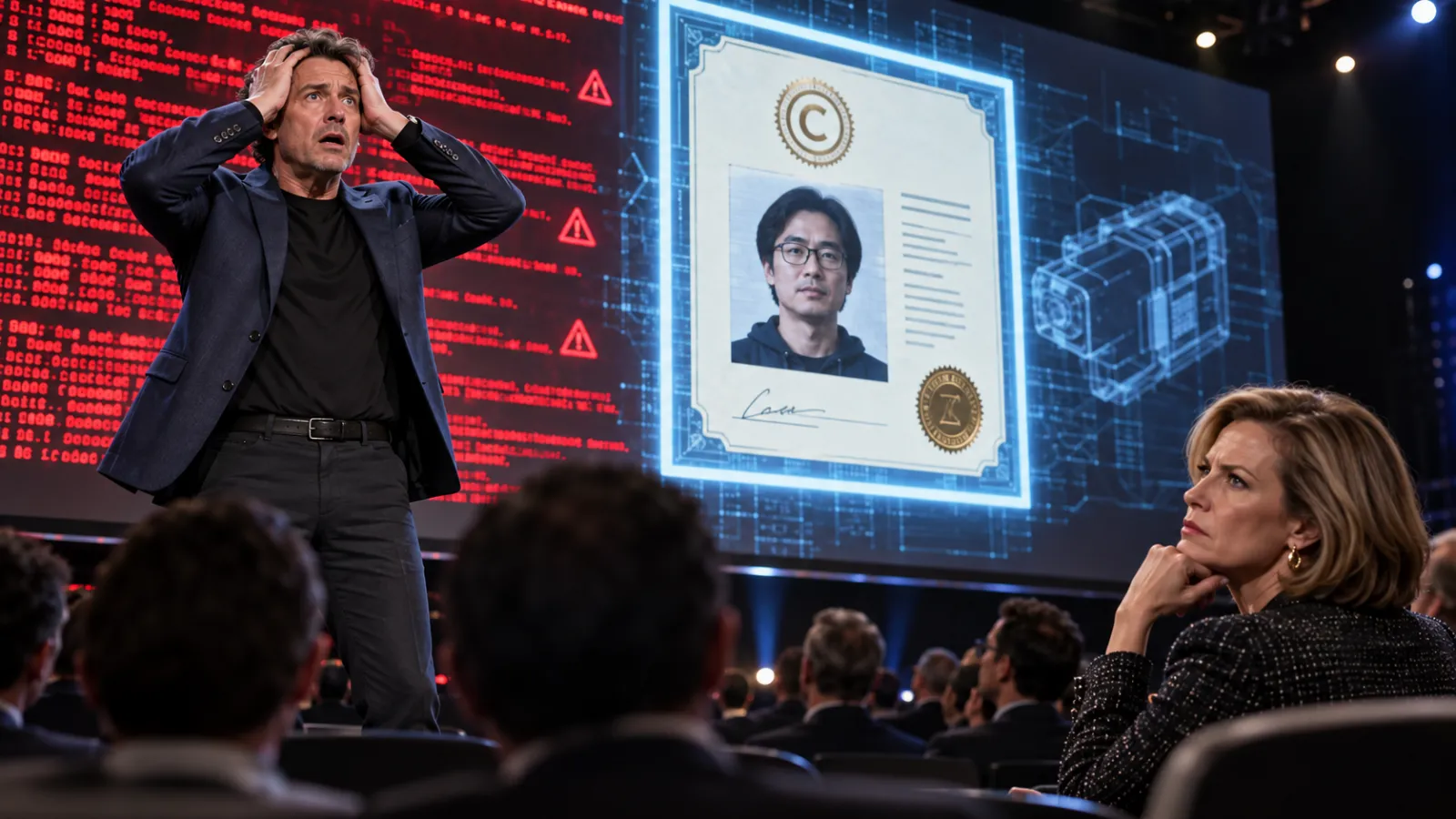
Chapter 4: Live Demo at the Fairmont Grand
On Friday morning at nine-thirty, the line of black town cars stretched two blocks down Mason Street toward California. The Fairmont Hotel sat atop Nob Hill like a neoclassical fortress, its limestone pillars catching the bright autumn sunshine.
I walked past the bronze lobby doors wearing a charcoal wool coat over a plain white collar, keeping my hands resting casually in my pockets. At the registration desk inside the marble foyer, an attendant scanned my laminated pass without glancing up, handing me a silver conference program. The front cover bore a full-page portrait of Vance Sterling, staring intensely toward the horizon beneath the bold title: The Architect of Autonomous Trade.
I entered the Grand Ballroom and slipped quietly into the second-to-last row of the mezzanine tier, choosing an aisle seat beside the sound and lighting consoles.
The room was magnificent and suffocating. Five hundred people packed the velvet rows beneath towering crystal chandeliers. There were managing partners from Sand Hill Road venture funds, senior executives from Danish shipping conglomerates, and technology reporters from major financial dailies with open laptops.
In the center of the front row, directly beneath the elevated stage, sat Evelyn Cross.
Evelyn was fifty-two years old, with sharp silver-gray hair cut cleanly at her jawline and a charcoal bespoke blazer that gave her an aura of unyielding authority. She had placed an open legal pad on her knee, holding a silver fountain pen poised above the paper. Beside her sat three senior partners from Apex Global Capital, their expressions neutral and analytical.
At precisely ten o'clock, the chandeliers dimmed until the ballroom was bathed in deep indigo light.
A low, resonant synth chord reverberated through the massive line-array sound system, vibrating through the mahogany floorboards. Across the back of the stage, an immense forty-foot ultra-high-definition LED video wall flickered to life. A glossy promotional film played, showing container ships battling ocean swells, freight trains crossing western deserts, and delivery vans navigating crowded metropolitan streets.
The voiceover thundered across the hall: "Global logistics has lived in the dark for half a century. Welcome to the era of absolute clarity."
A crisp white spotlight illuminated the left wing of the stage.
Vance stepped out into the beam of light to a roar of polite executive applause. He looked immaculate. His custom navy blazer featured midnight velvet lapels that caught the glare of the lights, and his hair was parted with geometric precision. As he raised both hands in a practiced gesture of gracious humility, the gold anchor cuff links at his wrists gleamed brightly.
"Good morning, San Francisco," Vance said into his wireless headset, his rich baritone filling the auditorium with effortless charisma. "Two years ago, I looked at our global supply chains and saw an archaic, broken relic. Wall Street said real-time multi-agent routing was a mathematical impossibility. Legacy software giants said we would need supercomputers in every port."
He paused, pacing deliberately toward center stage with fluid confidence.
"I refused to accept defeat," Vance continued, looking directly toward Evelyn Cross in the front row. "For twenty-four months, I dedicated every waking hour to solving the multi-dimensional routing matrix. I envisioned an autonomous engine that could think faster than the physical movement of cargo. An engine that turns chaos into perfect mathematical symmetry. I called that vision Prism."
He clicked his handheld presentation remote. The forty-foot screen behind him transitioned to an elegant graphic depicting a glowing geometric crystal refracting lines of blue and amber freight routes. Beneath the crystal, in glowing typography, was printed: Invented and Directed by Vance Sterling.
I sat in the back row, resting my back against the cushioned seat, watching the spectacle.
Vance moved through his presentation with practiced charm. He displayed benchmark charts comparing legacy freight brokers to NexaLogistics, showing theoretical fuel savings of thirty-two percent and route efficiency gains of forty-one percent. The venture capitalists in the audience nodded in unison, tapping hurried notes into their tablets.
"These numbers are impressive on paper," Vance said, his voice dropping to an intimate, conversational cadence that drew the entire room forward. "But anyone can hire graphic designers to render theoretical charts. True founders do not hide behind static slides. True founders demonstrate real power in real time."
A murmur of excitement rippled through the ballroom. Several tech journalists adjusted their camera lenses, pointing them toward the center stage.
Vance turned toward the giant screen behind him, raising his remote like a conductor preparing an orchestra.
"This morning, for the very first time, we have taken off the training wheels," Vance announced with theatrical triumph. "We have disconnected our staging sandbox. Behind this screen, NexaLogistics is connecting our live production clusters directly to the live data feeds of four international maritime alliances, three Class I freight railroads, and twenty regional delivery carriers."
He turned back to face Evelyn Cross, beaming with absolute certainty.
"You are about to witness fifteen thousand live enterprise cargo movements synchronized in real time by the mind of NexaLogistics," Vance declared, extending his arm toward the screen. "Let us watch the future begin."
He pressed the primary execution button on his remote. High above the stage, the server connection indicators on the display flipped from amber to bright green. I watched from the shadows, knowing the clock had just started ticking.
End of chapter 4