Family6 min read
My Daughter Said She Didn't Count
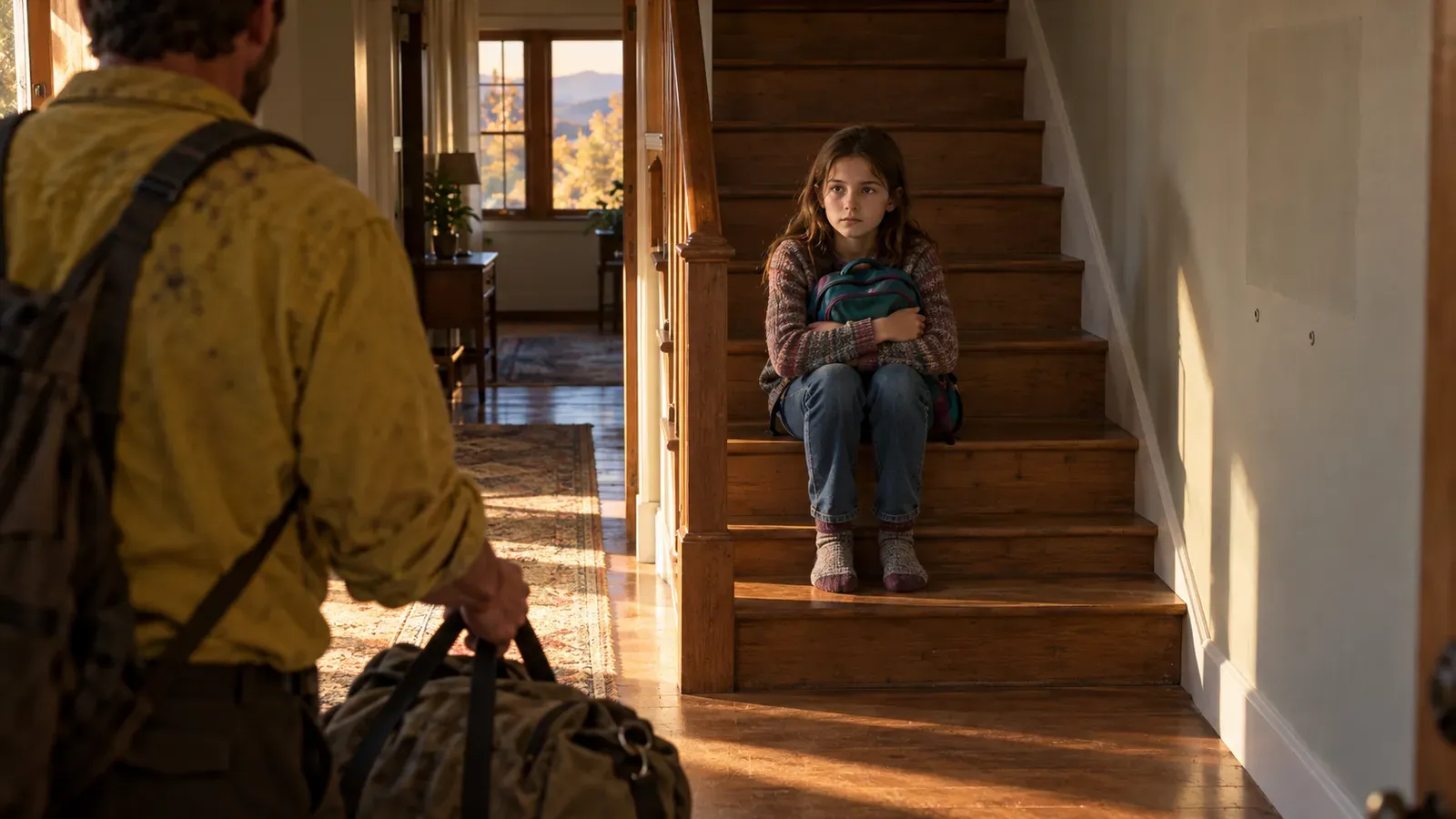
I came home from a Montana wildfire two days early and found my ten-year-old on the third stair, backpack on her knees, waiting to be allowed down in her own house. My wife, who runs a daycare downstairs, said it was a licensing thing and Bea was fine up there.
Chapter 1: Two Days Early
I came home two days early. My daughter said she didn't count.
That was the second thing that happened. The first was a woman coming down my front walk at ten to six on a Monday, with a little boy on her hip.
She was young, in a gray hoodie, with a lanyard around her neck that said RIDGEVIEW CARE CENTER. Keys and a badge hung off it, and a small zip pouch was clipped on beside them. The boy wore green dinosaur rain boots and kicked them against her side like he was riding something.
She was folding a white slip of paper, about the size of a gas receipt, into that pouch. When she saw me she stopped folding. She looked at me longer than a stranger should: the crew shirt, the duffel, my face. Then she zipped the pouch, buckled the boy into a car seat and drove off without a word.
One adult, one child, one car. I count without meaning to. You count your squad off the line every shift for fourteen days straight, and after enough seasons you count everything.
The front door was unlocked. I pushed it open and stood there with the duffel still in my hand.
Bea was on the third stair. Her backpack was on her knees, both arms around it.
"Bea. Why are you on the stairs?"
"I can't come down till six."
"Who says?"
"The license. I don't count."
Beyond the hall, through the doorway to the living room, Renee sat on the sofa with her laptop open. Plastic blocks and a yellow dump truck lay on the rug around her feet. She didn't look up.
"It's a form, Wade. She's fine up there."
I crossed the hall to the stairs and held out my hand.
Bea looked at it. Then she looked at the doorway, and then she took it. She stood with the backpack hugged against her chest and came down the stairs with me, one step at a time, and I walked her across the hall and into the living room, past Renee, all the way to the window.
Renee closed the laptop. "You're early."
"Fire's in mop-up. They cut a few of us loose."
That was true, as far as it went. The rest of it was in my shirt pocket, copied at fire camp onto the back of a fuel receipt:
Non-emerg. family msg for W. Kowalski. Caller: parent at spouse's daycare. Child OK. Asks you not tell spouse who called. Callback 406-555-0187.
I had called that number from camp at 8:40 Sunday night. Nobody picked up. I sat on a cooler for an hour reading Child OK until it stopped meaning anything, and then I went and asked the superintendent for a release. We were due out Tuesday anyway. He signed it. I rode the supply truck out at eleven, checked my gear in at the crew station around four-thirty, got in my own truck and drove home. I didn't call ahead.
"Upstairs till six," Renee said. "It's a licensing thing. Quiet time. She likes her room. Don't you, Bea?"
"It's fine," Bea said.
"She's got her books up there, her own bathroom. Honestly, it's the best part of her day. No toddlers." Renee smiled at me. There was no apology in it, and no heat either. She said it the way she'd tell a parent what time nap ended.
Bea was looking past me, through the far doorway, at the clock over the kitchen stove. "Am I allowed?"
It was 5:52.
"Yes," I said.
She nodded the way my rookies nod at a safety briefing. She didn't believe me.
Renee went out to the front hall to close the day, and I followed.
The sign-in table stood by the door where the shoe bench used to be. On it lay a clipboard with the day's sign-in sheet, a white binder with a printed label, LICENSING — KEEP ON SITE, a gray cash box and a pad of carbon receipts lying open. Renee opened the cash box and laid some folded bills inside. The top sheet left on the pad was a yellow carbon. Her handwriting:
Early hrs — 75.00 — cash — R.K.
I didn't know what early hours meant. I didn't ask.
On the wall beside the door, in a plastic frame, hung the license. I read it the way I read a weather board in camp, numbers first.
Family Child Care Home. Licensed capacity: 8.
Under the frame was a smaller sign: We accept state child-care assistance.
There was small print below the capacity line, a footnote in gray type. I leaned in to read it.
"Kitchen," Renee said. She shut the cash box and put her hand flat on my back. "You must be starving."
I set the duffel on the kitchen counter, and it landed beside a letter.
It had been opened and flattened out. It was addressed to Renee Kowalski, Little Pines Family Child Care. Nobody else. Welcome to your business line of credit. Forty thousand dollars. First payment of $612 due November 1.
Through the window over the sink, the backyard had changed. Four wooden stakes stood in the grass past the swing set with orange string pulled tight between them, a long rectangle where there had been nothing in September.
Renee picked the letter up, folded it in thirds and slid it into the drawer by the phone charger. "Business stuff. I'll tell you about it."
"What's out back?"
"Same answer." She kissed my cheek. "You smell like a campfire."
Dinner was chili she'd made on Sunday. The three of us ate at the kitchen table, and Renee did most of the talking: a boy who bit, a new cubby system. Bea answered what I asked her. School was fine. Fifth grade was fine. Her teacher was nice.
When her bowl was empty she stood, carried it to the sink, rinsed it and set it in the rack. Then she turned around.
"Thank you for dinner. Can I go up now?"
She said it the way a kid says it at a friend's house.
"Sure, hon," Renee said.
"You don't have to," I said.
Bea went anyway. I listened to her go up. Fourteen stairs. Her door closed.
Renee went up to shower a little after nine. I went out to the hall with my jacket, and my hand went to the wall by the door, where I'd hung it every time I came off a roll for twelve years.
I'd seen the rack in September. I'd hung my jacket on the newel post instead and not thought about it past that. Tonight I stood there and read it.
A white rack, eight hooks, and over each hook a printed label from Renee's label maker. Seven names I didn't know. On the eighth, TOBI.
This was the rack I'd said sure to in August. Renee needed the wall by the door for one more little one, she'd said, licensing wanted the hooks by the door, and I'd said sure on my way out to the truck.
Above the rack the paint was a different color. A rectangle of it, paler and cleaner than the rest, where five years of coats and small hands had never touched the wall. Inside the rectangle were two old screw anchors, set low enough for a five-year-old to reach.
I knew exactly how low, because I had drilled the holes.
That pale rectangle was where the pine board with Bea's name on it had hung for five years.
End of chapter 1