Family5 min read
My Daughter Said She Didn't Count
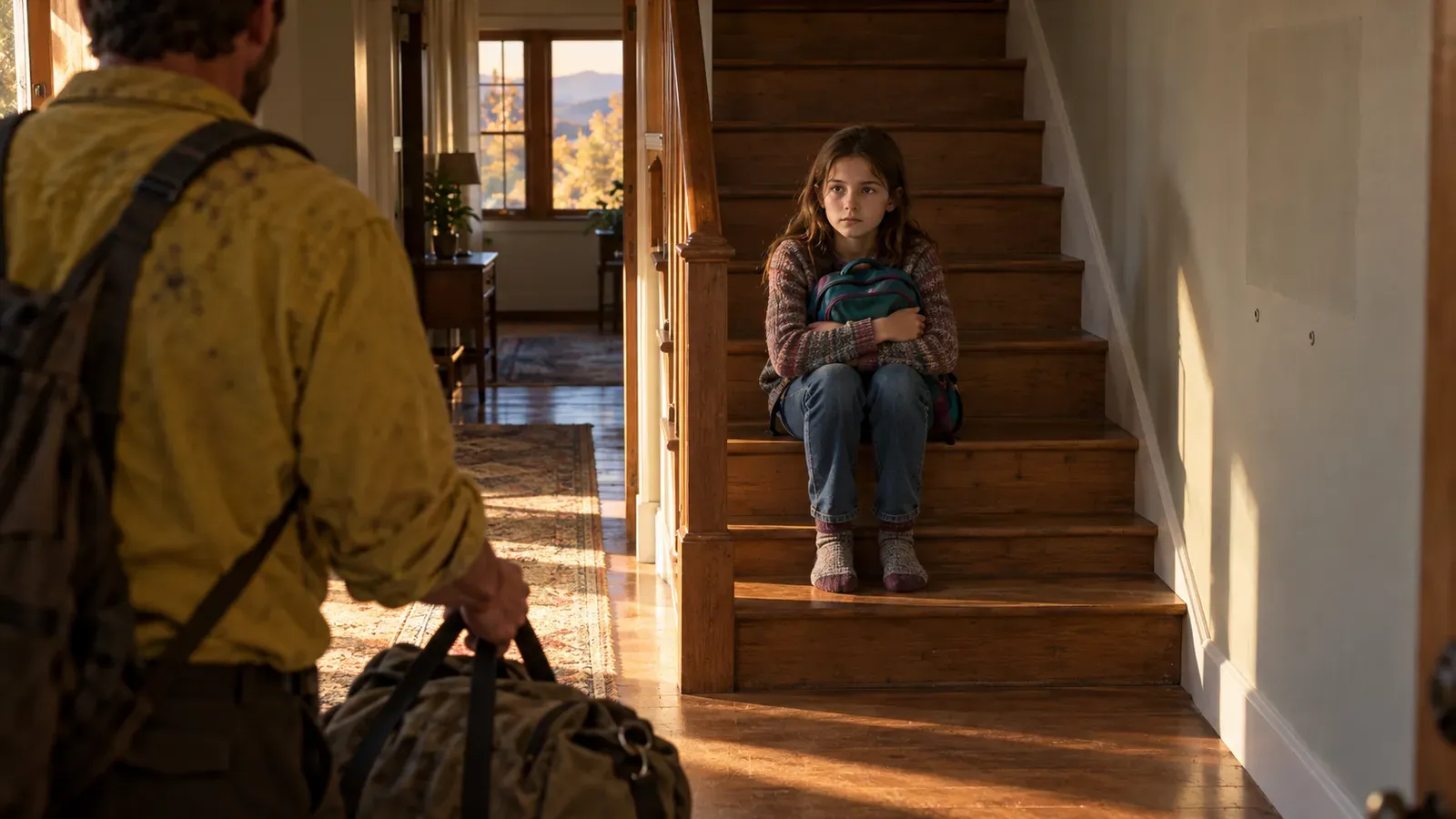
I came home from a Montana wildfire two days early and found my ten-year-old on the third stair, backpack on her knees, waiting to be allowed down in her own house. My wife, who runs a daycare downstairs, said it was a licensing thing and Bea was fine up there.
Chapter 6: Correction
I put Bea on the bus at 7:25 and hung the license back on its nail on my way out. Renee was in the living room with the first three kids. She didn't look up.
The licensing office is on the second floor of a brick building downtown, above a tax preparer. I was at the counter at 8:02. One woman behind it, reading glasses on a cord, a coffee mug full of pens.
I gave her the statement with the form clipped behind it. She read the statement first, all four sentences. Then the form. Then the statement again.
"You're the husband," she said.
"I own the house."
"I can't take a household form from you. The provider files that, and she'll have to file it again." She tapped the lined paper. "This I can take. This is a complaint. Somebody will come out."
"When?"
"We don't say when."
Bea had told me that on Monday night. You don't know when.
"With your daughter counted, that home is at nine," the woman said. "It's licensed for eight. She has to be at eight before she opens tomorrow. Not after somebody visits. Tomorrow."
"What happens to the eighth kid?"
She took her glasses off. "That's the provider's call. Most of them let go of the last one they took."
I'd known that since a parking lot at 6:35 the morning before. I'd wanted to hear somebody say it across a counter anyway.
"Does anybody need to talk to my daughter?"
"No." She made a copy of my statement and stamped the original. "We count who's there."
There was more I could have put on her counter. It wasn't mine to put there. Tasha had said so in the truck.
The office called the house at ten. I was in the kitchen when Renee took it in the front hall with a toddler on her hip, and I heard her half. "Yes. I understand. Tomorrow. Yes." Her phone voice, level all the way through.
She re-filed before nap time was over. At one o'clock she came into the kitchen and said it to the window over the sink.
"Tobi's last day is today. Last one in."
At 4:31 my phone buzzed.
Done. They kept copies. I'm sorry I didn't text sooner.
At a quarter to six I went out to the hall and stood by the stairs. Tasha came in the front door. Tobi ran at her in his dinosaur boots, and she lifted him onto her hip and went to the rack. She took his jacket off the eighth hook, then the little backpack.
The printed TOBI label was already gone. Where it had been there was a clean strip, whiter than the rest of the rack. Tasha looked at it a second.
Tobi saw Bea through the kitchen doorway and waved with his whole arm. Bea waved back from the table. She didn't get up.
Tasha looked at me over his head. I nodded. She nodded. For once she didn't say she was sorry. Then she went out.
Bea was still looking at the doorway when I came back in.
"Is Tobi done?"
"Yes."
She put her pencil down on her spelling list.
"Tobi's mom is the one who told me," I said. "About the stairs."
Bea thought about that for a while. "She says sorry back," she said. "When I say it."
On Thursday at ten to four the doorbell rang. Nobody at Little Pines rang the doorbell.
The woman on the step had a canvas bag and a state badge on a lanyard. Renee let her in. She read the license by the door first, gray type too. Then she walked the rooms with a clipboard. Living room. Classroom. I could hear her pen.
She stopped in the kitchen doorway. Bea was at the table with a science worksheet about the water cycle, and I was across from her.
The woman looked at Bea, then at her clipboard. Her pen moved once.
"Eight," she said, to nobody, and wrote it down.
I'd counted with her. I couldn't help it.
Bea looked at me. I nodded at the worksheet, and she went back to the arrows between the cloud and the lake. Her chair didn't move.
The woman spent forty minutes at the sign-in table with Renee and the binder. Renee answered every question in the voice she used for the cleanup song. By the next week it was on paper: one citation for false household information, one for caring for more children than the license allowed, and a corrective plan with dates on it.
On Friday Renee put a letter in every cubby. Little Pines Family Child Care would close at this address on October 30. She'd rented a duplex in East Helena. She told me across the sign-in table, like a change in pickup times, and I listened the same way.
Friday was the day Bea had asked about. I went back, for six hours.
I drove to the crew station for the last day of the season and signed out on a sheet with twenty names on it. My gear had been in the cage since Monday. The superintendent caught me at the truck and wanted to talk about May. I told him to give the squad to my second.
He looked at me for a while, the way he looks at a slope before he sends us up it. Then he walked me into his office and pulled the district posting up on his own computer. It closed at five. I finished the application at 2:40, with him reading over my shoulder and fixing my spelling.
I was at the mailboxes when the bus came over the rise.
That night Bea made a card for Tasha, which I left at the Ridgeview front desk on Sunday, and inside, in purple marker, it said only You counted me.
Tasha texted me the next week that her mother had moved to a later shift to keep Tobi in the mornings, and that she'd given up one of her nights to cover the rest.
For two weeks Renee ran Little Pines downstairs and slept upstairs, and I slept on the couch. I met the bus every afternoon at 3:41. Bea did her homework at the kitchen table. Nobody said quiet time.
On Saturday, October 31, Renee backed a rented box truck up to the front walk.
I carried the cots out for her. Nine. She packed the label maker herself, in its own box, and put a label on the box. Last she took the drill to the rack by the door. Eight hooks, seven labels and one clean strip.
She said goodbye to Bea in the kitchen. I stayed in the hall and let them have it without me.
At the truck she stood with the keys in her hand and looked at the house.
"Are you going back in May?" she said.
"No."
She nodded, like it was a number she could have used a long time ago. Then she got in and drove down the gravel road, and the lawyers took November.
I went inside and hung my jacket on the newel post, out of habit. The wall by the door was bare. Four new holes where the rack had been. Above them, the paler rectangle of paint, and two old anchors set low enough for a five-year-old.
At 7:12 that evening my phone buzzed. An email, from the district.
I started Monday at seven.
End of chapter 6