Family5 min read
My Daughter Said She Didn't Count
I came home from a Montana wildfire two days early and found my ten-year-old on the third stair, backpack on her knees, waiting to be allowed down in her own house. My wife, who runs a daycare downstairs, said it was a licensing thing and Bea was fine up there.
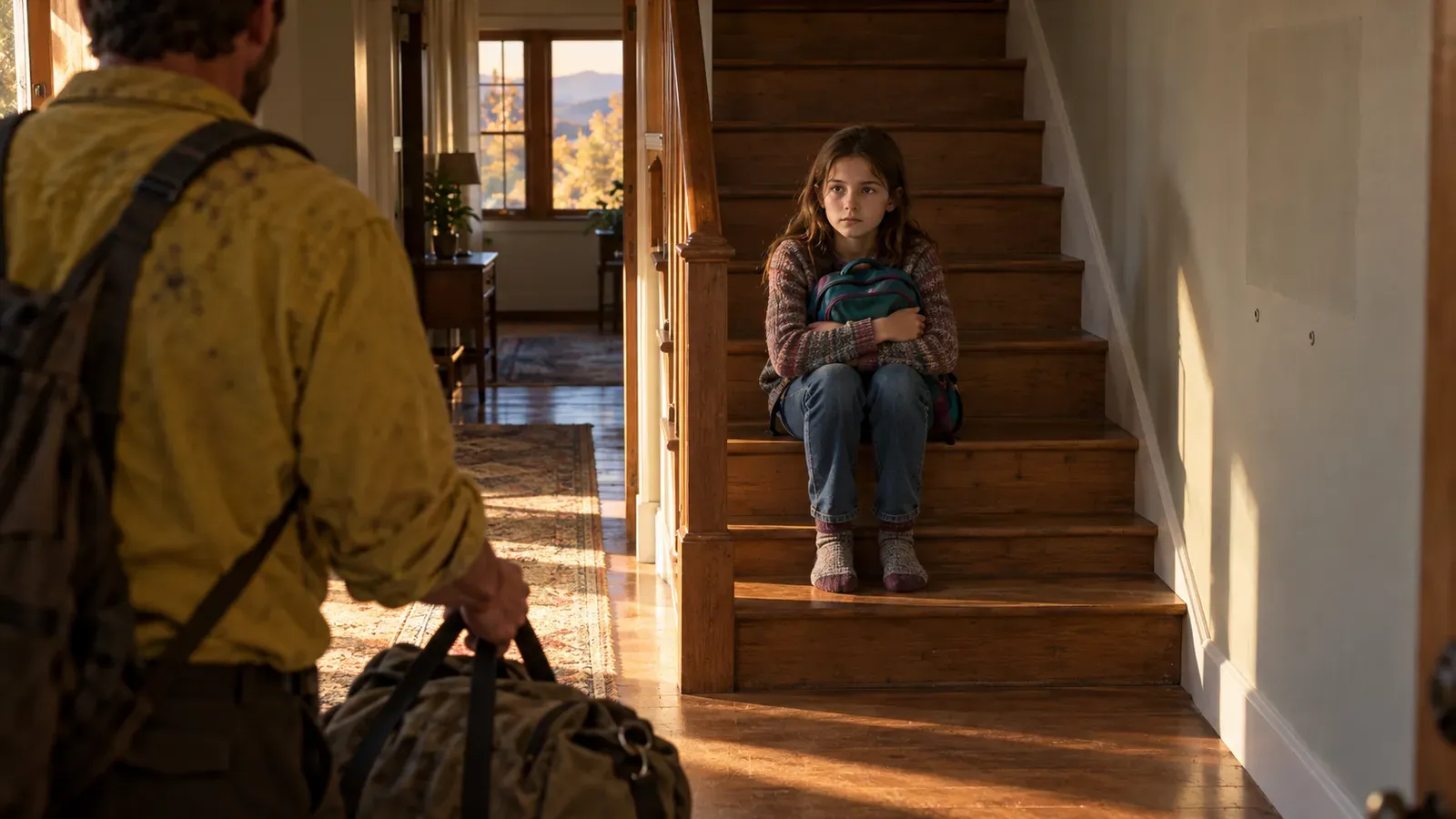
Chapter 2: Visitors Don't Need Hooks
Bea's light was still on. I went up the fourteen stairs and stopped in her doorway.
She was in bed with a library book open on her knees, not reading it. Her backpack sat on her desk chair, zipped, the straps tucked in. It used to live on the floor by the front door, where she dropped it coming in. On the desk beside it was her lunchbox, blue, with BEA across the lid in purple marker, the letters gone over twice.
"Hey," I said.
"Hi."
She moved her feet so there was room on the bed. I didn't take it. I sat down on the floor by the door with my back against the frame and my boots out in front of me, about as far from her as the room allowed. You learn that one early on a crew. You don't walk up on somebody who's working up to telling you something.
"On the stairs," I said. "You said you don't count. What does that mean?"
She closed the book on her finger. "I don't count. For the license."
"Who told you that?"
"Nobody." She looked at the book. "I heard Renee on the phone."
"When?"
"The day after you left. In August."
I waited. That's the other thing you learn. Ask one question, then shut up.
"On the paper I'm a visitor," she said.
"What paper?"
She lifted one shoulder. "The license paper. It's eight. If the lady comes and sees me down there, I count."
"What lady?"
"From licensing. She comes sometimes. You don't know when." She said it the way she'd tell me the bus schedule.
I had a dozen questions. I picked the smallest one. "Your board's not by the door."
"Tobi has my hook."
"Who's Tobi?"
"He's three. He waves at me." She pulled the blanket straight across her knees. "It's okay. Visitors don't need hooks."
Nobody had said that last part to her. I could hear it. It was a ten-year-old's arithmetic, done alone on a stair, and it had come out even.
"Where's the board now?"
"Garage."
I looked at the purple letters on the lunchbox for a while.
"I called you from camp," I said. "Twice. You said everything was good."
"You said be easy on Renee."
I had said that. In the driveway at the end of August, with the truck running and one hand on top of her head. Be easy on Renee, she's got a lot going on. I'd meant pick up your shoes.
"I have my room," Bea said. "And my books. And the bathroom's just mine. It's fine, Dad. Really."
"Okay."
"Do you go back Friday?"
Friday was the crew's last day of the season. A gear check, a sign-out, and a superintendent who'd want to talk about next May. I could have said no. I didn't know yet what no would cost or who would pay for it, and I have never once lied to her about a schedule.
"I'm here tonight," I said. "And tomorrow."
She nodded like she was filing it somewhere. Then she put the book on the nightstand, turned off the lamp and lay down facing the wall.
I stayed on the floor. The hall light lay across the carpet as far as the bed. After a while her breathing went long and slow, and her hand came loose from the edge of the blanket. I counted the breaths without meaning to, and then I made myself stop.
Renee was at the kitchen table at half past nine with wet hair, her label maker and a stack of plastic cubby bins. The machine ground out a strip. She cut it, peeled the backing and pressed it down with her thumb. SPARE CLOTHES. WIPES. ART.
"She asleep?"
"Yes."
"Good." Another strip. "She's been tired. Fifth grade's a lot."
I ran a glass of water at the sink and leaned on the counter, on the spot where the letter had been.
"On the stairs," I said. "She said she doesn't count. What did she mean?"
Renee didn't stop working. "Bea's on the form, Wade. Everybody who lives here is on the form. That's the rule." She smoothed a label flat. "She's ten. She hears 'license' and 'count' in the same week and builds a whole story out of it. You know how she is."
"Upstairs till six."
"Quiet time. And honestly, it's for her." She looked up then. "You've never been here at four o'clock. Eight little kids in two rooms. The noise. She'd come in off the bus and go white. She hates it. Upstairs she's got her room, her books, nobody touching her stuff. I'd have given anything for that at ten."
It sounded right. It sounded like something I'd have said yes to on the phone from camp, and maybe I had.
"The board," I said.
"I know." She winced, and it looked real. "It's in the garage. Licensing wants the hooks by the door, one for every enrolled child, labeled, and that was the only wall. I was going to put it up in her room. I bought the screws, they're in the junk drawer. I just haven't had a minute since August, Wade. Not one."
"And the letter."
"The classroom." She set the label maker down. "That's what the stakes are. A prefab, twelve by twenty-four, heated, its own door. By spring the kids are out there all day instead of in your living room. You get your house back." She tapped the table once. "It's in my name so it never touches you or the house. If it goes bad, it's mine. I did that on purpose."
"Forty thousand."
"It pays for itself. I've done the numbers. I'll show you the numbers."
She would have, too. She had a spreadsheet for everything, and every one of them balanced. Most of what she'd said she believed, and some of it was probably true. That was the worst part of standing in that kitchen. I couldn't find the place where it stopped being reasonable.
I didn't tell her what Bea had heard on the phone. I didn't tell her about the note in my shirt pocket. I drank the water.
"I'm home through Thursday," I said.
"Good." She smiled and picked the label maker up again. "Bea'll like that."
I went out the back door and sat on the step. Frost was starting on the grass. The porch light reached as far as the swing set and caught the orange string beyond it, four corners and a long empty rectangle, pulled tight.
At 9:52 the phone buzzed in my jacket.
A text, from a number with no name. I took the fuel receipt out of my shirt pocket, unfolded it on my knee under the porch light and checked the number against it, digit by digit, twice.
Same number. The one that had rung out at fire camp on Sunday night.
This is Tasha Okafor, Tobi's mom. I'm the one who called. Can we talk without Renee? I'm off at 6.
End of chapter 2