Family4 min read
My Daughter Said She Didn't Count
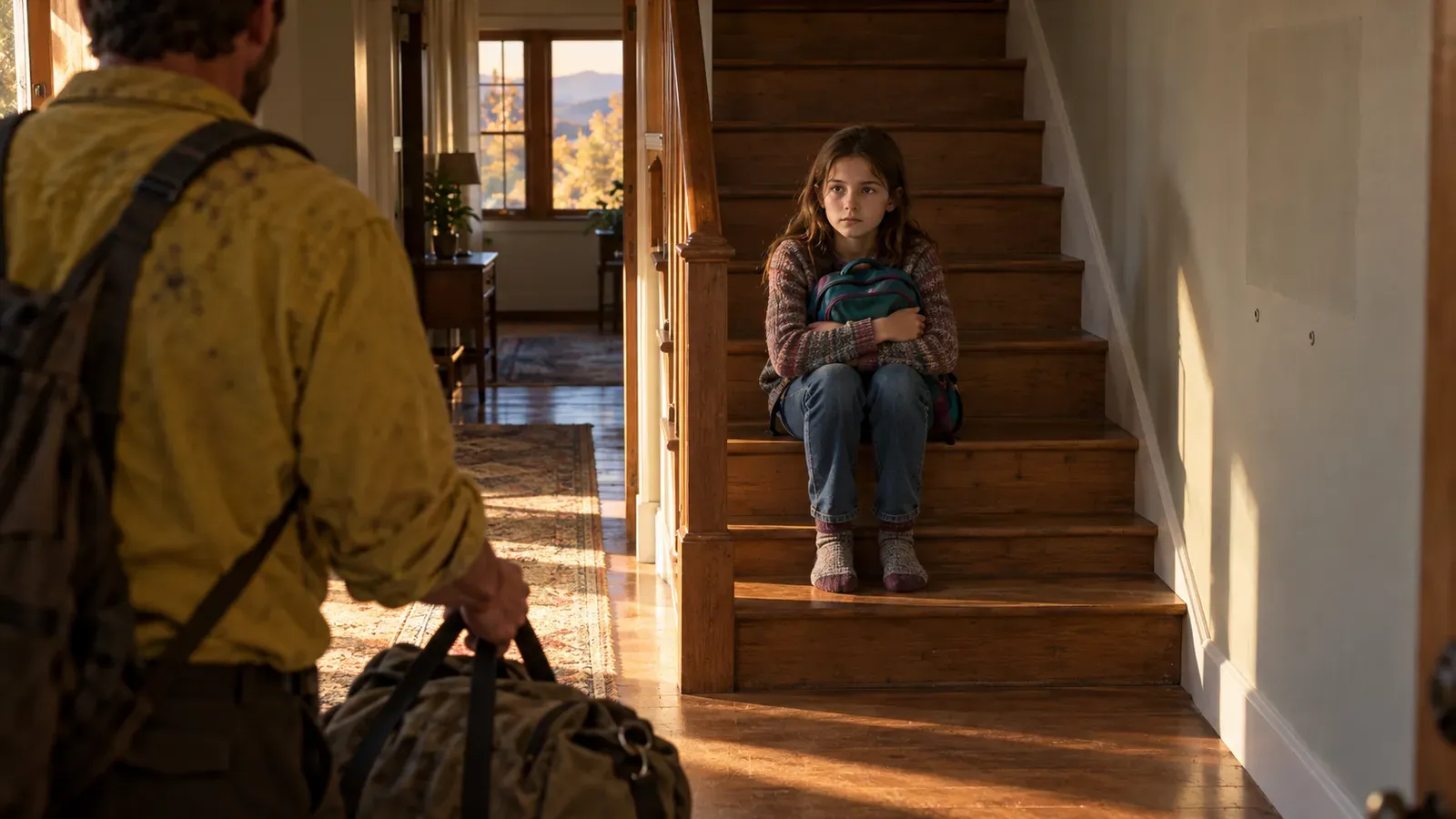
I came home from a Montana wildfire two days early and found my ten-year-old on the third stair, backpack on her knees, waiting to be allowed down in her own house. My wife, who runs a daycare downstairs, said it was a licensing thing and Bea was fine up there.
Chapter 7: Hooks
On Monday, November 2, I was at the district yard in town at 6:52, with a lunch cooler and a hard hat that still smelled like Spar Creek. Fuels crew. Seven to three, a grade lower than the squad I'd run, home every night. Last year I made about $68,000, and close to $30,000 of that was overtime and hazard pay. The new job paid about $46,000. My second got the squad, and the track that went with it, and he called me Sunday night to tell me like he was the one who owed me something.
In September I'd done that math before my coffee got cold. I did it once more in the yard that first morning, and then I left it alone.
Bea got herself to the 7:25 bus. I met the 3:41 every day that week.
On Friday the subsidy office ended Renee's provider agreement and told her to pay the $525 back to Tasha's family. Tasha kept her assistance. The classroom order was cancelled, and the line of credit stayed where Renee had put it, in her name alone. That weekend I pulled the four stakes out of the backyard, wound the orange string around my hand and put it in the trash.
On Saturday, November 7, I went out to the garage after breakfast. Bea came with me in her coat over her pajamas.
With the cots gone, the board stood by itself against the studs, face out, the way I'd left it in October. I carried it to the bench and wiped it down with a rag. Pine, thirty inches, four pegs. Under the shop light the letters over the end peg looked worse than they had at one in the morning. The edges were gone. The middle of the E was nearly gone.
Bea stood at the end of the bench and looked at it for a while.
"Can you make it darker?"
"Yep."
I took the woodburner out of the top drawer, unwound the cord and plugged it in. It takes about two minutes to come up to heat. Bea watched the time on my phone and told me when it was two minutes, which I hadn't asked her to do.
I went over the B first. The tip moves slow in pine. If you hurry it, it skips and leaves a scorch where you didn't want one, so you don't hurry it. A thin line of smoke came up and the garage smelled like a campfire. Bea leaned in. I put my free hand out flat, and she leaned back exactly that far and no farther.
Then the E. Then the A.
When I lifted the tip off the last stroke the letters were darker than they'd been in July 2021. They were darker than anything I'd ever burned.
"Better?" I said.
She ran one finger beside them, not on them. "Better."
In the front hall the wall was the way Renee had left it. Four holes from the rack. The paler rectangle. The two old anchors inside it, low.
I'd brought a pencil from the bench. I held it out and Bea took it.
"Where do you want it?"
She stood with her back flat against the wall, between the door and the bottom stair. The old anchors came to her waist. She looked down at them and didn't say anything about it.
Then she turned around to face the wall and put her hand up where she'd reach to hang something. She moved it up an inch. She brought it back down half of that. She drew a short line with the pencil and stepped back to look at it.
"There."
It was a good height. I'd have put it two inches lower and been wrong by June.
I pulled the old anchors with pliers. I filled their holes and the four from the rack with spackle, six holes, and scraped them flat with a putty knife. When the spackle dried I'd paint the whole wall, so there wouldn't be a rectangle anymore. That could wait for a weekend.
The screws Renee had bought for Bea's room were still in the junk drawer, in a paper bag with the receipt stapled to it. They were the right length. I used them.
I stood at the wall with the drill, and Bea held the level against the top of the board. The bubble sat in the middle.
"It's in the middle," she said.
Two screws, sixteen inches apart, into the studs. I gave each one a last quarter turn by hand. Then I took my hands off it, and it stayed.
Bea looked at the board for a long time. Then she reached up and touched the end peg, the way you check whether paint is dry.
"Okay," she said, and went to get dressed.
On Monday, November 9, the district let us go at three. I was home at 3:22. I hung my jacket on the first peg and walked down the gravel road to the mailboxes.
The cottonwoods were bare now. Somebody up the valley was burning slash piles, and the smoke lay flat along the ditch. I stood by the mailboxes and counted fence posts without meaning to. Eleven to the bend.
The bus came over the rise at 3:41.
Bea came down the steps with her backpack on one shoulder and said thanks to the driver. On the walk up she told me about a spelling test, a boy in her row who lost a tooth in the middle of it, and a substitute who couldn't say anybody's last name. It was more words than she'd said to me in all of October. I didn't count them.
At the porch she went in ahead of me. She didn't stop in the hall. She didn't look at the stairs, or through the doorway at the clock over the kitchen stove.
She went to the wall by the door, slid the backpack off her shoulder, and hung it on the end peg, under her name.
The end